Best AI Paraphrasing Tools (2026): Rewrite Without Losing Meaning
Tools ranked in this guide





Disclosure. I'm Huzefa Abbasi, founder of WriteHybrid, so my own tool's ranking here isn't impartial. This is an editorial comparison from hands-on use, each vendor's public pricing in June 2026, and the reviews real customers leave on Trustpilot, Reddit, and Capterra, not a lab study, and I publish no invented evasion percentages. If your work has to clear an AI detector, the only result that counts is the one you get by running your own rewritten text through the exact checker your reader uses. Verify it yourself.
Paraphrasing is not the same as humanizing, and the difference decides your tool
This is the single most important thing to understand before you pay for anything on this list. A classic paraphraser, QuillBot is the archetype, swaps synonyms and shuffles clauses. A humanizer rewrites rhythm and sentence structure. The two have different failure modes:
- A paraphraser can preserve your meaning almost perfectly and still read like a machine, because the underlying cadence never changed. That's fine for readability and ESL clean-up, but it's exactly the pattern many detectors latch onto: the words look different, the statistical rhythm doesn't.
- A humanizer can read beautifully and still drift from your point if it's too aggressive, because it's moving structure around.
So I judged these tools on two things at once: do they actually reduce the machine feel, and do they keep what you meant? And I'm going to be blunt about which tools here are paraphrasers sold partly as detector-bypass tools, because if you buy a synonym engine expecting it to beat Turnitin, you will be disappointed, and independent testers have repeatedly shown paraphraser-class output still flags.
If your reader only cares about readability and grammar, no AI detection involved, a paraphraser is often plenty, and QuillBot is the best of them. The moment a detector or LMS check enters the workflow, synonym tabs alone usually aren't enough, and you want a purpose-built humanizer that changes structure.
How I picked, and what I refuse to claim
I ranked on hands-on use, pricing transparency, genuineness of the free tier, mode/register control, and each tool's real reputation on Trustpilot, Reddit, and Capterra. What I won't do is hand you a "bypass rate," for paraphrasers or humanizers, detectors disagree, change versions, and react differently to a synonym swap than to a structural rewrite. For any tool below, the dependable test is the same: rewrite one real paragraph, run it through the checker your audience uses, and decide from that.
At a glance (pricing and ratings verified June 2026)
Ratings are approximate "at the time of writing" and vary by regional Trustpilot domain; confirm pricing at checkout.
| Tool | Type | Free tier | Entry paid | Reputation (approx.) |
|---|---|---|---|---|
| WriteHybrid | Humanizer (structural) | 500 words/mo, recurring | $9/mo · 10k words | Newer; small review base |
| QuillBot Humanizer | Paraphraser-first | 125 words/day | $19.95/mo Premium | ~4.8 · 10,000+ reviews |
| Smodin Humanizer | Multilingual suite | 1,000 words/mo | $10/mo · 25k words | Rating withheld (review breach) |
| Phrasly | Student paraphraser | 200 words, one-time | $12.99/mo · 25k words | ~4.4–4.7 · 2,300+ reviews |
| Netus AI | SEO paraphraser | 200 words, one-time | $19/mo · 50k words | ~4.4 · small sample |
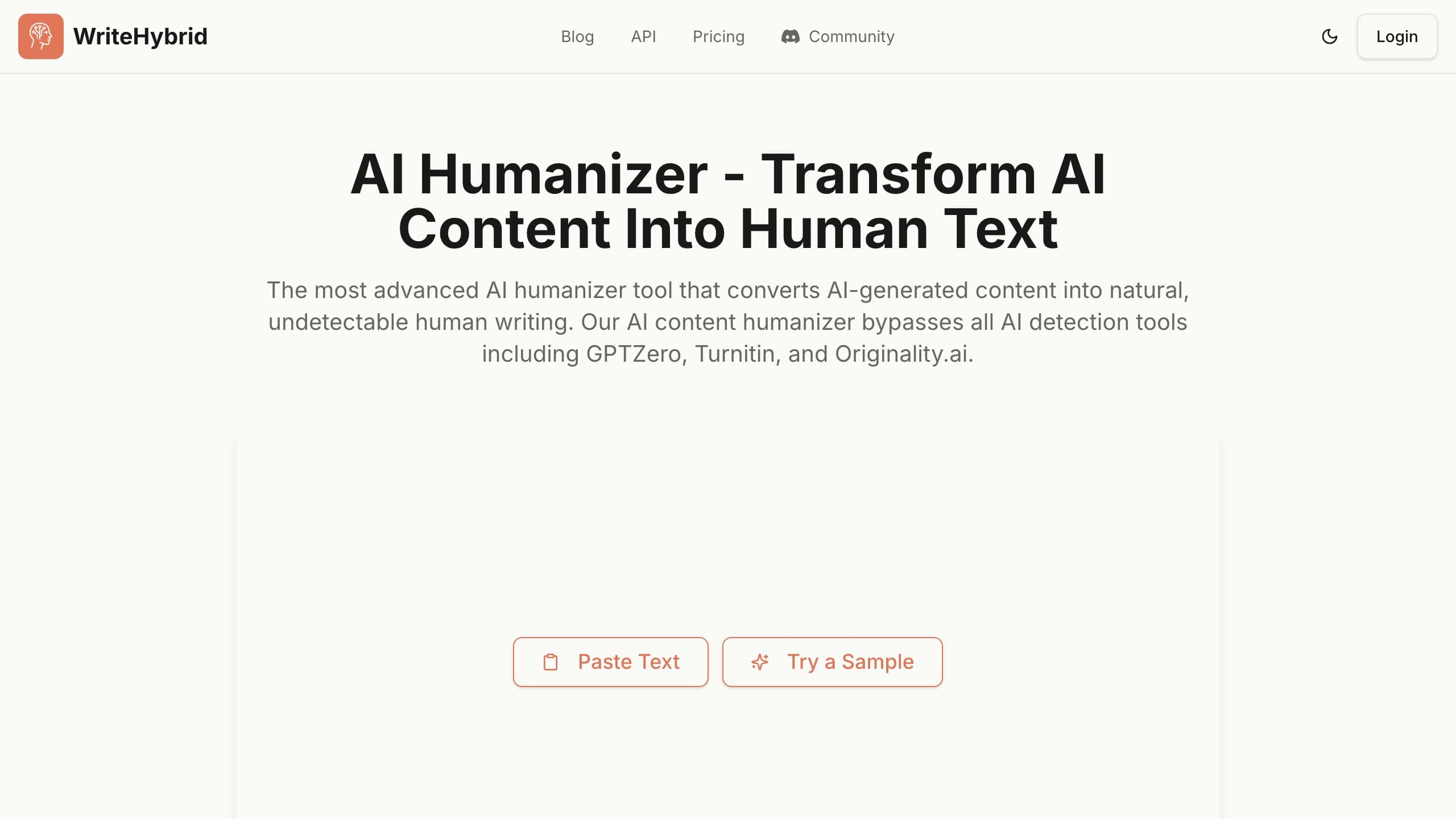
1. WriteHybrid, best rewrite-plus-meaning balance
The pick when the rewrite must read human and survive a detector, it changes structure, not just vocabulary, with the caveat that I build it.
Best for: Writers who rewrite after an AI draft and still need the result to read human for detector-sensitive work.
Pros
- +Targets cadence and structure, not just synonyms, the gap paraphrasers leave
- +Named Academic, Marketing, Casual, Technical modes set register first
- +Recurring 500-word free tier and $9 entry make it cheap to test, with 14-day refund
Cons
- −Not a grammar suite or citation manager, pair it with a proofread
- −Free quota is small for long documents
- −Newer brand with a thinner public review trail than QuillBot
- −Cannot promise a detector outcome
I build this, so weigh it accordingly. The reason it leads a paraphrasing comparison is precisely that it isn't a paraphraser: it targets cadence and structure, not just vocabulary. Paraphrase-first tools often preserve meaning yet still read machine-regular because they only changed the words, WriteHybrid prioritizes reading naturally without vandalizing your thesis, and its modes let you set register first. It isn't a grammar checker or citation manager, so pair it with a proofread. The recurring 500-word free tier and $9 entry plan (about $0.0009 per word once paying) make it cheap to test on your own paragraphs, with a 14-day refund. As a younger product it doesn't have QuillBot's ten-thousand-review trail, so use the free quota to compare it head-to-head before committing.
Pricing (verified June 2026)
- Free: 500 words/month, recurring, all modes.
- Starter: $9/month for 10,000 words, with API access.
- Pro: $19/month for 50,000 words.
Who it's for
Writers whose rewrites must read human and pass a client's or institution's check, not just look superficially reworded.
2. QuillBot Humanizer, best pure paraphraser, best reputation
The category's most-loved tool and the best pure paraphraser, just don't mistake it for a reliable detector-bypass humanizer.
Best for: Writers and ESL users who want top-tier paraphrasing, grammar, and citations, with no detector check in play.
Pros
- +Best reputation in the entire category: ~4.8 stars across 10,000+ Trustpilot reviews
- +Genuinely strong paraphrasing, grammar, and ESL rewriting with multiple modes
- +Simultaneous grammar-and-paraphrase sliders, plus a plagiarism checker
Cons
- −A paraphraser at heart, conservative rewrites leave machine cadence intact
- −Its humanizer module is a secondary feature, not a detector strategy
- −Free tier is a daily micro-limit of 125 words; reviewers note rigid refunds
- −Its own AI detector throws false positives on hand-written text
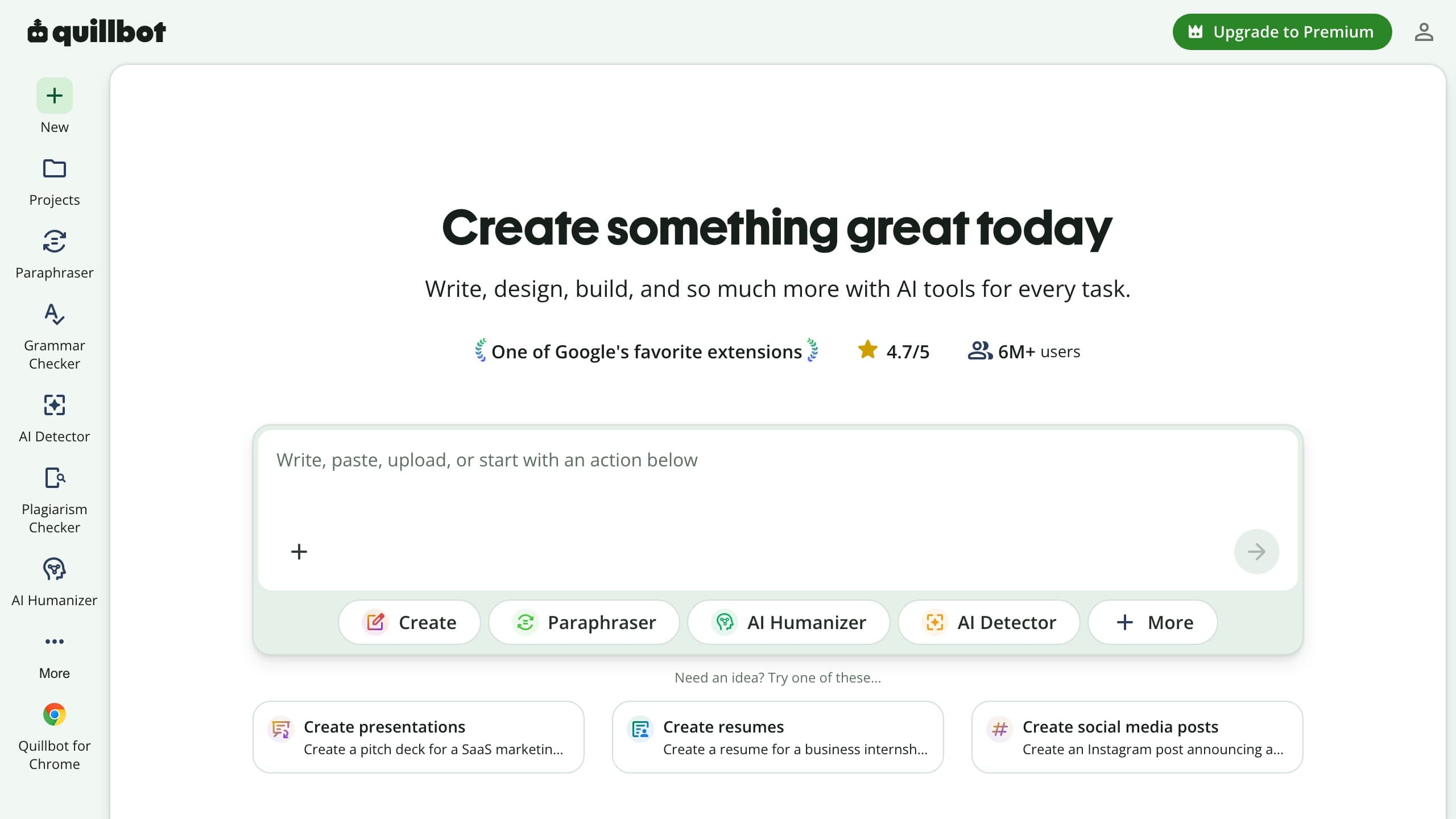
QuillBot's paraphraser is genuinely the best in this set for grammar and ESL rewriting, and the simultaneous grammar-and-paraphrase sliders are handy. Its reputation is the strongest of any tool on this page, at the time of writing roughly 4.8 stars across 10,000+ Trustpilot reviews, with praise for accuracy, ease of use, and how much time it saves students and non-native writers. But be clear-eyed about what it is: a paraphraser. Its humanizer module is a secondary feature, and its conservative rewrites tend to leave the machine cadence intact, which is why it's an excellent readability tool and a weak detector strategy. The recurring complaints are a stingy 125-word daily free cap that functions as a trial, rigid no-prorated refunds, and an in-app AI detector that reviewers say throws false positives on their own writing. Best treated as an adjacent feature if you already live in QuillBot, not as your way past a checker.
Pricing (verified June 2026)
- Free: 125 words/day.
- Premium: $19.95/month (an annual headline near $8.33/mo requires paying upfront, monthly is $19.95).
Who it's for
Students, ESL writers, and editors who want best-in-class paraphrasing and grammar, with no detection requirement.
3. Smodin Humanizer, best multilingual bundle
A genuinely useful multilingual suite with a generous recurring free tier, undercut by a withheld Trustpilot rating and rigid refunds.
Best for: ESL writers who want paraphrasing, humanizing, and translation in one subscription.
Pros
- +Most generous non-WriteHybrid recurring free tier: 1,000 words/month
- +Essentials is one of the cheaper entry tiers here
- +Translation and paraphrase together genuinely help ESL academic writers
Cons
- −Trustpilot rating currently withheld after a fake-review guidelines breach
- −Recurring complaints: accidental annual upgrade via promo banner, rigid no-refund
- −The humanizer is buried among many modules, interface complexity
- −Grammar suggestions inconsistent on long pasted documents
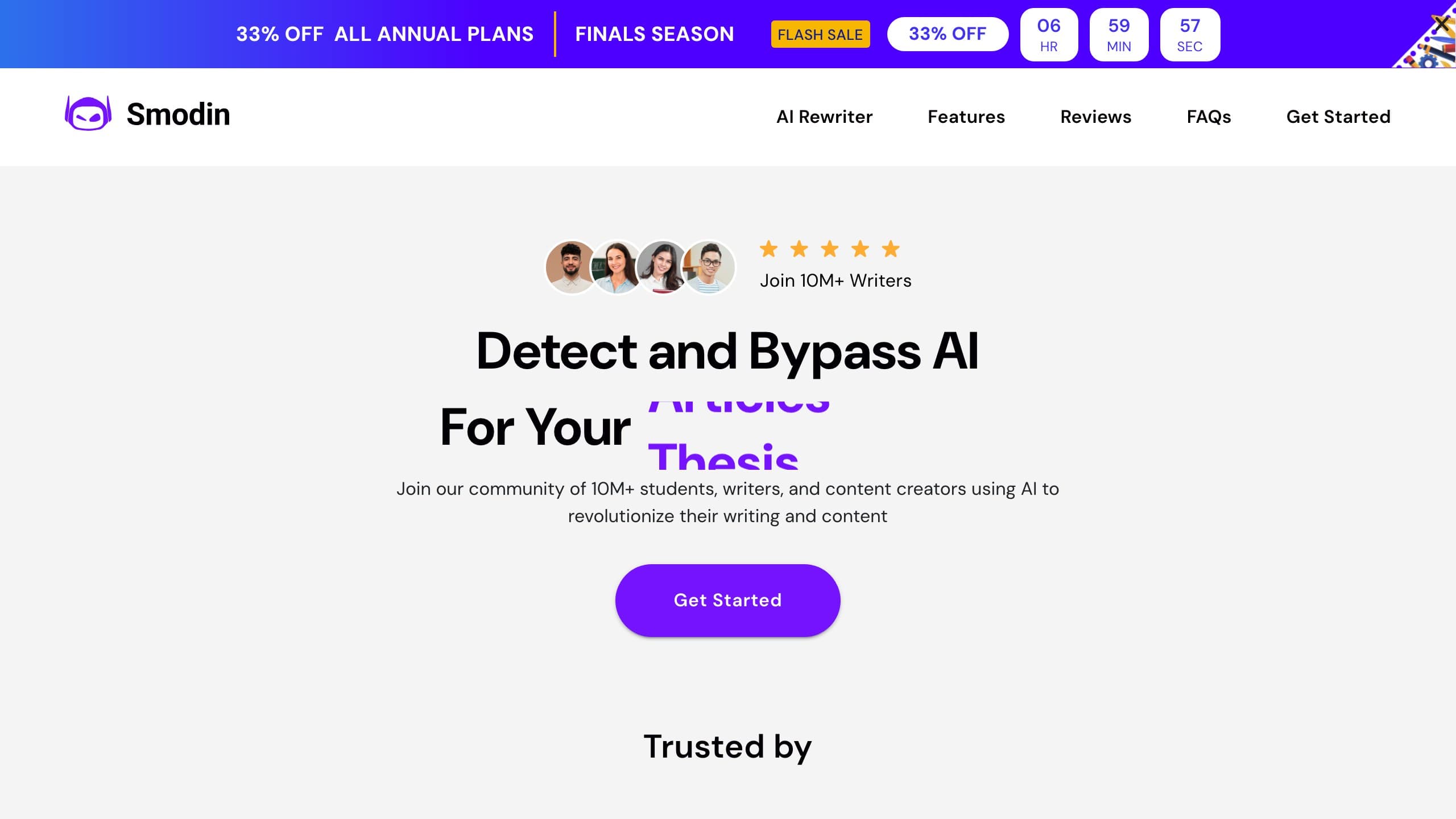
Smodin bundles its humanizer inside a multilingual writing suite, and two facts stand out: the Essentials plan is one of the cheaper entry tiers here, and the free quota, 1,000 words a month, recurring, is the most generous non-WriteHybrid free lane on this list. Translation and paraphrase living next to each other is genuinely useful for ESL academic writers working from non-English sources. The reputation picture needs an honest flag, though: at the time of writing Trustpilot withholds Smodin's rating for a breach of its guidelines after removing fake reviews, and while some regional pages show high scores, the recurring complaints are specific, users describe accidentally being switched to an annual plan by clicking a discount banner, then hitting a rigid no-refund policy, with students reporting denied refunds. The trade-off in daily use is interface complexity: the humanizer is buried among many modules, and grammar suggestions can be inconsistent on long pasted documents.
Pricing (verified June 2026)
- Free: 1,000 words/month, recurring.
- Essentials: $10/month, 25,000 words.
- Productive: $20/month, 80,000 words.
Who it's for
Multilingual and ESL writers who want translation plus paraphrasing in one place, and who'll read the billing screen carefully.
4. Phrasly, best student paraphrase cadence
The most-loved student paraphraser, a real review base behind it, provided you accept annual billing and inconsistent results on strict detectors.
Best for: Students turning bullet notes into prose before a detector or grammar check.
Pros
- +Strong, well-earned reputation: ~4.4–4.7 stars across 2,300+ Trustpilot reviews
- +Student-essay cadence, shorter than QuillBot, less synonym-dense than Netus
- +Academic mode preserves claim order well as a humanize-lite step
Cons
- −Free access is a tight one-time ~200 words
- −Recurring complaints about annual billing and refunds
- −Inconsistent against strict detectors, a paraphraser’s structural limit
- −No substitute for manually paraphrasing quoted material
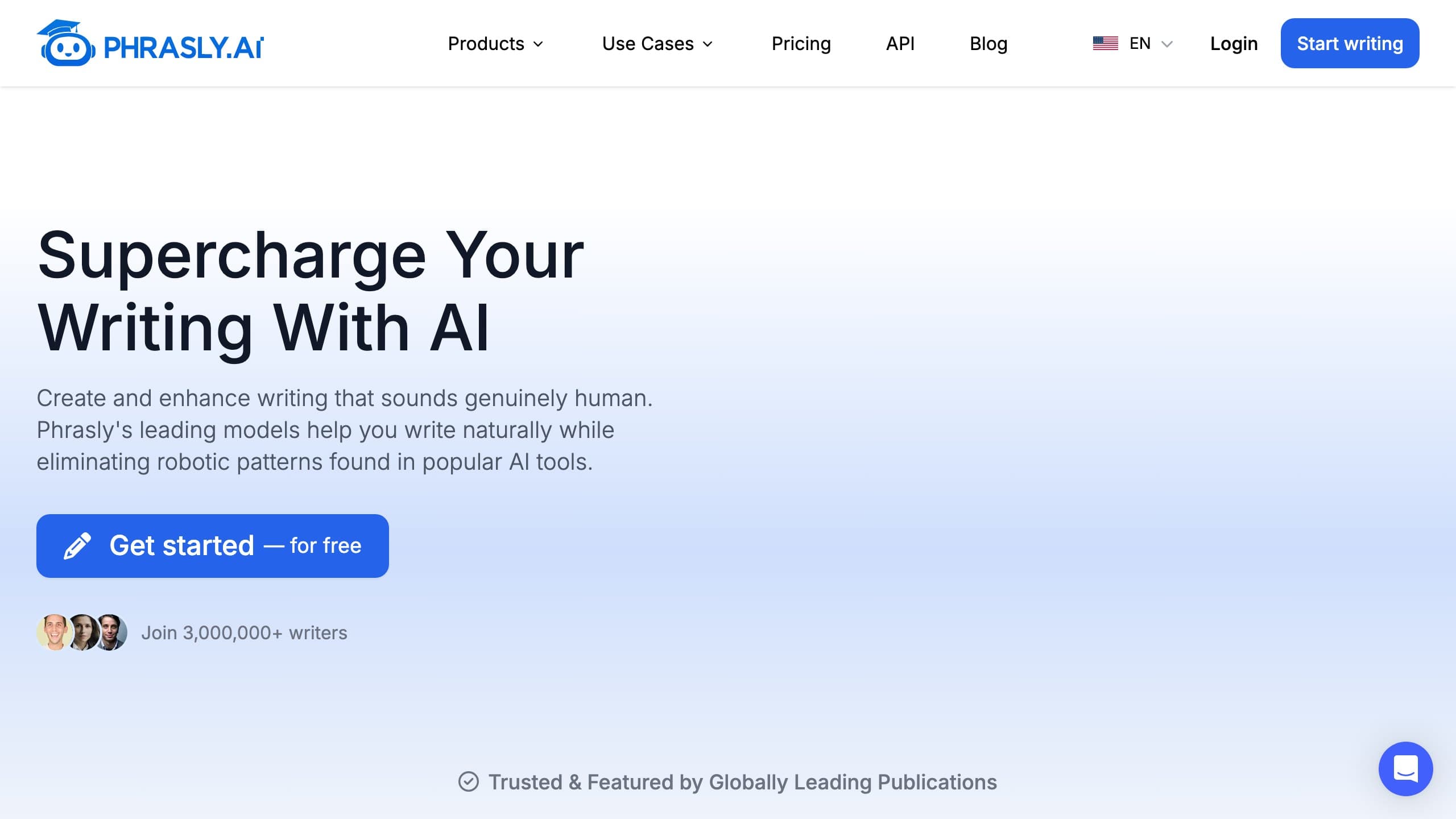
Phrasly paraphrases with a student-essay cadence, shorter output than QuillBot, less synonym-dense than Netus AI, and preserved claim order well on my source-rewriting tasks. Its academic mode works nicely as a humanize-lite step for turning bullet notes into paragraphs, and it has the second-strongest reputation here: roughly 4.4–4.7 stars across 2,300+ Trustpilot reviews, the healthiest sentiment of the competitors, with praise for the simple, fast interface. The honest caveats match the rest of the paraphraser class: recurring complaints about annual-billing surprises, and inconsistent results once a strict detector is involved, because word-level paraphrasing leaves structural patterns in place. The Student plan is budget-friendly, but always cite originals, it's not a substitute for manually paraphrasing quoted material, and the trial is a tight 200 words.
Pricing (verified June 2026)
- Trial: 200 words, one-time.
- Student: $12.99/month, 25,000 words.
- Pro: $24.99/month, 75,000 words.
Who it's for
Students who want an affordable, well-reviewed paraphraser for turning notes into prose, and who'll verify on their institution's checker.
5. Netus AI, SEO repurposing, with caveats
A capable SEO paraphraser for breaking up syndicated copy, but a thin community footprint, opaque credit pricing, and reviews reporting still-flagged output.
Best for: SEO teams rewriting blog paragraphs at volume where no detector check is involved.
Pros
- +Aggressive sentence-splitting breaks uniform rhythm in syndication pipelines
- +Large word bundle on the Solo plan
- +Some reviewers credit it for SEO ranking improvements
Cons
- −Thin Reddit/community footprint and an opaque credit-based pricing model
- −Reviews report technical "ERROR" credit issues and at least one unauthorized charge
- −Independent testers and reviewers report output still flagged as AI
- −No academic mode; bad for legal/contractual text needing precise duplication
Netus AI's paraphrase engine splits sentences aggressively, which is good for breaking uniform rhythm in syndication pipelines and bad for legal or contractual text that needs precise duplication. There's no academic mode, the marketing centers on SEO paraphrasing, and its single Solo plan gives a large word bundle but no budget tier below it. Its reputation is the thinnest here: a small Trustpilot sample (around 4.4 stars across ~40-odd reviews, with the vendor replying to negatives), almost no Reddit footprint, an opaque credit-based pricing model that hides the real per-word cost until you've spent a batch, and reviews reporting technical "ERROR" credit problems and output that still flags on other detectors. The thin independent enthusiasm is itself a mild signal. Fits content-repurposing workflows; reach for Smodin or WriteHybrid when you must preserve technical definitions or face a checker.
Pricing (verified June 2026)
- Trial: 200 words, one-time.
- Solo: $19/month, 50,000 words.
Who it's for
SEO teams repurposing volume content where readability matters more than detection, who'll watch the credit meter.
Paraphraser or humanizer? A decision rule
If your task is "make this paragraph less stiff" with no detection check in play, a paraphraser like QuillBot may be all you need, and it has the reputation to back it. If your task is "this draft must survive a detector or a client's QA," lean on a humanizer that rewrites structure, and still verify by hand. The tell is simple: synonym substitution keeps lexical overlap but leaves the original rhythm, which is exactly the pattern detectors latch onto even when the words look different. Buying a paraphraser to beat a detector is the most common mistake in this category.
How to choose
- Rewriting plus a human read for detector-sensitive work: WriteHybrid.
- Best pure paraphrasing, grammar, and ESL clean-up (no detector): QuillBot.
- Working across languages: Smodin.
- An academic tone on a student budget: Phrasly.
- Repurposing SEO content at volume: Netus AI.
Pricing above was verified in June 2026, confirm at checkout, and test on your own text before you commit.
Why the detector math shifted in late 2025
Paraphrasers got a harder job in late August 2025, when Turnitin updated its detector to target machine-rewrite patterns more directly. Because paraphraser-class tools change vocabulary over an unchanged sentence skeleton, that's precisely the signal the newer "AI-paraphrased" detection layers were built to catch, which is why independent reviewers increasingly report synonym-swapped output still flagging. GPTZero, Originality.ai, and Copyleaks keep refining their own models on separate release cycles. The takeaway isn't that paraphrasers are useless; it's that they're readability tools, and any 2024 claim that a paraphraser "beats" a detector should be treated as expired.
Detection: what we can and can't tell you
No pass-rate numbers here, because no one can honestly produce them, and that's doubly true for paraphrasers, whose structural limitations make them unreliable against strict checks. Detectors disagree, change versions, and react differently to a paraphrase than to a structural rewrite.
For any tool above, the dependable test is the same: rewrite one real paragraph, run it through the checker your audience uses, GPTZero, Turnitin, Originality.ai, or Copyleaks, and decide from that. If you genuinely need to clear a detector, a structural humanizer plus a manual edit is a more honest path than a synonym engine, but only your own test on your own detector confirms anything.
How to get a clean, meaning-preserving rewrite
- Match the tool to the job. Readability only? A paraphraser. Detector or QA in play? A humanizer plus manual editing.
- Read for meaning, not smoothness. The danger with aggressive paraphrasing is quiet meaning drift, re-read against your original.
- Protect quoted material and technical terms. Paraphrasers mangle precise definitions and citations; restore those by hand.
- Don't rely on synonyms to beat a detector. Lexical change without structural change is what gets flagged.
- Verify on the detector that matters. Run the final text through the exact checker your reader uses before relying on it.
Frequently asked questions
Related reading
Try WriteHybrid on your text
Paste AI-generated copy below. 500 humanized words free every month after signup.
Was this page helpful?
Your feedback helps us improve our testing write-ups.