Disclosure. I'm Huzefa Abbasi, founder of WriteHybrid. This is editorial guidance, not a lab benchmark. Where a rewriter is used to reduce AI-detector flags, the outcome depends on your draft and the detector your reader uses — verify on your own text rather than trusting any tool's marketing.
What an AI rewriter actually does
A rewriter takes a passage you wrote (or a model wrote) and produces a new passage with the same essential meaning in different sentences. The qualities that matter for output are paraphrasing depth, tone shift, register preservation, and lexical variety. When the input is AI-generated and you care about detection, a fifth concern appears: whether the rewrite still reads as human to a checker.
Rewriters show up under many names — paraphraser, spinner, humanizer, tone shifter. The underlying operation is similar: map input text to output text under constraints. The constraints differ. A citation paraphraser optimizes for sentence-level fidelity. A humanizer optimizes for how the whole passage reads, varying rhythm and breaking the model's habitual phrasing. Pick the tool whose goal matches your job.
For a comparison-focused take, see the best AI paraphrasing tools. For a detector-focused take, see our humanizer.
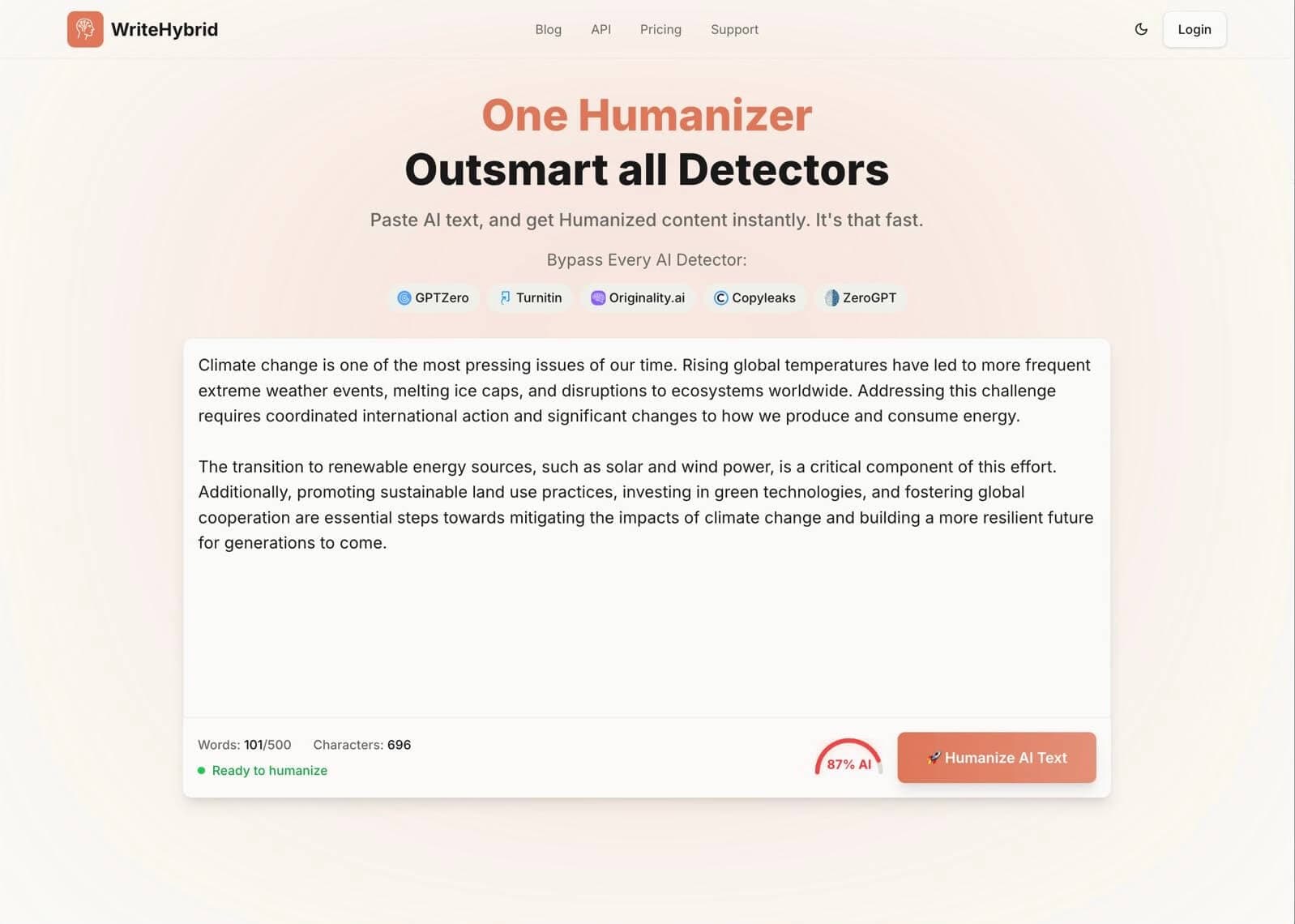
Paraphrasing vs humanizing
Most "AI rewriter" tools were built for paraphrasing — turning a sentence into a different sentence that means the same thing, often for style-shift or citation use cases. Humanizer tools were built to reduce AI-detector flags. The two goals overlap, but the optimization differs:
- A paraphraser focuses on keeping each sentence close in meaning to the original.
- A humanizer focuses on how the whole passage reads to a detector, which usually requires sentence-length variation, register-aware edits, and breaking the model's habitual phrasing.
That difference has a practical consequence. A tool tuned for tight sentence-level paraphrasing can keep your meaning beautifully and still leave the passage looking machine-written, because it never changed the rhythm a detector responds to. If you only need new wording, that's fine. If you need the output to read as human and keep your register, you want a humanizer — ideally one with mode controls so you can match tone to use case.
Tone, register, and when rewriters fail
Register collapse is the most common rewriter failure. An academic paragraph rewritten into casual blog voice might read differently to a detector, but it fails the assignment. Good rewriters expose explicit modes — academic, marketing, casual, technical — and tune sentence length and vocabulary to each.
Tone shift is not the same as dumbing down. Moving from passive to active voice, or third person to first, can improve readability without changing your claims. Bad rewriters do the opposite: they replace precise terms with vague ones ("utilize" for "use", "facilitate" for "help") and lean into exactly the stiff academic-English patterns that read as machine-generated.
Before you rewrite, label the register you need: who is reading, what formality level, what citation style. After you rewrite, read aloud. If a sentence sounds unlike you or your brand, edit it manually — the rewriter gave you a draft, not a final.
What to look for in an AI rewriter
- Mode controls. Academic, marketing, casual, technical. Single-mode tools tend to collapse register.
- Meaning preservation. You should be able to read the rewrite against your original and confirm the claims, qualifiers, and citations survived.
- Sentence-length variation. Output with monotonic sentence length reads flat to both people and detectors.
- A way to test it yourself. A usable free tier matters more than a marketing badge — run your own content through it before you pay.
On that last point: WriteHybrid's recurring free tier gives you 500 words a month with no card, which is enough to try a rewriter on your own text and judge tone and meaning preservation before committing to a plan.
Try WriteHybrid free
500 humanized words every month, no credit card. Earn more through referrals.