Disclosure. I'm Huzefa Abbasi, founder of WriteHybrid. This is editorial commentary, not a lab benchmark. Whether any tool reads as "undetectable" depends entirely on your specific draft and the detector your reader runs — so treat every vendor's claim, including ours, as something to verify yourself.
What "undetectable AI" actually claims
In product copy, "undetectable" usually means: a passage your tool produces, fed into a detector someone has heard of, returns a label other than "AI." That is a weaker claim than it looks. Detectors disagree constantly — the same passage can read as strongly AI on one checker and clean on another. A vendor can simply pick the detector that scored best and put the badge above the fold.
The version of the claim worth taking seriously is statistical, not absolute: across passages like the ones your audience actually writes, and across the detectors your reader is likely to use, the tool usually produces output that reads as human without destroying your meaning. That is a tendency on a given day with given detectors — not a guarantee that holds forever.
"Undetectable" also does not mean "indistinguishable from your own writing." A humanizer can pass an automated checker while still reading flat to a teacher who knows your voice. Detector pass rate and reader trust are related, but they are not the same thing.
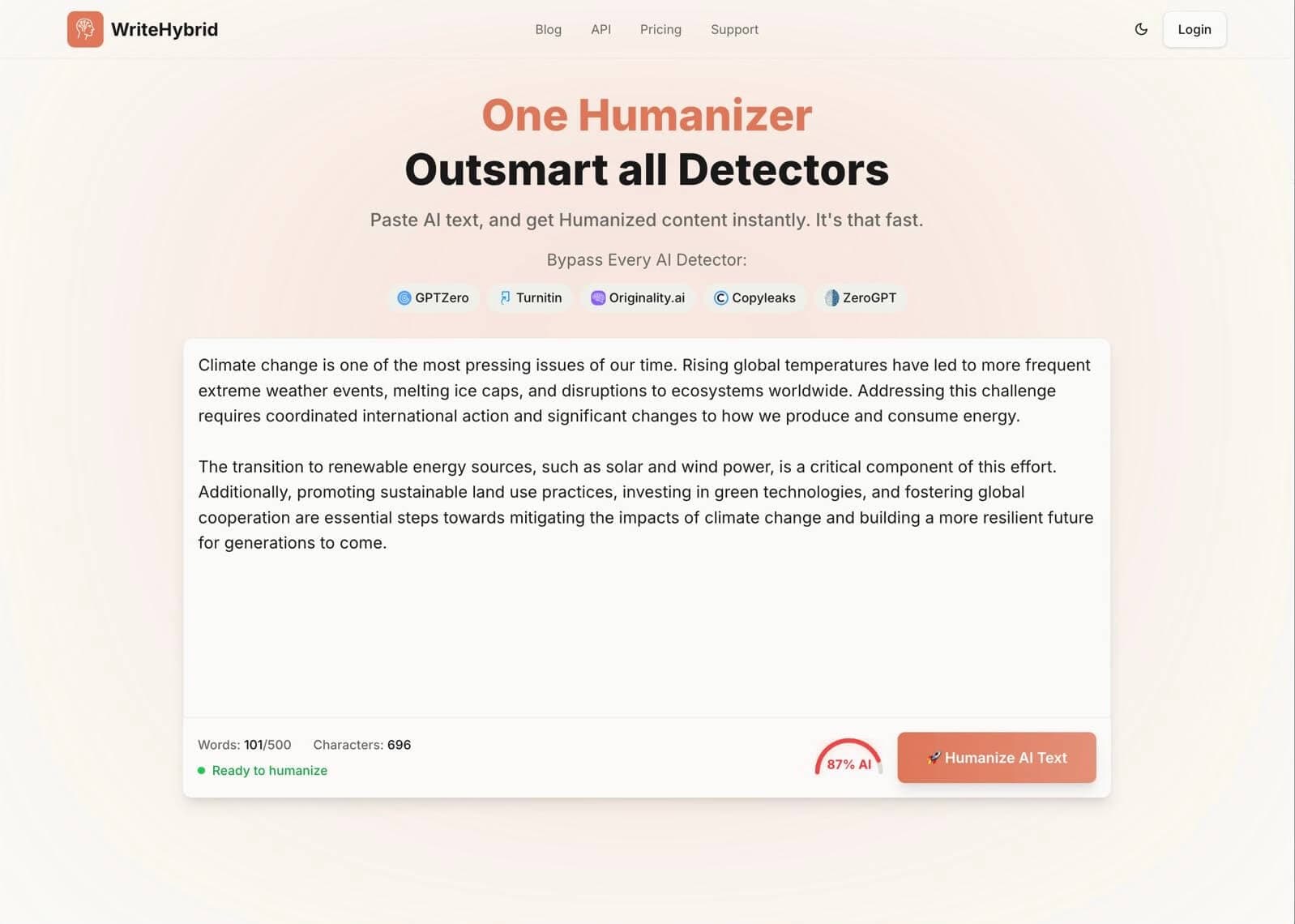
Why most "undetectable" claims don't hold up
The most common gap is the detector source. Vendors frequently quote scores from their own built-in checker — which is not a third party and has every incentive to be lenient. Once you submit the same output to an independent detector, the picture often changes.
Another pattern is cherry-picked content. A tool tested on short, casual marketing blurbs can look strong while struggling on dense academic prose with preserved terminology and citations. The harder the register, the more likely any humanizer is to leave patterns behind. That's why a claim built on one content type tells you little about how a tool behaves on yours.
Detection: what we can and can't tell you
We don't publish a reproducible benchmark of detector pass rates, because honest numbers would require controlling for text, length, detector, and detector version — all of which move. Any single percentage would be more marketing than measurement, so we won't put one in front of you.
What we can say is procedural. If "undetectable" matters for your work, the test is simple and it's yours to run: take your real draft, humanize it, and submit the output to the exact detector your institution or client uses — ideally more than once, since results can shift. That single check tells you more than any vendor's headline number.
The hidden trade — keeping your meaning
A passage that reads as human but no longer says what you meant has failed, even if a detector calls it clean. The quiet failure mode of aggressive humanizing is meaning drift — a changed claim, a dropped qualifier, a mangled citation. Pass rate without meaning preservation is a hollow win.
So the right way to weigh a tool is on both axes at once: does it read as human and does the rewrite still match your original argument? The only reliable way to know is to read the output against the input yourself before you rely on it.
Try WriteHybrid free
500 humanized words every month, no credit card. Earn more through referrals.
How to pick a humanizer if you care about this
Three questions filter out most of the field:
- Can you test it on your own text first? A usable free tier or trial is worth more than any badge.
- Does it expose modes for the register you write in — academic, marketing, casual, technical?
- Can you read the rewrite against your original to confirm your meaning survived?
If you are evaluating a tool for academic work, test it on a genuinely formal, citation-heavy passage — that is the hardest case and the most honest one. For marketing copy, lighter content is more forgiving. There is no single "undetectable" score; there is only how your draft reads to the detector your reader will actually use.