Disclosure. I'm Huzefa Abbasi, founder of WriteHybrid. This is editorial guidance based on hands-on work with AI text and detectors, not a lab benchmark. Detection outcomes depend heavily on your specific draft and the exact detector (and version) checking it, so treat any tool's "bypass" promise — including ours — as something to verify on your own text.
What "humanize AI text" actually means
To humanize AI text is to rewrite output from a language model until it no longer reads as machine-generated — to a careful human reader first, and to an automated detector second. The goal is not to fool every system forever. It is for your sentences to read like a competent human wrote them, and to stop tripping the patterns that detectors are tuned to notice.
The honest framing here is probability, not a guarantee. Detectors update, models change, and the same passage can score differently a month later. A page that promises "guaranteed bypass" is overpromising. The useful question is narrower: how often does this method, on this kind of content, pass the detector your reader is likely to use — and does it keep your meaning while doing so?
The three methods that actually work
Three approaches keep coming up, and they are not mutually exclusive — most people combine a manual or prompt edit with a tool pass.
1. Manual rewriting
You read the AI output one sentence at a time, replace formal connectives, break up sentences that monotonously hit the same length, and add a specific detail or anecdote the model could not have known. This is the slowest method and, done well, the highest quality. It works because it attacks the things detectors actually respond to — predictability, uniform rhythm, and repeated phrasing — all at once. You are not swapping synonyms; you are changing rhythm and adding evidence only you could supply.
2. Prompt-based rewriting
You stay in the original model and ask it to rewrite its own output with constraints — "vary sentence length between 8 and 28 words", "remove every instance of 'in today's', 'leveraging', and 'unlock'", "rewrite as a first-person account of a real experience." This works better than most users expect. The catch is drift: models tend to slide back into their default patterns once the constraint falls out of context mid-paragraph, so a prompt-only pass usually still needs a manual skim or a dedicated humanizer afterward.
3. Tool-based rewriting (humanizers)
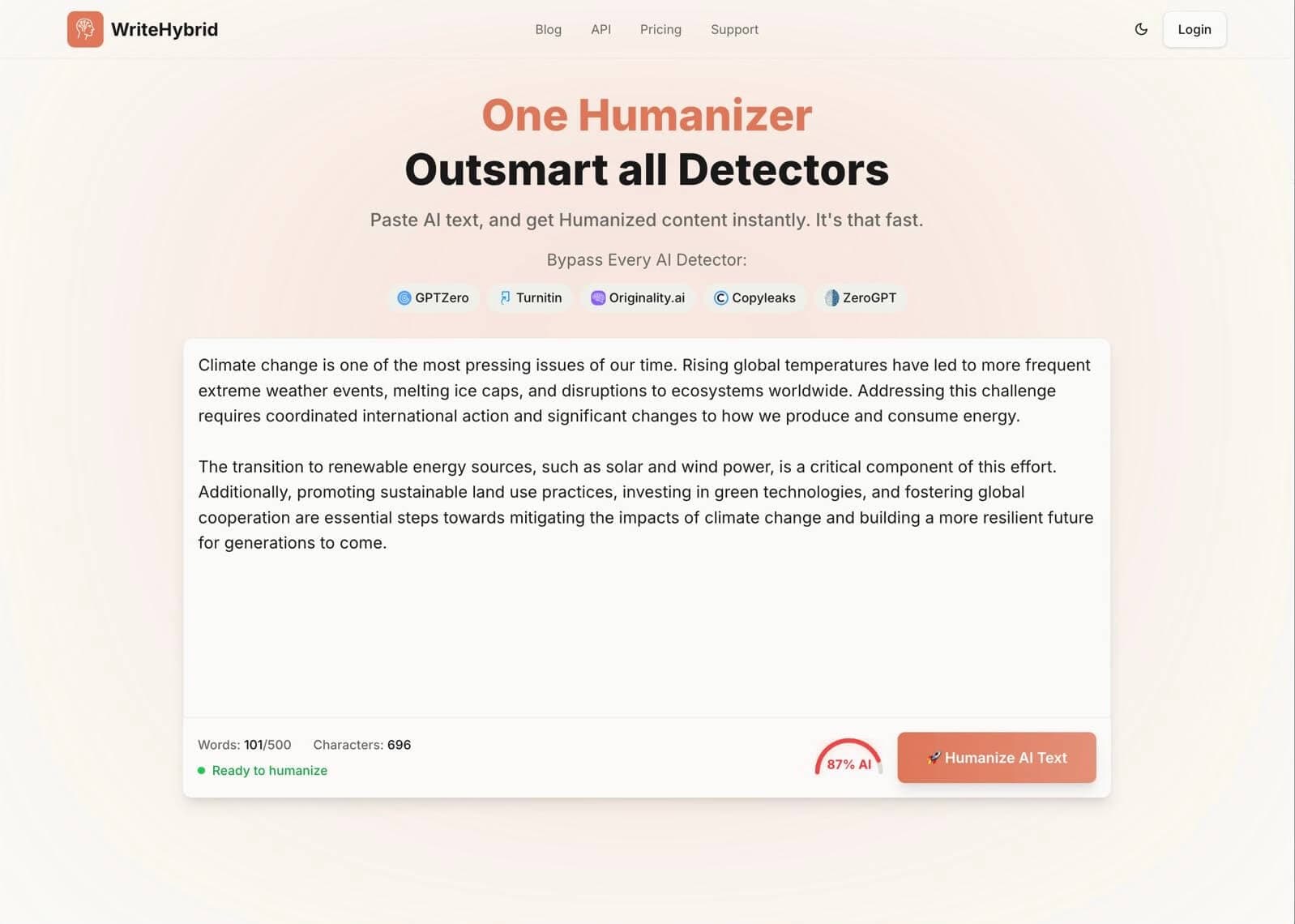
You paste your AI output into a humanizer like WriteHybrid, pick a mode (academic, marketing, casual, technical), and the tool rewrites the passage with sentence-length variation, register adjustment, and lexical substitution. Quality varies far more between tools than the marketing pages admit — which is why it's worth testing a couple on your own text before committing.
Try humanizing 500 words free this month
No credit card. Side-by-side output so you can verify meaning before you copy.
Detection: what we can and can't tell you
This is the part most pages get wrong. Detection outcomes vary enormously by the exact text, its length, and which detector — and which version of it — checks the work. We don't run a controlled, reproducible public benchmark, so we won't put pass-rate percentages in front of you that we can't stand behind.
What we can say from hands-on use: casual and blog-style content is the easiest to humanize convincingly, while formal academic passages — dense with preserved terminology and citations — are where any humanizer is most likely to leave detectable patterns. If your work is going through an institutional checker, the only number that matters is your own. Paste your real draft, humanize it, and run the output through the detector your audience actually uses before you submit anything graded. No vendor's claim substitutes for that test.
A workflow we recommend
For high-stakes drafts — essays, client deliverables, anything a detector will see — a three-pass sequence beats a single click:
- Fix substance first. Answer the prompt, cite sources, remove hallucinations. No humanizer rescues a weak argument.
- Prompt or manual pass. Break the obvious fingerprints ("delve into", uniform 18-word sentences) before you paste into a tool.
- Tool pass + read-aloud. Humanize in the register that matches the assignment, then read the output aloud. If a sentence sounds unlike you, edit it manually.
Most of the gain comes from steps 1 and 3; the tool handles the rhythm and predictability work at scale, while you supply the judgment about substance and voice.
Why preserving register matters as much as bypass
A passage that reads clean to a detector but no longer says what you meant has failed. The most common quiet failure is meaning drift: a rewrite that changes a claim, drops a qualifier, or garbles a citation in the name of sounding different. Always read the rewrite against the original and confirm the argument survived intact.
The other failure mode is register collapse. An academic essay rewritten into casual blog tone will read worse to your professor than the AI version did. This is why mode-aware tools matter — matching the rewrite's formality to the assignment is as important as reducing detector flags. WriteHybrid exposes distinct Academic, Marketing, Casual, and Technical modes for exactly this reason.
If you want a tool, pick by use case
We maintain "best of" lists with use-case-specific picks, based on pricing, free tiers, modes, and editorial judgment rather than invented scores:
Caveats we want you to know
Detector scores drift. A passage that passes one quarter may not the next, and the detector your humanizer checks against internally is rarely the one your institution runs. If you are submitting high-stakes work, re-run the final draft through a current, third-party detector right before submission.
Humanizers cannot make a poor argument convincing — they rewrite the surface, not the substance. The first pass of any draft should still answer the question your reader actually has. We also don't encourage academic dishonesty; we explain what detectors measure so writers whose genuine work is mis-flagged can respond with evidence.