Best AI Humanizers for Essays (2026): A Hands-On Ranking
Tools ranked in this guide





Disclosure. I'm Huzefa Abbasi, founder of WriteHybrid, so my own tool's placement here deserves scrutiny. This ranking comes from hands-on use, each tool's public pricing checked at its live checkout in June 2026, and publicly visible Trustpilot and Reddit reviews, not a lab test, and I don't publish invented evasion percentages. Whether a humanized essay clears the AI-detection checker your course uses comes down to your own text and that specific checker, so test it there yourself. The assumption throughout is that you're refining a draft of your own argument, not submitting fully AI-written work, check your course policy.
How we ranked these (and what we left out)
The failure mode that ruins essays isn't a stiff sentence, it's a humanizer that synonym-spins one paragraph until the thesis goes muddy. An essay has a job a paragraph doesn't: it has to keep its argument order, its formal register, and its citations exactly while losing the machine cadence. A smooth-reading introduction attached to a scrambled body still earns a bad grade.
So I ranked these five on the things that decide whether an essay survives a rewrite:
- Argument fidelity: does your thesis still come first, do topic sentences still answer the prompt, and do "however / therefore / because" chains still hold after the pass?
- Register fit by essay type: argumentative and analytic essays need formal tone; reflective and personal essays reward a distinct voice, different tools win different briefs.
- Citation handling: do parenthetical citations and quotes come back unbroken when you run only your own prose?
- Cost, free access, and reputation: can you test it on a real paragraph first, and what do recurring reviews say about output and billing?
There are no pass-rate numbers on this page. A figure like "passes GPTZero 9 times out of 10" describes one detector version against one passage on one day, and dressing that up as a measurement would be dishonest. The number that decides your essay grade is the one you generate on your own draft, on your course's checker.
At a glance (pricing verified June 2026)
| Tool | Free tier | Entry paid | Best essay fit |
|---|---|---|---|
| WriteHybrid | 500 words/mo, recurring, no card | $9/mo · 10k words | Argumentative & analytic essays |
| Phrasly | 200 words, one-time | $12.99/mo · 25k words | Lit reviews & undergraduate essays |
| WriteHuman | 200 words, one-time | $12/mo Basic | Line-by-line essay revision |
| StealthWriter | 250 words, one-time | $19/mo · 30k words | Personal & reflective essays |
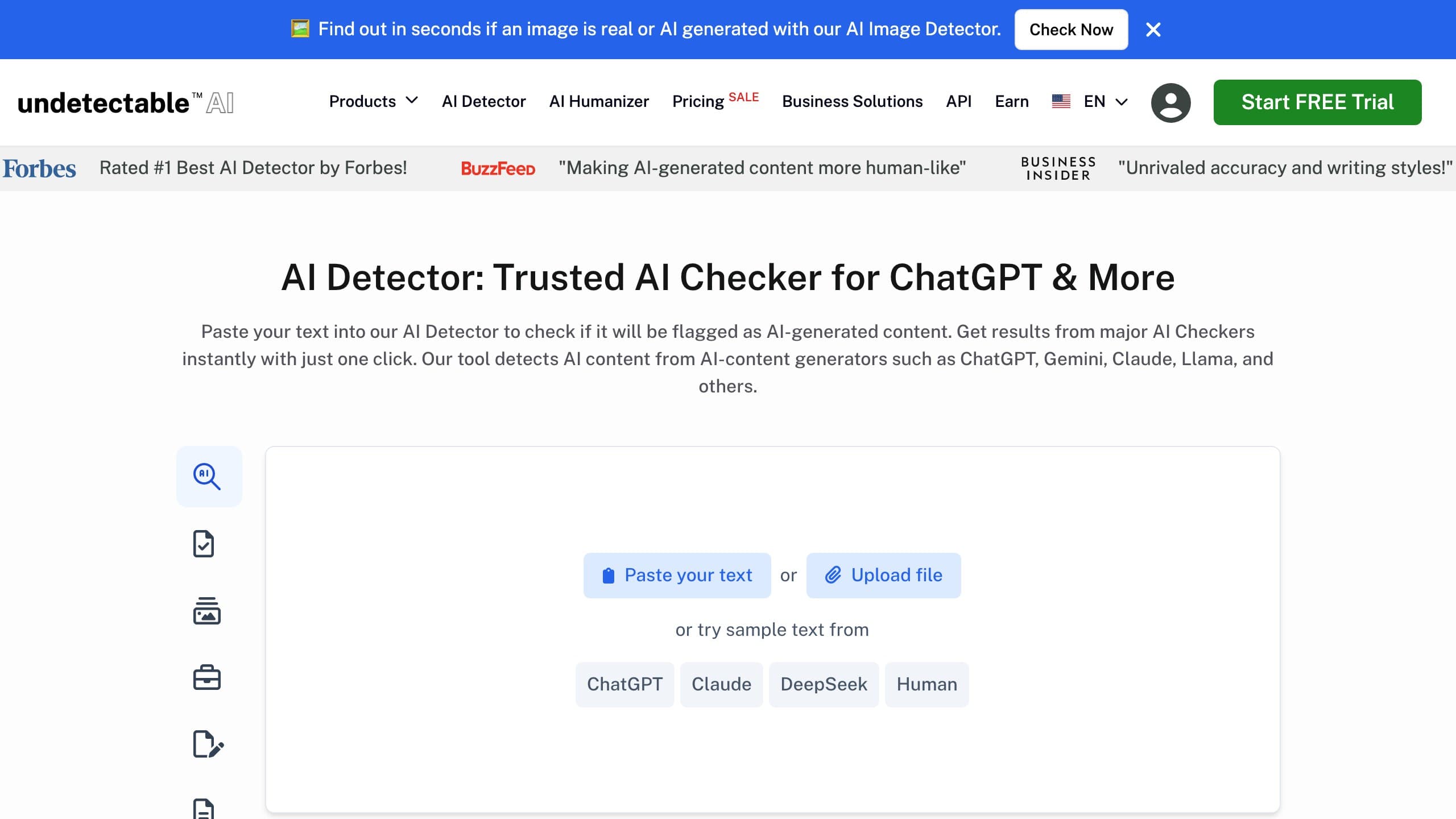
| Undetectable.ai | 250 words, one-time | $14.99/mo · 10k words | Simple persuasive essays only |
The ranking, in order
Ranked by essay fit: argument fidelity leads, then register suited to your essay type, then cost and reputation. The right pick depends on whether you're writing a formal argument or a voice-led personal piece.
1. WriteHybrid, best at keeping the argument intact
The strongest choice for structured essays: Academic mode loosens cadence without rearranging your case, and the recurring free tier lets you test a real paragraph first.
Best for: Argumentative and analytic essays where the thesis, topic sentences, and transitions must survive the rewrite.
Pros
- +Academic mode shortens inflated introductions and restores plain verbs without inverting claim order
- +Recurring 500-word monthly free tier (no card) covers a short essay section at zero cost
- +Lowest entry price here ($9/mo) plus a clear 14-day refund window
- +Left formatted in-text citations intact in my own use when I ran body text only
Cons
- −A full essay may need several free-tier passes across the month
- −Web-only; no offline app
- −It's my product, weigh it against the alternatives below
I build this, so weigh the placement accordingly, but the reason it leads for essays is concrete and checkable. Academic mode is tuned to shorten the inflated introductions language models love and restore plain verbs, without inverting your claim order. That's the exact thing that matters for an essay: a humanizer's job is to change the rhythm, not to re-argue your case. In my use it also left formatted parenthetical citations intact when I selected only my own body text and kept quotes out of the box.
The recurring free tier is what makes it testable. A five-paragraph essay fits 500 free words a month if you humanize section by section, with no card on file, so you can see how it handles your introduction before you pay. If you upgrade, Starter is $9/month for 10,000 words and Pro is $19/month for 50,000 words with API access, with a 14-day refund.
The honest caveat: read the output for outline fidelity every time, because no tool, mine included, can promise a detector result, and a rewrite that quietly drops a qualifier can change what your essay claims.
Pricing (verified June 2026): Free, 500 words/month, recurring, includes Academic mode. Starter, $9/month, 10,000 words. Pro, $19/month, 50,000 words plus API. Modes: Academic, Marketing, Casual, Technical.
2. Phrasly, best for literature reviews and undergraduate essays
Its rewrites read like a capable undergraduate essay, which is ideal when your draft already follows intro-body-conclusion scaffolding, at a low per-word cost.
Best for: Argumentative essays and literature reviews on a student budget that already have a clear structure.
Pros
- +Output resembles competent undergraduate essay prose, natural for intro-body-conclusion drafts
- +Parenthetical citations survived its rewrites on most of my samples
- +Around 4.4 stars across hundreds of Trustpilot reviews, the best-rated competitor here
Cons
- −Conclusions sometimes get reordered, blurring the logic, re-read those by hand
- −Free trial auto-renews into a paid plan; set a cancellation reminder
- −Independent reviewers flag inconsistency specifically against Turnitin
Phrasly's rewrites often resemble a capable undergraduate essay, which is exactly what you want when your draft already follows intro-body-conclusion scaffolding, it tightens the prose without sounding like marketing copy. Parenthetical citations survived its rewrites on most of my samples, and the Student plan is priced for monthly essay volume.
The weak spot for essays specifically is the conclusion: it sometimes reorders sentences there and blurs the logic, so re-read your closing paragraph by hand after a pass. On reputation, Phrasly is well-regarded, roughly 4.4 stars across hundreds of Trustpilot reviews, with students praising its plain interface, but two complaints recur: the free trial quietly converting to a paid subscription, and inconsistency against Turnitin's AI report even when lighter detectors clear it. It's a fair fit for argumentative essays and reviews; less so for a technical lab report.
Pricing (verified June 2026): Trial, 200 words, one-time. Student, $12.99/month, 25,000 words, academic mode. Pro, $24.99/month, 75,000 words.
3. WriteHuman, best for revising an essay line by line
The side-by-side diff is the reason to pick it: you can compare paragraph-level changes before submission and defend any edit you accepted.
Best for: Students who revise essay-by-line and want to see exactly what changed before accepting it.
Pros
- +Side-by-side diff lets you compare paragraph-level changes before you submit
- +Clean, low-clutter editor that's pleasant for careful revision
- +Replies to most negative Trustpilot reviews, a reassuring support signal
Cons
- −Enhanced mode is Pro-only ($22); the $12 Basic plan is Standard mode
- −200-word one-time trial is too small to evaluate a full essay
- −Reviewers repeatedly describe detection as 'works sometimes, not others'
WriteHuman's side-by-side diff is the reason to choose it for essays: you can compare paragraph-level changes against your original before submission, which helps if you ever need to defend an edit to a writing-centre tutor or explain a phrasing choice. It's one essay at a time, there's no bulk mode, and it's stylistic only, so it won't repair an argument that was weak to begin with. (It's not the same company as WriteHybrid, despite the similar name.)
The checkout detail to know is mode gating: the stronger Enhanced register is Pro-only at $22/month, while the $12 Basic plan is Standard, and the 200-word one-time trial is too small to judge a full essay. Reputation sits around 3.9 stars across roughly 200 Trustpilot reviews, with the recurring theme being inconsistency, "works sometimes, not others", plus billing confusion between monthly and annual plans. To their credit, the company replies to most negative reviews.
Pricing (verified June 2026): Trial, 200 words, one-time. Basic, $12/month, Standard mode. Pro, $22/month, unlocks Enhanced.
4. StealthWriter, best for personal and reflective essays
Its multi-variant workflow shines on voice-led writing, generate a few versions, pick the least conversational, then tighten transitions yourself.
Best for: Voice-forward personal essays, reflective journals, and opinion pieces, not APA-heavy research papers.
Pros
- +Multi-variant output lets you choose the version with the least conversational drift
- +Mature rewrite engine that holds up well on general, voice-led prose
- +Friendlier reception on ProductHunt (~4 stars) than its small Trustpilot sample suggests
Cons
- −No dedicated academic register; formal passages drift casual on aggressive variants
- −Low Trustpilot score (around 2-3 stars) on a small sample, billing and cancellation complaints
- −Reviewers report difficulty removing card details and unresponsive support, start monthly
StealthWriter's multi-variant workflow is its real strength for essays with a voice: paste your introduction, generate a few rewrites, pick the one with the least conversational drift (start with the Ghost variant), then tighten the transitions yourself. For a reflective essay or opinion piece where the rubric rewards a distinct voice, that control is genuinely useful, and the underlying rewrite engine is mature.
It ranks fourth because it isn't built for formal essays. There's no dedicated academic register, so formal passages drift casual on the more aggressive variants, not my pick for an APA-heavy research paper. Reputation is the other caution: Trustpilot sits low (around 2 to 3 stars) but on a small sample of reviews, with complaints clustering on cancellation, card-removal difficulty, and unresponsive support; ProductHunt is friendlier at about 4 stars. Start on a monthly plan so you can leave quickly if the output quality slips after a model update.
Pricing (verified June 2026): Trial, 250 words, one-time. Pro, $19/month, 30,000 words, all variants. Premium, $39/month, 100,000 words.
5. Undetectable.ai, simple persuasive essays only
Workable for a straightforward persuasive essay, but it flattens nuance on analytic writing and carries the heaviest billing complaints in this group.
Best for: Personal narratives and simple persuasive essays, not evidence-heavy or theory-dense research papers.
Pros
- +Handles personal narratives and simple persuasive essays acceptably
- +Well-known brand with a useful free detection scanner
Cons
- −Flattens nuance and softens definitions on abstract or theory-dense essays
- −Highest entry price in this group for its essay fit
- −Heaviest billing complaints here, trial conversion and credit forfeiture on cancellation
Undetectable.ai works for a personal narrative or a straightforward persuasive essay, but on abstract or theory-dense writing it tends to flatten nuance and soften definitions, a real risk on analytic-philosophy or legal-analysis essays where a single hedged claim carries the argument. Independent reviewers report the same drop-off on complex content. The entry price is also the highest in this group relative to its essay fit.
It ranks last on reliability and billing. Ratings vary by source, Trustpilot's main profile sits in the low-to-mid 3s while several independent reviews cite numbers closer to 2 across 700-plus reviews, but the complaints are consistent: a short trial that converts to a charge, credit forfeiture on cancellation, and refund refusals. If you use it for an essay, verify that every topic sentence still answers the prompt after the rewrite, keep it away from evidence sections, and consider a virtual card.
Pricing (verified June 2026): Trial, 250 words, one-time. Starter, $14.99/month, 10,000 words. Pro, $29.99/month, 50,000 words.
The late-2025 shift that changed essay detection
Essay detection didn't stand still, and one date anchors the change. On 27 August 2025, Turnitin added AI bypasser detection to its AI writing report: the "AI-generated only" category now includes text it judges to have been AI-generated and then run through a humanizer, and a separate category flags AI text revised by a paraphrasing tool. Turnitin also replaced numeric scores between 1% and 19% with an asterisk to limit false positives.
For essays, that has a concrete consequence. The introduction and conclusion are the most heavily rewritten parts of any AI draft, and they're also where graders and detectors look hardest. A humanizer that softened your intro past last year's detector may leave a different fingerprint against the post-August model, and you won't see it until you check. That's why this page carries no pass percentages: they go stale the moment a detector updates. Treat re-testing your own essay each term as part of the workflow, not an optional extra.
Honesty on essays: refine your argument, don't manufacture it
An AI humanizer should make a draft you actually wrote read more like you, not generate the essay for you. Most institutions, in policy and honour codes, treat submitting AI-generated work as original very differently from polishing your own prose, and Turnitin's bypasser detection is aimed squarely at the former. The safest mindset for an essay: the thinking, the argument, and the evidence are yours; the humanizer only adjusts how a draft of that thinking reads.
Practically, that means never running quotations through a humanizer (you'll misquote your source), keeping your own voice in the thesis and conclusion where it matters most, and checking your course's specific rules on AI assistance before you submit.
Detection: what we can and can't tell you
This is the part vendors skip. No tool on this page, mine included, can promise your specific essay will clear a specific checker. Detectors disagree, update without notice, and score an introduction differently from a body paragraph. On an essay, GPTZero tends to react to uniform sentence rhythm, Turnitin now folds humanized AI into the August 2025 bypasser category, Originality.ai is the harshest on lightly edited AI prose, and Copyleaks scores on its own logic entirely. An essay that clears one of them can still trip another within the hour.
What I can offer is qualitative: tools with a real formal register (WriteHybrid, Phrasly) hold an argumentative essay's structure and citations more reliably, while voice-led tools (StealthWriter) shine on reflective essays but drift on formal ones. The dependable approach is unchanged, humanize your introduction and one body paragraph, run them through the exact checker your course mentions, and decide from that result rather than any vendor's promise.
How to get a natural, intact essay
A few habits protect both your argument and your grade:
- Humanize the body before the intro and conclusion. Those get rewritten most aggressively, so do them last and read them hardest.
- Check topic sentences after every pass. Each should still answer the prompt; if the rewrite buried it, restore it by hand.
- Keep a citation sidecar file. Pull quotes and references out before humanizing, then reinsert them so batch edits can't break your brackets.
- Patch failures one paragraph at a time. If a single paragraph trips your checker, rewrite that paragraph manually instead of re-running the whole essay.
- Verify on your course's checker. A slightly stiffer sentence that's still correct beats a smooth one that argues the wrong thing.
Frequently asked questions
Related reading
Try WriteHybrid on your text
Paste AI-generated copy below. 500 humanized words free every month after signup.
Was this page helpful?
Your feedback helps us improve our testing write-ups.