WriteHybrid vs StealthWriter (2026): Variant Shopping vs One Tuned Output
Side-by-side comparison


Disclosure. I'm Huzefa Abbasi, founder of WriteHybrid, so I have an obvious stake in this comparison. StealthWriter is a competitor I've used hands-on, and everything below is based on that, on each tool's public pricing as of June 2026, and on publicly visible user reviews, not a lab benchmark. Detection outcomes depend on your exact text and the specific detector your institution runs, so treat any tool's "bypass" marketing (mine included) as a claim to verify yourself.
What you're actually choosing between
Both tools do the same core job: paste an AI-generated draft, choose how aggressively to rewrite it, and get something that reads more naturally. The difference is what they hand back.
StealthWriter's signature move is variety. It labels its rewrite settings Ninja, Ghost, and Stealth, and you effectively shop among variants until one reads, or scores, the way you want. Framed as choice, that can also become work: you're the one comparing outputs every time. WriteHybrid takes the opposite approach. You pick a register up front (Academic, Marketing, Casual, or Technical) and get one output tuned for it. Less shopping, fewer tabs, less second-guessing.
Who is each actually for? StealthWriter fits a tinkerer who produces short pieces, a blogger or SEO writer who enjoys running a paragraph three ways and keeping the best line. WriteHybrid fits someone who wants a dependable single pass across different kinds of writing and would rather not gamble on a 3-day refund window. That second axis, what happens to your card after you subscribe, matters at least as much as the workflow, and it's where this comparison gets uncomfortable for StealthWriter.
StealthWriter suits writers who like choosing among variants and produce short pieces; WriteHybrid suits those who want one tuned output, longer pastes, and a refund window they can actually use.
Best for: Writers deciding between StealthWriter's multi-variant model and WriteHybrid's single-output, mode-driven approach, and who will verify detection on their own checker.
Pros
- +StealthWriter: multiple rewrite variants per input
- +StealthWriter: competitive per-word cost at its higher tier
- +WriteHybrid: one tuned output per register, less manual comparison
- +WriteHybrid: recurring free tier, larger paste capacity, 14-day refund
Cons
- −StealthWriter: ~5,000-character cap forces splitting long essays
- −StealthWriter: 3-day refund and a one-time 250-word trial
- −StealthWriter: reviewers report billing and cancellation friction
- −WriteHybrid: no multi-variant picker if you specifically want that
Key features that actually matter
Headline marketing rarely tells you how a tool behaves at 11pm before a deadline. Here's the breakdown that does, feature by feature.
Writing modes and tone control
StealthWriter's three labels, Ninja, Ghost, and Stealth, are aggression settings rather than separate engines. They turn the paraphrasing dial from light to heavy, and you choose among the resulting variants. There's no register control: nothing that tells the tool "this is an academic paper, keep it formal" versus "this is a blog, loosen it up." You manage register yourself by picking the variant that happens to land closest to the tone you want.
WriteHybrid inverts that. Instead of an aggression slider, you select the purpose, Academic, Marketing, Casual, or Technical, and the rewrite is tuned to that register in one pass. For mixed work that distinction is the practical difference: a Technical mode that preserves precise terminology is a different job than a Casual mode that deliberately loosens phrasing, and a single aggression dial can't make that call for you.
Input and word limits
StealthWriter caps input at roughly 5,000 characters per paste, about 750 words. A standard 1,500-word essay therefore has to be split into at least two chunks, run separately, and stitched back together. Because the variants paraphrase independently, those seams can show: a clause-ordering choice that reads well in chunk one may clash with the rhythm of chunk two. WriteHybrid accepts longer pastes, so most single documents run in one pass and keep a consistent voice end to end. If you routinely work long, this single difference reshapes your whole workflow.
Free tier and trial
This is the starkest gap. StealthWriter offers a one-time 250-word lifetime trial, enough to see the variant picker once, gone before you've tested it on a real assignment, and it requires an email to unlock. WriteHybrid gives 500 words every month, recurring, with no card required, roughly 6,000 words across a year you can spend re-testing as your own writing changes and as detectors update. For evaluating a tool honestly before paying, a recurring allowance beats a single sample by a wide margin.
API, extensions, and integrations
StealthWriter is a web app only: no public API, no Chrome extension, no Word or Google Docs add-in. Everything happens by pasting into the site. WriteHybrid exposes an API on the $19/month Pro plan, which matters if you want to wire humanizing into a content pipeline or run batches programmatically rather than tab-by-tab. Neither tool should be picked on integrations alone, but if automation is on your roadmap, only one of these supports it today.
Editor UX
In hands-on use, StealthWriter's editor is fast, rewrites land in roughly fifteen seconds, and the tabbed variant view is clean. The friction isn't speed, it's the decision load: every run ends with you reading three outputs and judging which holds up, which compounds on a multi-chunk document. WriteHybrid's editor returns one result per run, so the loop is paste, read, lightly edit, done. Whether that's a feature or a limitation depends entirely on whether you enjoy comparing variants.
Support and billing experience
This is where StealthWriter's public reputation drags. Across reviews, the recurring theme isn't the editor, it's what happens around the subscription: charges after cancellation, difficulty getting stored card details removed, and slow or absent support replies. Pair that with a 3-day refund window and the risk profile is real. WriteHybrid's 14-day refund and clearer monthly entry exist specifically to take that anxiety off the table.
The editors, side by side
Specs tell you what's possible; hands-on use tells you what's pleasant. Here's how the two compare across the dimensions that decide day-to-day satisfaction.
Output quality
StealthWriter's variants genuinely differ from one another, which is its strongest card: when one pass reads awkwardly, another often fixes it. The weakness is consistency, the heavier Ghost variant tends to reorder clauses in ways that can blur an academic argument, and longer inputs sometimes pick up tense drift. WriteHybrid aims for one clean register-matched output rather than three to choose from; you trade the variety for predictability. Neither approach is "better" in the abstract, it depends on whether you'd rather curate or receive.
Customization and control
If you measure control by knobs, StealthWriter wins: three aggression settings plus variant selection is more hands-on tuning than WriteHybrid's mode picker. If you measure control by outcome, WriteHybrid's register targeting often gets you there faster, because you're telling the tool the destination instead of nudging it there one variant at a time. Tinkerers will prefer the former; people who want a result will prefer the latter.
Ease of use
Both are paste-and-go and neither has a learning curve worth mentioning. The difference is the end of the loop: StealthWriter asks you to evaluate multiple outputs every time, while WriteHybrid hands back a single one. On a one-paragraph rewrite that's trivial; on a 2,000-word document split into chunks with three variants each, the comparison work adds up fast.
Support and billing
On this axis the gap is not close. StealthWriter's reviews repeatedly flag billing and cancellation friction and unresponsive support, against a 3-day refund. WriteHybrid offers a 14-day refund and a recurring free tier that lets you avoid the question of refunds entirely by testing before you pay. If you've been burned by an auto-renewing tool before, weight this heavily.
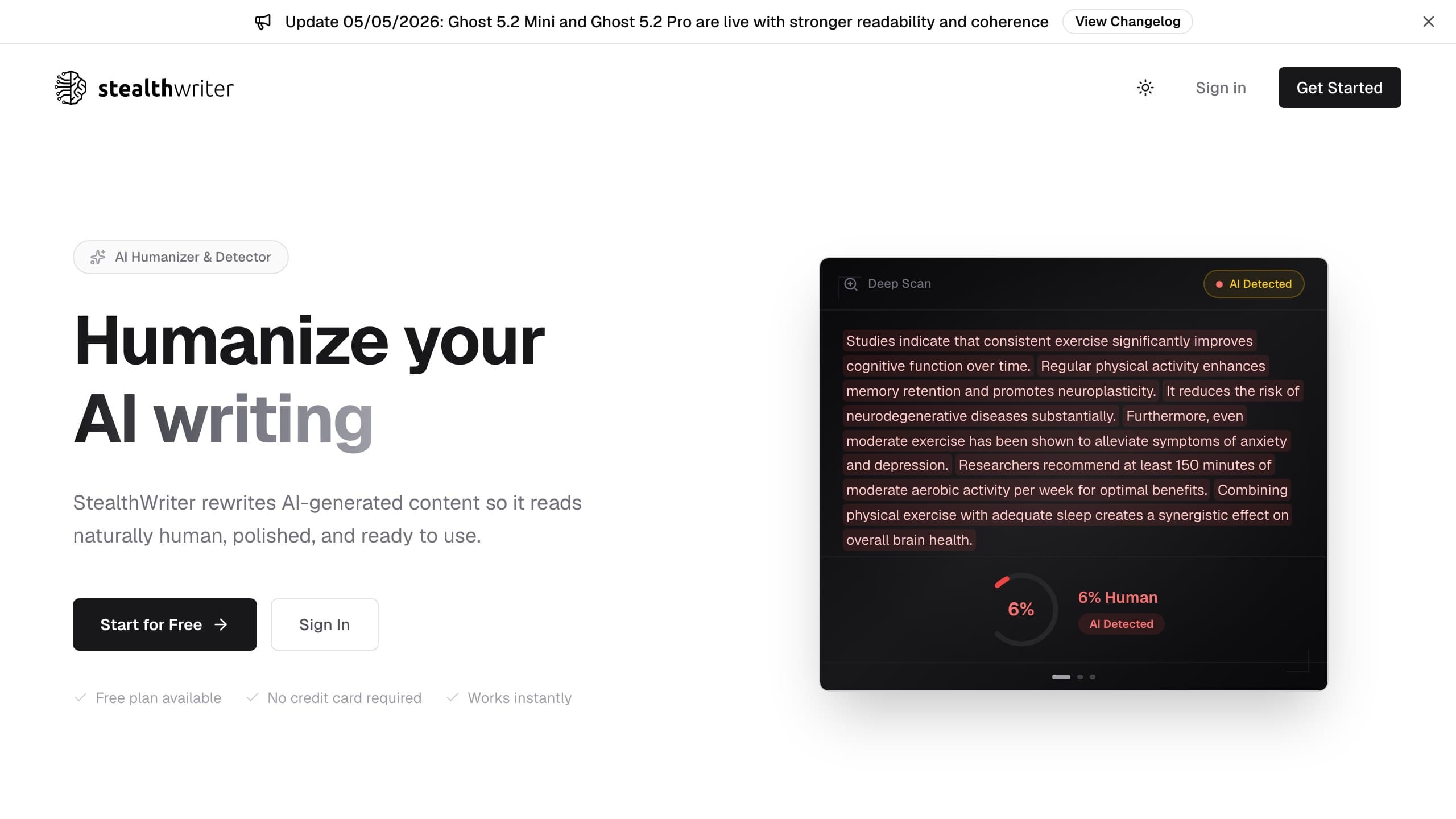
An illustrative rewrite
StealthWriter's variants tend to reorder clauses and paraphrase aggressively. This shows the style its settings produce, it illustrates register, not detection, and is not a pass/fail claim:
Pricing (verified June 2026)
I checked both tools against their live checkouts in June 2026. Annual and monthly toggles change the headline numbers, so confirm at checkout before subscribing.
| Plan | WriteHybrid | StealthWriter |
|---|---|---|
| Free | 500 words/month, recurring, no card | 250 words, one-time (lifetime) |
| Entry paid | $9/mo, 10,000 words (Starter) | $19/mo, 30,000 words |
| Higher tier | $19/mo, 50,000 words (Pro, + API) | $39/mo, 100,000 words |
| Modes | Academic, Marketing, Casual, Technical | Ninja, Ghost, Stealth (variants) |
| Refund window | 14 days | 3 days |
On the math: StealthWriter is genuinely competitive per word at volume. Its $19 entry plan works out to about $0.0006 per word ($19 ÷ 30,000), under WriteHybrid Starter's roughly $0.0009 ($9 ÷ 10,000). Its top tier holds that rate, $39 ÷ 100,000 is about $0.0004 per word. If you reliably burn through tens of thousands of words a month, those gaps are real money. WriteHybrid's counter is at the entry point and the edges: it's cheaper to start ($9 versus $19), carries a much longer refund window (14 days versus 3), and its recurring free tier, 500 words every month, beats StealthWriter's single 250-word lifetime trial for actually evaluating the tool before you commit.
There's a subtlety the per-word numbers hide: a low rate only helps if you use the allowance. Buy 30,000 words a month and write 8,000, and your effective rate is far higher than the sticker. Match the plan to your real monthly output, not your optimistic one. And treat the 3-day refund as a hard deadline, three days is barely enough to test against one real assignment, and it sits right next to the billing complaints below.
How to use StealthWriter for the best results
If you do choose StealthWriter, a little discipline gets you more from it and protects you from its rough edges:
- Split long drafts deliberately. Because of the ~5,000-character cap, break at paragraph or section boundaries, never mid-argument, so the seams between chunks fall where a reader would naturally pause.
- Run all three variants on the first chunk. Use that first pass to learn which setting (Ninja, Ghost, or Stealth) suits this document's tone, then apply it consistently to the rest so the voice doesn't lurch between sections.
- Read for meaning, not just flow. The heavier variants reorder clauses; check that nothing important got softened, reversed, or dropped, especially in topic sentences and conclusions.
- Verify on your own detector. Paste the final, stitched draft into the checker your audience actually uses (Turnitin, GPTZero, Originality.ai, or Copyleaks) before you rely on it. The variant dashboard is not that check.
- Diarize the refund and watch billing. Set a reminder inside the 3-day window, and if you cancel, confirm the charge actually stops, given the review patterns, don't assume.
What real users say about StealthWriter
I read through StealthWriter's public Trustpilot profile and Reddit threads to sanity-check my own impressions against a larger sample. At the time of writing, StealthWriter holds a low Trustpilot rating, around 2 stars, across roughly 20+ reviews (the exact figure drifts between about 1.7 and 2.8 depending on which regional Trustpilot domain you open). That's a small sample, so weight it accordingly, but the pattern in the negative reviews is consistent enough to flag.
What satisfied users tend to mention:
- The core variant feature does its job for short, casual rewriting.
- On ProductHunt the reception is noticeably warmer (around 4 stars), which suggests the more technical early-adopter crowd has had a smoother experience than the general Trustpilot population.
The recurring complaints are harder to ignore, because the same issues show up from different people:
- Billing after cancellation: multiple reviewers describe being charged again after they believed they'd cancelled, and difficulty getting stored card details removed.
- Support friction: support is widely described as slow or unresponsive, with emails reportedly going unanswered.
- Reliability: scattered reports of downtime and inconsistent output quality on longer inputs.
None of this means StealthWriter doesn't work, the ProductHunt sentiment and the people who like the variant model are real too. But if you're going to subscribe, the honest advice from the review pattern is practical: treat the 3-day refund as a hard deadline, watch your billing closely, and consider a virtual card. That caution is exactly the friction WriteHybrid's recurring free tier and 14-day refund are designed to remove.
The detector landscape shifted in late 2025, and it matters here
Humanizers don't operate against a fixed target. In late August 2025, Turnitin rolled out a detector update aimed squarely at humanizer output patterns, and the whole category, variant tools like StealthWriter included, produced less reliable results almost overnight. The other major checkers move too: GPTZero, Originality.ai, and Copyleaks each revise their models on timelines none of us controls.
What that means for you is simple. Any "bypass" figure quoted in a review captured one detector version on one day; the build you'll actually face may already be different. It's why WriteHybrid stopped advertising headline pass percentages altogether and instead tells you to run your finished draft through your own checker, the one measurement that reflects the detector you're up against right now, not the one that existed when someone wrote a glowing testimonial.
Detection: what we can and can't tell you
This is the honest part. StealthWriter markets its variants on the implication that one of them will clear detectors, but no tool can promise an outcome for your specific draft. Detection moves with the passage, its length, and the detector, and which version of it, running the check. I won't publish pass-rate numbers I can't stand behind on your text, and neither should anyone else.
What I can say from hands-on use: the variants do produce noticeably different rewrites, which can genuinely be handy when one pass reads awkwardly. But dense academic passages with preserved terminology and citations are where any humanizer is most likely to leave detectable patterns, and StealthWriter's clause-reordering style can drift meaning there if you don't read carefully. The only number that protects you is your own: humanize your real draft and run the output through the detector your audience actually uses before you submit anything graded.
When StealthWriter is the better pick
- You like choosing among variants and tuning rewrites by hand.
- Your drafts fit comfortably under the ~750-word input cap without awkward splitting.
- You produce enough short-form volume that its lower per-word cost at the higher tier wins.
When WriteHybrid is the better pick
- You want one tuned output and less time spent comparing tabs.
- You write long-form content the 5,000-character cap would force you to split.
- You'd rather evaluate before paying, a recurring free tier and a 14-day refund instead of a 3-day window next to a rough billing reputation.
- You need API access or distinct registers like a Technical mode.
If variant-shopping suits how you work and your essays are short, StealthWriter is reasonable, just go in with eyes open about the refund and billing reports. If you'd rather get a clean register-matched rewrite in one pass and test it risk-free first, WriteHybrid is the smoother fit.
How to get the most natural output
Whichever tool you land on, the difference between "obviously rewritten" and "reads like you" comes down to habits, not settings:
- Don't ship the first pass. Humanizers smooth grammar, but they also flatten voice. Re-insert a contraction, a short sentence, an aside, the small irregularities that make writing sound like a person wrote it.
- Mix registers intentionally. If a tool offers different modes or variants, match them to the section: a looser tone for an intro, a tighter one for a methods paragraph. Uniform output across a long piece is itself a tell.
- Keep citations and quotes intact. Paraphrasers love to "improve" reference markers and direct quotes. Copy your bibliography aside before you run anything, then diff it afterward and restore anything that moved.
- Run it through more than one detector. GPTZero, Turnitin, Originality.ai, and Copyleaks disagree constantly. Clearing one is not clearing all, check against the specific one that gates your submission.
- Read it aloud once. Your ear catches reordered clauses and dropped logic faster than your eye, and that's exactly where aggressive paraphrasing slips.
Frequently asked questions
Related reading
Try WriteHybrid on your text
Paste AI-generated copy below. 500 humanized words free every month after signup.
Was this page helpful?
Your feedback helps us improve our testing write-ups.