WriteHybrid vs WriteHuman (2026): Privacy Promise vs Modes, API, and Refunds
Side-by-side comparison


Disclosure. I'm Huzefa Abbasi, founder of WriteHybrid, so I have an obvious stake in this comparison. WriteHuman is a competitor I've used hands-on, and everything below is based on that, on its public pricing as of June 2026, and on publicly visible user reviews, not a lab benchmark. Detection outcomes depend on your exact text and the detector your institution runs, so treat any "bypass" marketing (mine included) as a claim to verify yourself.
Name collision. WriteHuman and WriteHybrid are different companies with confusingly similar names. People searching "write human ai" land on both, so it's worth being sure which tool you're actually evaluating before you enter a card.
What you're actually choosing between
These two compete for the same searches but pitch different things. WriteHuman's whole identity is privacy plus undetectability: it markets a no-storage policy ("content never stored") and leans hard on "bypass AI detection" language. WriteHybrid pitches breadth and control: four dedicated writing modes, a recurring free tier, and API access for automation. Neither pitch settles the question on its own, because WriteHuman's public reputation adds a third axis, billing and consistency, that's easy to miss until you've paid.
Who WriteHuman is for: writers handling confidential or NDA-bound drafts who value a no-storage promise and will pay for the Enhanced tier where the quality lives. Who WriteHybrid is for: people who want register control across academic, marketing, and technical writing, an API to automate with, and a low-risk way to evaluate before committing.
WriteHuman wins on a privacy-first positioning; WriteHybrid wins on dedicated modes, API access, a recurring free tier, and a cleaner refund reputation.
Best for: Writers weighing WriteHuman's no-storage privacy promise against WriteHybrid's modes, API, free tier, and refund terms, and who will verify detection on their own checker.
Pros
- +WriteHuman: no-storage privacy policy for confidential drafts
- +WriteHuman: large word allowances and a useful keyword-bracketing feature
- +WriteHybrid: four dedicated modes and API access on Pro
- +WriteHybrid: recurring 500-word monthly free tier (no card)
Cons
- −WriteHuman: best (Enhanced) output is gated behind a paid tier
- −WriteHuman: no API, and users report inconsistent results
- −WriteHuman: recurring billing and refund complaints on Trustpilot
- −WriteHybrid: lower top-tier word caps than WriteHuman
Key features that actually matter
Headline word allowances make WriteHuman look like a runaway value until you map the features to what you'll actually use. Here's the breakdown that drives the decision, with the verifiable specifics.
Writing modes and tone control
WriteHuman splits into two output models: Standard and Enhanced, with Enhanced gated behind the paid tier. There's no academic-versus-marketing register control, you choose a quality level, not a voice. Its one genuinely clever extra is keyword bracketing: wrap a term in brackets and WriteHuman tries to preserve it through the rewrite, which helps protect names and technical vocabulary.
WriteHybrid approaches tone differently with four named modes, Academic, Marketing, Casual, and Technical, that you select up front so the rewrite commits to the register you need. If your work spans a formal paper and a blog post, choosing the register beats hoping a single "enhanced" pass lands in the right voice.
Input and word limits
WriteHuman accepts around 10,000 characters per paste (about 1,500 words), which is generous for a single pass and means most essays go through without heavy chunking. Its paid tiers advertise large monthly allowances, 80,000 words on Basic, 200,000 on Pro. WriteHybrid meters smaller monthly budgets (500 free, 10,000 on Starter, 50,000 on Pro) but pairs them with register modes and an API. If raw volume is your bottleneck, WriteHuman's allowances are larger; if control and automation matter more, WriteHybrid's smaller budget may still fit.
Free tier and trial
WriteHuman offers a small one-time trial, around 200 words, lifetime, which is barely enough to see the editor and not enough to judge the Enhanced output you'd actually buy. WriteHybrid runs a recurring free tier: 500 words every month with no card, resetting so you can keep testing on new drafts. Over a year that's roughly 6,000 words of evaluation versus a single 200-word sample, and that gap matters because WriteHuman's free output is weaker than its paid Enhanced tier.
API, extensions, and integrations
WriteHuman has no public API, so automating humanizing through a pipeline isn't an option, it's a paste-in-the-browser tool. WriteHybrid offers API access on the $19/month Pro plan, which is the deciding factor for anyone scripting a content workflow. Neither leans on browser extensions, so this comes down to whether automation is part of your job.
Editor UX
WriteHuman's interface is clean and genuinely easy to navigate, reviewers consistently praise that, and it's true in hands-on use. You paste, pick Standard or Enhanced, optionally bracket keywords, and run. WriteHybrid's editor is similarly focused but adds the mode selector as the primary control. Both are simple; the difference is whether you're choosing a quality level (WriteHuman) or a register (WriteHybrid).
Support and billing experience
This is WriteHuman's weakest area and the source of most of its negative reviews, detailed below. The recurring pattern is billing friction: annual charges that buyers expected to be monthly, charges after cancellation or on paused subscriptions, and a refund stance that several reviewers describe as effectively "no." WriteHybrid offers a 14-day refund window and a recurring free tier specifically so the decision happens before money changes hands.
The editors, side by side
Both tools take a stiff AI draft and make it read more like a person wrote it. The difference is in consistency and how much of the good output you have to pay to see.
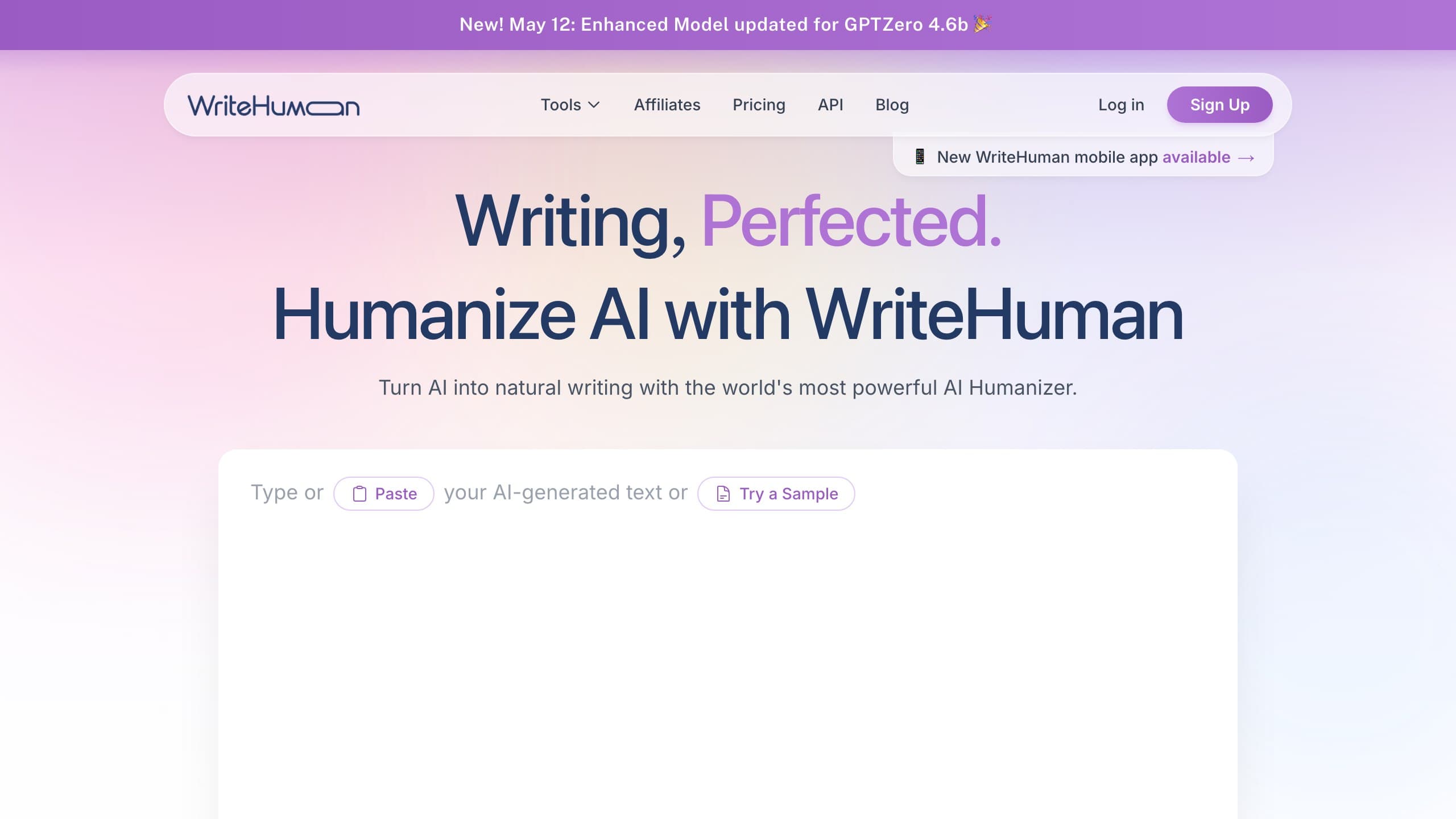
An illustrative rewrite
WriteHuman's Enhanced mode produces a relaxed, conversational register. This shows the style, not a detection result:
Output quality
On its Enhanced tier, WriteHuman produces relaxed, conversational prose that reads well for blog and general content. The recurring caveat from reviewers, and the thing to plan around, is inconsistency: the same kind of text can read smoothly one run and stiffly the next. WriteHybrid's mode-specific output is steadier in register because each mode targets a defined voice, though like any humanizer it's strongest on general prose and weakest on dense academic passages.
Customization
WriteHuman's customization is mostly the quality toggle plus keyword bracketing, useful but narrow. WriteHybrid's customization is the register itself: picking Academic versus Marketing materially changes sentence structure and vocabulary. If you need to protect specific terms, WriteHuman's bracketing is a neat tool; if you need a consistent voice, WriteHybrid's modes do more.
Ease of use
Both are beginner-friendly. WriteHuman earns genuine praise for a clean, uncluttered interface, and it's quick to learn. WriteHybrid is comparably simple, with the mode picker as the main decision. Neither tool has a learning curve worth worrying about, the real friction with WriteHuman shows up at billing, not in the editor.
Support and billing
This is the decisive split. WriteHybrid's 14-day refund and recurring free tier are built to let you decide before paying. WriteHuman's billing, annual-versus-monthly confusion, charges after cancellation, and a contested refund process, is the most repeated complaint in its reviews. If you're cautious about subscriptions, weigh this as heavily as any output difference.
Pricing (verified June 2026)
I checked both tools against their live checkouts in June 2026. Annual toggles change the effective rate, so confirm before subscribing.
| Plan | WriteHybrid | WriteHuman |
|---|---|---|
| Free | 500 words/month, recurring, no card | 200 words, one-time (lifetime) |
| Entry paid | $9/mo, 10,000 words (Starter) | $12/mo, 80,000 words (Basic) |
| Higher tier | $19/mo, 50,000 words (Pro, + API) | $22/mo, 200,000 words (Pro) |
| Modes | Academic, Marketing, Casual, Technical | Standard, Enhanced (Enhanced gated to paid) |
| Refund window | 14 days | 14 days (refunds often contested in reviews) |
On the math: WriteHybrid Starter is about $0.0009 per word ($9 ÷ 10,000) and Pro about $0.00038 per word ($19 ÷ 50,000). WriteHuman Basic looks dramatically cheaper per word on paper, $12 for 80,000 words is roughly $0.00015 per word, but that figure only holds if you genuinely use that volume and accept the tier you're on. The caveat is the quality cliff: the output WriteHuman markets is Enhanced, and Basic buyers may not get the same result, so compare the tier you'll actually pay for rather than the headline allowance. WriteHybrid is cheaper to enter ($9), matches the 14-day refund window on paper, and its recurring free tier (roughly 6,000 words a year) beats a single 200-word trial for evaluation.
A note on that refund window: WriteHuman lists a money-back policy, but as the reviews below show, getting one is the most contested part of the experience, so treat the free trial, not the refund, as your real safety net.
How to use WriteHuman for the best results
If WriteHuman is the tool you've chosen, usually for its privacy positioning or large allowances, here's a workflow that gets the most out of it while accounting for its quirks:
- Buy the tier you'll judge it on. Because the free and Standard output is weaker than Enhanced, evaluate on the tier you'll actually use, not the trial.
- Bracket what must survive. Wrap names, key terms, and cited phrasing in brackets so the rewrite preserves them instead of paraphrasing them away.
- Paste in reasonable chunks. It accepts around 10,000 characters per pass; splitting a long document into coherent sections tends to read better than forcing one giant pass.
- Run the same passage twice and compare. Given the consistency complaints, generate two versions and keep the stronger one rather than trusting the first output.
- Verify on your own detector. WriteHuman markets undetectability, but the only result that counts is your draft on the checker your audience uses, GPTZero, Turnitin, Originality.ai, or Copyleaks.
- Watch your billing settings. Confirm whether you're on monthly or annual, and set a reminder before any renewal, this is where most WriteHuman regret comes from.
What real users say about WriteHuman
I read through WriteHuman's public Trustpilot profile and Reddit threads to sanity-check my impressions against a larger sample. At the time of writing, WriteHuman holds roughly a 3.9-star Trustpilot rating across 200+ reviews (the exact figure varies by regional Trustpilot domain), which puts it firmly in "mixed" territory rather than uniformly good or bad.
What satisfied users tend to praise:
- A clean, intuitive interface that's easy to learn.
- Enhanced-mode output that reads noticeably better than the free tier.
- Cases where it did help a draft read more naturally on general content.
The recurring complaints are striking because the same issues repeat across many independent reviewers:
- Billing surprises: the most common theme is being charged for an annual plan when the buyer believed they'd signed up monthly, plus charges after cancellation or on "paused" subscriptions.
- Refund friction: multiple reviewers describe a no-refund stance even for billing errors, with refunds sometimes only resolved after escalating directly to the company.
- Inconsistency: the single most repeated phrase across Trustpilot and Reddit is "works sometimes, not others", output that passes one day or one paste and gets flagged the next, especially on Originality.ai and Turnitin.
None of this makes WriteHuman a scam, plenty of people use it happily for low-stakes content, and support has resolved cases once escalated. But if you're a student or freelancer with a graded or client submission on the line, the billing pattern and the consistency complaints are worth taking seriously before you commit to annual billing.
The detector landscape changed in late 2025, and it matters here
This category is not static. Turnitin shipped a detector update in late August 2025 that specifically targeted humanizer output patterns, and tools across the board saw less consistent results overnight. GPTZero, Originality.ai, and Copyleaks all iterate on their own schedules too. WriteHuman's "works sometimes, not others" reputation is partly what that volatility looks like from a user's seat.
The practical takeaway is the same regardless of which tool you pick: a bypass rate you read in any review is a snapshot of one moment against one detector version, and by the time you paste your own essay the detector may have moved. That's the core reason WriteHybrid no longer publishes headline bypass percentages and instead points you to test your real draft, the only measurement that reflects today's detector on your actual text.
Detection: what we can and can't tell you
This is the honest part. WriteHuman markets undetectability, but no tool can promise an outcome for your specific draft. Detection moves with the passage, its length, and the detector, and which version of it, that checks it. I won't publish pass-rate numbers I can't stand behind on your text.
From hands-on use, Enhanced mode reads naturally on blog and general content, and dense academic writing with preserved terminology and citations is the hardest case for any humanizer. The only reliable check is your own: humanize your real draft and run the output through the detector that gates your work, GPTZero, Turnitin, Originality.ai, or Copyleaks. And if you're buying the Basic tier, test on that tier, since Enhanced is what most of the marketing reflects.
When WriteHuman is the better pick
- Privacy is your top priority and you need a no-storage policy for confidential drafts.
- You produce high word volumes and will pay for the Enhanced tier where the quality lives.
- You want keyword bracketing to protect specific terms through a rewrite.
- You don't need an API or distinct academic-versus-marketing registers.
When WriteHybrid is the better pick
- You want dedicated modes for academic, marketing, casual, and technical work.
- You need API access for automation, which WriteHuman doesn't offer.
- You want a lower entry price, a recurring free tier to test with, and fewer billing surprises.
- You'd rather decide before paying than navigate a contested refund later.
If confidential client work drives your decision, WriteHuman's policy is a legitimate reason to choose it, just verify Enhanced output on your detector and read the current billing terms carefully. If you want register control, automation, or a cheaper, lower-risk way in, WriteHybrid fits better.
How to get the most natural output
Whichever tool you land on, the humanizer is one step, not the finish line. These evergreen habits move the needle more than any single setting:
- Don't trust a single pass. Generate a couple of versions, compare them, and combine the strongest sentences, especially with a tool prone to run-to-run variance.
- Add human specifics by hand. A concrete example, a real number, or a first-person aside is the hardest signal for a detector to mimic and the easiest for you to add.
- Break up uniform rhythm. Classifiers react to even sentence lengths and predictable structure; vary them deliberately.
- Protect citations and quotes. Use keyword bracketing (or manual locking) so a rewrite never paraphrases a direct quotation or scrambles a reference.
- Check more than one detector. GPTZero, Turnitin, Originality.ai, and Copyleaks disagree regularly; the only score that matters is the one your audience runs.
- Read it aloud before submitting. If a line sounds unnatural to you, it will to a reader too, fix it regardless of any tool's output.
Frequently asked questions
Related reading
Try WriteHybrid on your text
Paste AI-generated copy below. 500 humanized words free every month after signup.
Was this page helpful?
Your feedback helps us improve our testing write-ups.