Disclosure. I'm Huzefa Abbasi, founder of WriteHybrid. This is an editorial explainer, not a lab benchmark. Whether any method clears the detector you face depends on your exact text and the specific detector (and version) checking it — so verify on your own draft rather than trusting any "bypass" claim, ours included.
How AI detectors work
Most detectors score text along three axes. None of them read for truth, citation quality, or whether you understood the material — they estimate how likely each token is to have been produced by a language model versus a human.
- Perplexity: how predictable each word is given the words before it. Lower perplexity is more model-like; higher perplexity is more human.
- Burstiness: variance in sentence length and structure. Models tend to produce uniform sentences; humans cluster bursts of short sentences with occasional long ones.
- N-gram fingerprints: characteristic two- and three-word combinations that specific models reuse. "Delve into", "in today's fast-paced", "it's important to note" are textbook ChatGPT signatures in 2026 corpora.
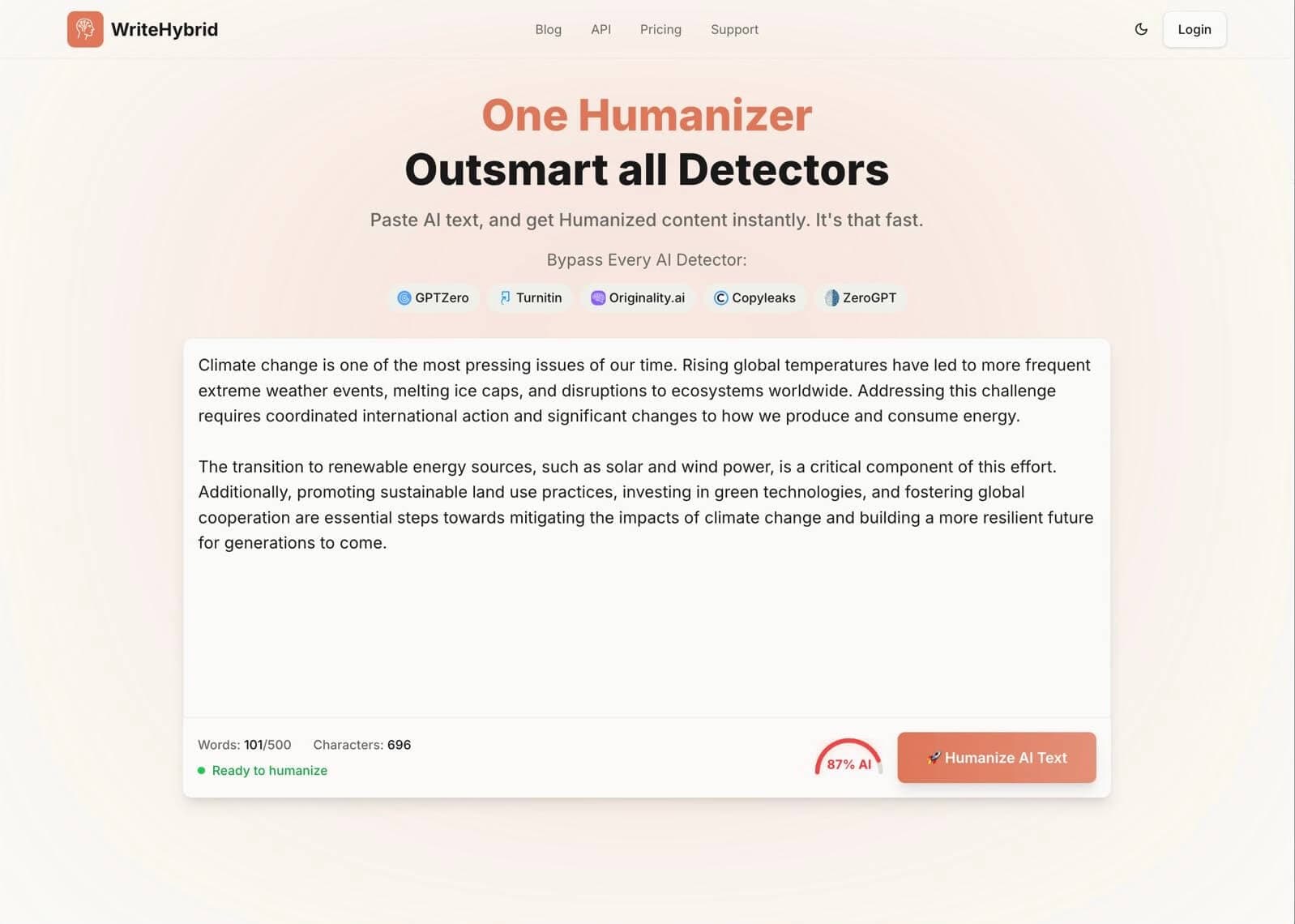
Detectors combine these signals differently. Some expose a single "% AI" score; others highlight sentence-level flags. For deeper reading on the math, see how to humanize AI text.
Why detectors disagree
Each detector was trained on a different dataset and weights the three axes differently. GPTZero leans heavily on burstiness. Originality.ai leans on n-gram fingerprints. Winston rewards stylistic irregularity. Turnitin's own classifier is among the strictest on academic register.
The practical upshot is that the same passage can read as clearly AI on one detector and clean on another. Knowing which detector your reader will use matters as much as how you edit — there is no universal "clean" score, only the result on the specific checker that will see your work.
Methods that consistently help
The interventions that map directly onto what detectors measure are:
- Sentence-length variation: alternate short and long sentences deliberately; aim for a wider range than the model-default 14–22-word band.
- First-person specifics: a single concrete anecdote the model could not have generated breaks the n-gram fingerprint dramatically.
- Register matching: academic mode for academic input, marketing for marketing. Casualizing an essay is a worse failure than the original AI flag.
- Avoid Latinate substitution: replacing "use" with "utilize" leans into exactly the patterns detectors trained on academic English flag.
Tool-based humanizers automate the burstiness and predictability edits at passage scale. Careful manual editing tends to win on the strictest detectors when you have time; tools close most of the gap when you don't. Neither is a guarantee, which is why the testing step below matters.
Try WriteHybrid free
500 humanized words every month, no credit card. Earn more through referrals.
What doesn't work (despite the marketing)
Three popular "tricks" generally don't hold up:
- Inserting hidden characters or zero-width spaces. Modern detectors normalize these out and increasingly flag manipulated text.
- Asking the model to "write more like a human." On its own, this changes very little of the underlying predictability profile.
- Routing through Google Translate twice. The output is grammatically odd but still detectable; modern detectors handle round-tripped translations.
Marketing claims of "bypass all detectors" or "99% success" should be treated as unverified until you reproduce them on your own content with the detector your reader actually uses.
A testing workflow before you submit
Detectors update over time; a passage that passed earlier may not pass later. Before high-stakes submission:
- Humanize (or manually edit) in the register that matches the assignment.
- Run the output through the detector your institution or client actually uses — not a vendor's built-in dial.
- Read aloud and fix any sentence that sounds unlike you.
- Keep a dated screenshot if you might need to dispute a false positive later.
Treat any general guidance — including this page — as a starting point, never a substitute for testing your specific draft on the detector that will judge it.
Detectors as testing tools, not verdicts
Think of an AI detector the way a baker treats a thermometer — useful for testing, not for judging whether an argument is correct. They are imperfect and produce false positives on genuine human writing, especially from non-native English speakers.
We explain how detectors behave so writers can understand and respond to them honestly — including writers whose own work is wrongly flagged. We do not encourage academic dishonesty; the point is to demystify a class of tools that increasingly sits between writers and their readers.