How AI Detectors Work (2026): Signals, Limits, and What Humanizers Change
AI detectors score statistical patterns, not authorship. Understanding perplexity, burstiness, and classifiers explains why humanizers help sometimes and fail other times.
Disclosure. I'm Huzefa Abbasi, founder of WriteHybrid, an AI humanizer, and I keep my editorial standards public because I have an obvious stake in this topic. This guide explains detector behavior from the mechanics vendors describe and from hands-on use, it is editorial, not a controlled lab study. Whether any passage flags depends on the exact text and the specific detector (and version) your reader runs, so treat every "bypass" claim, including mine, as something to verify on your own draft.
AI detectors do not read your intent, check a database of known essays, or know who sat at the keyboard. They score statistical patterns in the text itself: how predictable your word choices are, how much your sentence length varies, and whether a trained classifier recognizes features it learned from large piles of labeled AI and human writing. Humanizers exist to change those patterns deliberately. That is the entire reason a detector result is a probability rather than a verdict, and why a paragraph can read perfectly to you and still come back flagged.
This guide explains the machinery without the vendor mysticism, so you can interpret a score instead of panicking at one. We will work through what a detector actually measures, how it converts those measurements into a number, where the major detectors differ, what humanizers genuinely change under the hood, and, most importantly, the honest limits that mean no tool can hand you a guarantee.
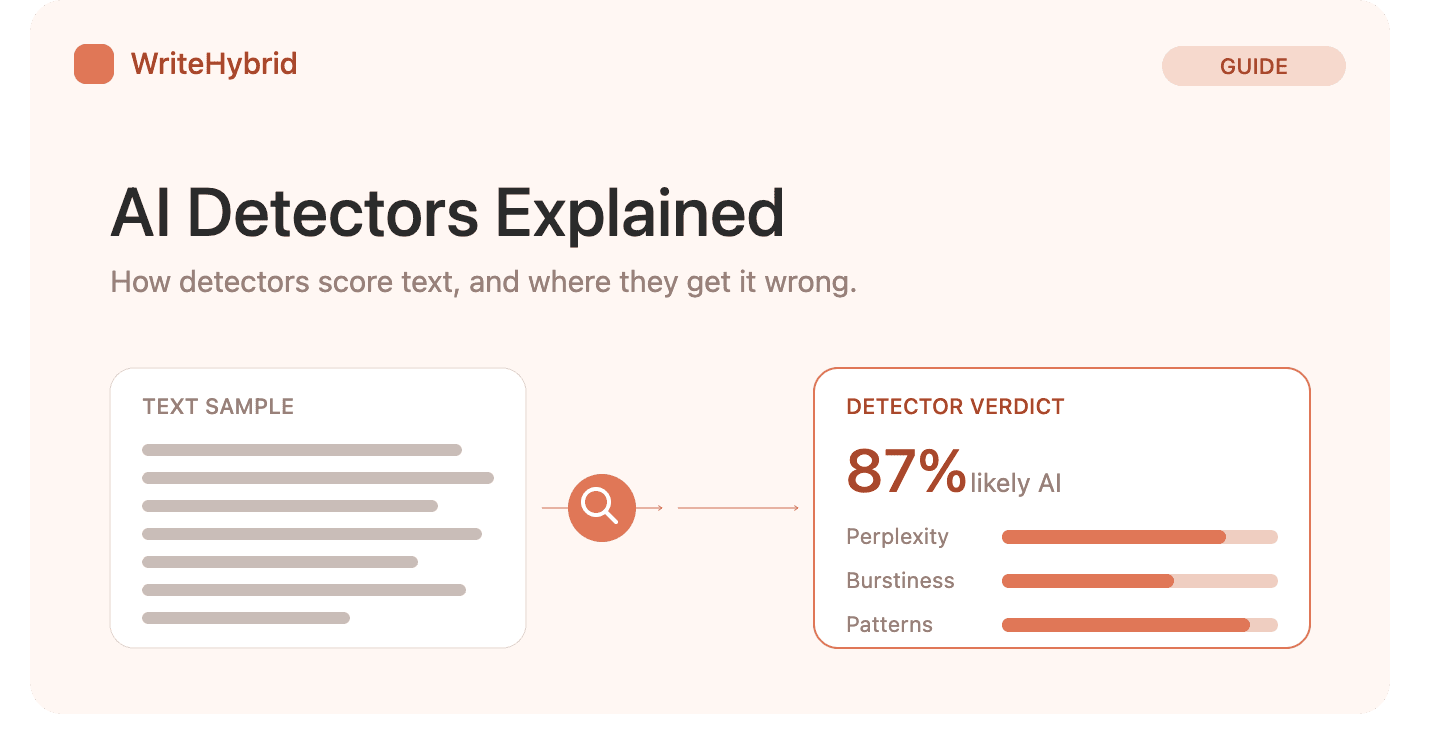
What an AI detector actually measures
Start with what a detector is not. It is not a plagiarism checker comparing your text to a corpus of existing documents (that is a separate product, even inside tools that bundle both). It is not an authorship oracle. It is a statistical classifier that takes your text, extracts a set of numerical features from it, and estimates the likelihood that text with those features was machine-generated.
The intuition is simple once you see it. Large language models are trained to predict the most plausible next word given everything before it. When they generate, they tend to choose high-probability, "safe" continuations. Across a few hundred words, that habit leaves a measurable fingerprint: the prose is unusually smooth, unusually even, and unusually fond of certain phrasings. Detectors are built to notice exactly that smoothness. Human writing, by contrast, is lumpier, we contradict ourselves, drop a three-word sentence, chase a tangent, and reach for an odd word because it is the one we happened to think of.
So the real question a detector asks is: does this text look like it was optimized for plausibility, or like it was produced by a messy human mind? Everything below is just different ways of measuring that.
The three signal families
Almost every consumer detector is some weighted blend of three signal families, sometimes with a fourth stylometric layer on top. Understanding each one tells you precisely why an edit helps or fails.
Signal 1, Perplexity
Perplexity measures how surprised a reference language model is by your sequence of words. If each next word is highly predictable given the previous ones, perplexity is low, and low perplexity is the statistical signature of machine prose, because that predictability is exactly what the model was optimizing for. Instruction-tuned models lean on high-probability tokens: "utilize" instead of "use," "furthermore" as a connector, "comprehensive" as a default adjective, "it is important to note" as a throat-clear.
Skilled editors and good humanizers raise perplexity by swapping predictable phrasing for less common but still grammatical choices. The trap is that random synonym substitution also raises perplexity, while quietly wrecking meaning. That is why perplexity alone is gameable, and why reading the output matters as much as watching the number. The honest, reader-facing fix is plain verbs, specific nouns, and deleting the signature phrases catalogued in the make AI writing sound human guide.
Signal 2, Burstiness
Burstiness captures how much sentence length and structure vary across a document. Human writers naturally mix fragments with long, multi-clause sentences; AI drafts often flatline in a narrow band, say, a uniform 14 to 22 words per sentence with very little variation. Burstiness was one of the earliest signals GPTZero discussed publicly, and it still matters even now that classifiers dominate, because uniform rhythm remains rare in genuine human drafts.
The practical move is to deliberately vary sentence length while rewriting, the same manual technique described in the humanize AI text guide. One caution: forcing variation without changing the underlying content can read choppy, so an editorial read-aloud is the cheapest way to catch a rhythm that improved the metric but hurt the prose. Burstiness is the single signal you can most reliably move by hand, which is why it is the first thing manual editing targets.
Signal 3, Supervised classifiers
Beyond perplexity and burstiness, the major detectors train binary classifiers on feature vectors pulled from text: n-gram frequencies, syntactic patterns, embedding distances to known AI corpora, token-probability distributions, and proprietary signals vendors do not fully disclose. These classifiers are the heaviest-weighted component in most modern tools, and they are retrained as vendors collect fresh ChatGPT, Claude, and Gemini output. That retraining is why a phrasing that slipped past a detector one month can partially fail the next without anything changing on your end, the model under the hood quietly moved.
Classifiers are also why detectors disagree with one another so routinely. Each vendor trains on a different mix of data with different labeling choices, so it is entirely normal for one tool to flag a passage another clears. Treat that disagreement as information, not noise: it is direct evidence that "AI-ness" is a judgment call, not a measured fact.
Signal 4, Stylometry and metadata
A quieter fourth layer matters in academic and enterprise settings. Stylometric features look at punctuation habits, function-word ratios, paragraph structure, and consistency of voice across a document, the kind of fingerprint forensic linguists use. Some institutional tools also weigh metadata they can see (paste timing, document version history in an LMS, copy-paste signatures) that consumer web detectors never touch. You cannot edit your way out of metadata signals with phrasing alone, which is one reason a consumer score never fully predicts an institutional result.
How a detector turns signals into a score
The features above get combined, usually by the classifier, into a single probability between 0 and 1, which the interface then dresses up as "98% AI," a colored meter, or a sentence-by-sentence highlight. Three things about that final number are worth internalizing.
First, it is a probability, not a percentage of your text that is AI. "98% likely AI-generated" does not mean 98% of your sentences are machine-written; it means the model is highly confident about the whole passage. Second, vendors pick a threshold above which they call something AI, and that threshold is a business decision balancing false positives against false negatives, it is not a law of nature. A tool tuned to rarely accuse innocent writers will miss more humanized text, and vice versa. Third, shorter samples are noisier: most detectors are far less reliable under roughly 150–300 words, because there simply are not enough sentences to measure burstiness or stabilize the classifier.
The takeaway is that two detectors can read the same paragraph and land on "12% AI" and "high probability AI" not because one is broken, but because they weigh the signals differently and drew their thresholds in different places.
How the major detectors differ
Vendors emphasize different signals, which is the practical reason results vary. The table below describes emphasis, not scores, and not a ranking. Weighting changes between releases.
| Detector | What it tends to emphasize | Where it shows up most |
|---|---|---|
| GPTZero | Burstiness plus a classifier; sentence-level highlighting | Students, journalists, general web |
| Originality.ai | Classifier and paraphrase-pattern signals | SEO and publishing teams |
| Copyleaks | Multi-signal ensemble, multilingual | Enterprise and LMS integrations |
| Winston | Strict classifier, frequent model updates | Mixed academic and business use |
| Turnitin (AI indicator) | Academic register plus a classifier, tuned on student writing | Universities, inside the LMS |
Why GPTZero and Turnitin disagree so often
GPTZero is a consumer-facing tool tuned on broad web text; Turnitin's indicator is tuned specifically on student submissions and lives inside a learning-management system that can chunk and score a document differently from a free web paste. The same essay can therefore produce two genuinely different results. This is not either tool malfunctioning, they are answering slightly different questions on slightly different inputs, which is exactly why a clean GPTZero check is reassuring but never a guarantee about your school's deployment.
Why Originality.ai and Copyleaks behave like publishing tools
Originality.ai and Copyleaks were built for teams shipping content at scale, so they lean harder on paraphrase-pattern and ensemble signals designed to catch lightly-spun or machine-paraphrased text. If your work is web content reviewed by an SEO or compliance team, these are the surfaces most likely to matter, and the ones where pasting raw, lightly-edited model output tends to do worst.
What humanizers actually change under the hood
Humanizers are not magic and they are not encryption. They are rewrite pipelines tuned to shift the signals above: raising perplexity with uncommon-but-grammatical word choices, increasing burstiness through sentence-length variation, and disrupting the phrase patterns classifiers associate with AI output. The good ones try hard to preserve meaning while doing it; the weak ones produce synonym soup that may fool one detector while failing another and mangling your argument in the process.
There is always a trade-off, and pretending otherwise is the dishonest part of this industry. Aggressive rewriting can introduce minor grammar slips and pull the output slightly away from your source meaning. That is acceptable when the facts and argument survive intact, and unacceptable when a number, citation, or claim quietly changes. The discipline that separates a usable humanizer pass from a liability is simple: always read the result, check multiple detectors, and never let a green badge override your own judgment about whether the text still says what you meant. For the full hands-on method, see how to humanize AI text; for tools you can verify yourself, see bypass AI detection.
False positives and false negatives
A false positive is human text flagged as AI. Common triggers include formal ESL academic prose, highly structured legal or technical writing, heavily templated business documents, and drafts that picked up ChatGPT-style phrasing during earlier editing. These cases hurt real people, which is why responsible institutions treat a flag as a prompt for review rather than a finding of misconduct.
A false negative is AI or humanized text that reads as human to the detector. This happens most when burstiness and perplexity were genuinely shifted and the classifier has not yet retrained on that particular output style. False negatives are not proof that a tool "works" permanently, they are proof that the detector has not caught up yet.
The implication runs in both directions: a detector score is not proof of guilt or innocence. It is one signal. In any academic-integrity process, a human review should follow any flag, and the writer should be able to show drafts and process. Both GPTZero and Winston shipped model updates in early 2026, so a confident score from last semester carries no authority this one.
A note for ESL and neurodivergent writers
The false-positive problem is not evenly distributed. Several studies and a steady stream of reports describe formal English written by non-native speakers being flagged at higher rates, because the careful, rule-following register that ESL writers often produce looks statistically "smooth" to a classifier. Writers who lean on highly structured prose for clarity can hit the same wall. If that is you, keep your drafts and revision history, a visible development arc is far stronger evidence of authorship than any single score, and it is the kind of evidence honor councils increasingly ask for.
How detection changed after Turnitin's 2025 update
This category is not static, and the clearest recent proof was Turnitin's detector update in late August 2025, which specifically targeted humanizer output patterns. Across the board, by the public accounts of users of nearly every consumer humanizer, results became less consistent overnight. Passages that had reliably read as human started coming back flagged, and tools that had marketed high "bypass" numbers went quiet or revised them.
The mechanism behind that shift is the classifier retraining described above: once a vendor feeds enough examples of a given humanizer's output into the training set, the patterns that tool tends to generate become the new thing to detect. GPTZero, Originality.ai, and Copyleaks each ship their own model revisions on independent timelines, so the August event was simply the most visible instance of a permanent dynamic.
The practical lesson is the one that should reshape how you read every review in this space: a bypass rate you saw quoted anywhere, even "98%", is a snapshot of one moment against one detector version. By the time you paste your own draft, that version has often already been replaced. That is exactly why WriteHybrid no longer publishes a headline bypass percentage and instead points you at the only measurement that reflects today's detector on your actual text: your own verification.
What no detector, or humanizer, can promise
Here is the honest center of the whole topic. Detection outcomes vary enormously by the exact text, its length, its register, and which detector, and which version of it, runs the check. GPTZero, Turnitin, Originality.ai, and Copyleaks each weigh the signals differently and retrain on their own timelines, so no single tool's result generalizes to all of them, and none of them can certify that your draft is "human" in a way the others will honor.
By the same logic, no humanizer can promise a pass. Anyone selling a guaranteed, permanent, 100%-undetectable result is selling against the basic mechanics of how these systems work. What an honest humanizer can offer is a faster, more consistent way to shift the signals in the direction detectors reward, paired with the obligation to verify. What I can tell you from hands-on use, rather than a fabricated number: stripping signature phrases and varying rhythm genuinely moves perplexity and burstiness, and dense, citation-heavy academic prose is where any tool is most likely to leave detectable patterns behind. If your work goes through an institutional checker, the only number that matters is your own, run your real draft through the detector your audience actually uses before you submit anything graded.
How to use detector knowledge in practice
- Identify your audience's detector first. A student LMS (often Turnitin), an SEO client's Originality.ai, an enterprise Copyleaks deployment, or a general GPTZero check, they are not interchangeable, and you should optimize for the one that will actually judge your work.
- Apply craft edits before reaching for a tool. Strip signature phrases and vary rhythm by hand; this moves the signals and makes any humanizer pass cleaner.
- Choose a tool you can test yourself rather than one selling a headline number, compare options in best AI humanizers.
- Verify on the target detector, not the humanizer's bundled score, which is marketing-adjacent.
- Re-verify before each submission, because classifiers update and last month's pass is not this month's.
- Pair every score with a human read for register, citations, and factual drift, the things a probability cannot see.
Choosing a tool you can verify
The single best filter when picking a humanizer is whether you can test it on your own writing before paying. That is the whole reason WriteHybrid offers a recurring free tier of 500 words per month with no card on file, paste a real paragraph, humanize it, and check it on your detector before you commit a cent. Paid plans are deliberately simple: $9/month for 10,000 words on Starter, $19/month for 50,000 words on Pro (which adds API access), with Academic, Marketing, Casual, and Technical modes and a 14-day refund window. Those are verifiable facts you can confirm at checkout. A "bypass percentage" is not, which is why you will not find one here.
If your specific concern is academic submission, the best AI humanizers for students roundup and the essay guide cover the LMS-aware workflow; if you want to understand what a detector check looks like from the other side, the AI detector tool lets you score a passage directly.
Detectors score statistics, not authorship, humanizers shift the odds, never the outcome.
Best for: Anyone who needs to understand why humanization helps sometimes and fails other times, and how to read a detector score honestly.
Pros
- +Three signal families explain most consumer detector behavior
- +Craft edits improve signals independent of any tool
- +Detector-specific tuning is possible once you know your target
- +The underlying mechanics stay stable even as exact scores drift
Cons
- −Vendors partially obscure their classifier features
- −False positives can harm ESL and innocent writers
- −A consumer result is never your institution’s Turnitin
- −Retraining means no permanent pass exists
A quick calibration exercise
Take one paragraph you know you wrote without any AI help and run it through a detector. Note the score, that is your personal baseline for false-positive risk. Many writers are startled to see a non-zero AI probability on fully human text, and that number is genuinely useful context the next time you interpret a post-humanization result. Repeat the exercise with a raw model draft and again after editing, and over a few pieces you will learn which of your habits move the needle most. Track your relative delta rather than the absolute number: absolute scores shift when vendors retrain, but the relative gains from your editing habits stay stable, and stability is the only thing worth optimizing for.
Related reading
- How to humanize AI text
- How to humanize ChatGPT text
- How to make AI writing sound human
- How to humanize an AI essay
Frequently asked questions
Was this page helpful?
Your feedback helps us improve our testing write-ups.