How to Make AI Writing Sound Human (2026): The Craft Guide
AI writing sounds robotic for five predictable reasons. Fix rhythm, voice, specificity, and cadence by hand, then verify on your own detector.
Disclosure. I'm Huzefa Abbasi, founder of the AI humanizer WriteHybrid; my editorial standards are on the record, and so is my bias. This is craft guidance drawn from years of writing and editing, not a controlled lab study. Detector outcomes depend on your exact text and the tool checking it, so verify any result, including mine, on your own draft.
"Sound human" means two different things, and conflating them is why so much advice fails. Readers notice uniform rhythm, empty transitions, and missing specificity, they feel that prose is "off" before they can name why. Detectors like GPTZero and Originality.ai score perplexity, burstiness, and classifier features, related signals, but not identical. Fixing readability usually improves detector scores too, but not always, and rarely all the way. This guide focuses on the craft of human-sounding prose. For tool-driven workflows, cross-read how to humanize AI text; for the patterns unique to ChatGPT, see humanize ChatGPT text.
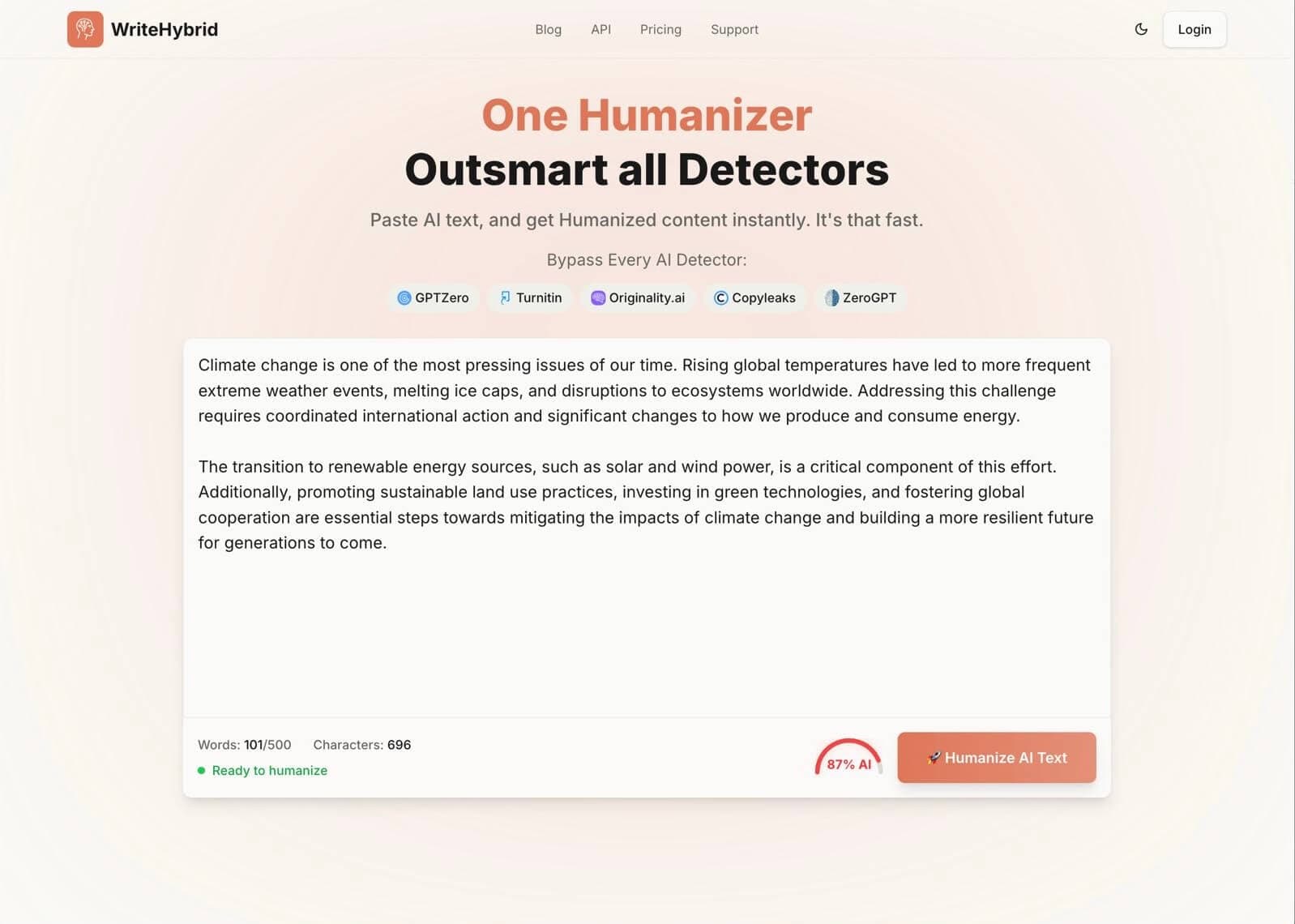
Why AI writing sounds robotic
Language models optimize for plausible continuation, not human messiness. That single fact produces five recurring patterns, and every craft technique below is a direct response to one of them.
Uniform sentence length. Most sentences land in a narrow band. Human writers spike short ("Not really.") and long (a multi-clause argument that keeps qualifying itself) inside the same paragraph.
Predictable word choice. High-probability tokens, "utilize," "comprehensive," "delve", lower perplexity, which detectors flag and readers experience as corporate blandness.
Empty transitions. "Furthermore," "Moreover," and "Additionally" as openers substitute the appearance of structure for actual logical connection.
Missing specificity. The model generalizes because it does not know your meeting yesterday, your lab measurement, or your client's real objection. It writes "many experts believe" because it cannot write "the third reviewer flagged this."
Register flatness. The same even tone whether the subject is grief, GPU architecture, or a product launch. Humans modulate; models hold one note.
Understanding these five explains every technique below, and why synonym spinners fail. They change words, not rhythm, voice, or specificity, so the prose stays robotic in every way that matters.
Craft 1, Rhythm and burstiness
Rhythm is the highest-leverage fix because it is both what readers feel and what detectors weight most. Per paragraph, aim for two or three sentences under ten words, one or two over twenty-five (grammatically clear, not run-ons), and the remainder mixed in between.
Before: "Climate policy requires international cooperation. Governments must align on emission targets. Renewable investment needs to scale quickly. Public support remains essential for long-term success."
After: "Climate policy is not a solo sport. Governments must align on emission targets, and that alignment has failed more often than climate diplomats admit. Renewable investment needs to scale faster than current pledges allow. Without public support, none of it sticks."
Count the words per sentence in the rewrite: six, twenty-two, fourteen, seven. Burstiness increased; the facts did not change. The deeper mechanics of why this works live in how AI detectors work.
Craft 2, Voice and the through-line
Voice is the thing AI cannot fake and the thing readers trust most. It is the consistent way you explain ideas: whether you favor analogy or example, whether you concede objections early or late, whether you are dry or warm. AI prose has no through-line because it has no point of view, it averages every plausible voice into none.
To build voice, pick a stance and hold it across the piece. Decide whether you are skeptical or enthusiastic about the subject and let that color word choice and what you choose to emphasize. Use the same one or two recurring analogies a real writer would return to. Concede the strongest counter-argument in your own words rather than hedging vaguely. A consistent voice is, counterintuitively, less statistically average than flawless neutral prose, which is why it reads human to people and often to classifiers at the same time.
Craft 3, Specificity and concrete detail
Insert one concrete detail per paragraph the model could not have invented: a date or duration, a proper noun from your context, a number from your notes, or a limitation you actually believe. AI over-indexes on universal claims; humans qualify from experience ("when we tested this with forty users last month, the quiet ones gave the sharpest feedback"). This single move improves reader trust more than any metric, and because specifics are statistically less predictable, it tends to raise perplexity in the direction classifiers reward too. Specificity is where craft and detection goals align most cleanly.
Craft 4, Word choice, plain over Latinate
Default AI favors Latinate verbs; plain Germanic equivalents sound more spoken and are less predictable in everyday contexts.
| AI default | Human swap |
|---|---|
| utilize | use |
| demonstrate | show |
| ascertain | find out |
| facilitate | help / enable |
| implement | run / apply |
| commence | start |
| endeavor | try |
The exception is formal academic register, which sometimes needs Latinate precision ("hypothesize" rather than "guess"). Keep discipline-standard terms, do not casualize "randomized controlled trial" into "a test." For essays, pair this with the register audit in humanize an AI essay.
Craft 5, Cadence and sentence openings
After length variation, the next-most-robotic feature is repeated sentence openings. AI starts consecutive sentences the same way, "The," "This," "It is", far more than humans do. Read your draft scanning only the first two words of each sentence; if a pattern repeats, rewrite to break it. Mix a question in occasionally, open with a subordinate clause once a paragraph, and let one sentence start mid-thought with "And" or "But." Cadence is the difference between prose that scans as composed-by-formula and prose that scans as thought-through.
When voice and detectors conflict
Readers prefer a consistent voice, a through-line in how you explain ideas. Detectors prefer statistical surprise. Sometimes the human-sounding choice (keeping a structural tic that is genuinely yours) nudges a score slightly higher. A simple decision rule resolves most of these conflicts: for creative nonfiction, op-eds, and personal statements, prioritize voice and accept the manual verification burden; for bulk SEO content, prioritize throughput and your detector column; for graded academic work, prioritize policy compliance first, register second, and detectors third.
When sounding human conflicts with sounding authoritative, methods sections, citation-dense paragraphs, do not casualize discipline conventions just to chase a score. Front-load human rhythm in abstracts and introductions where readers form trust, and keep formal sections formal while still varying sentence openings. The conflict is real, but it is almost always resolvable by deciding which audience matters most for that specific passage.
Adding a humanizer when craft isn't enough
Manual craft gets you a long way on readability, but for high-volume or high-strictness work a humanizer automates burstiness and perplexity shifts faster than you can by hand. Apply it after the craft steps, tools work better on partially cleaned input, and read the output for meaning drift, patching any sentence where the specificity you added got removed. WriteHybrid offers Academic, Marketing, Casual, and Technical modes and a recurring 500-words-per-month free tier so you can test it on a real paragraph; paid plans are $9/month for 10,000 words and $19/month for 50,000 (with API), with a 14-day refund. For a wider field, see best AI humanizers, and for the tool walkthrough, bypass AI detection.
A five-minute read-aloud protocol
Read the whole draft once without stopping and mark stumble lines. On a second pass, fix only the stumble paragraphs before any tool. After a humanizer pass, confirm the old stumbles are gone without new ones appearing, the common culprits are ambiguous pronouns from swapped nouns, missing transition logic, and comma splices from over-aggressive rhythm edits. Reading in a different font, or from an exported PDF, slows you down just enough to notice AI-shaped sentences your eyes skim in the editor. This is the cheapest quality check in writing and the one most people skip.
How detection changed in late 2025
Craft techniques are durable because they target why AI prose reads flat, but the detectors judging that prose keep moving. Turnitin's late-August 2025 update targeted humanizer patterns specifically, and results across the category became less consistent, which, perversely, raised the value of genuine craft. When tools alone became less reliable, the writers who had also varied their rhythm, built a real voice, and added specifics were the ones whose work held up. GPTZero, Originality.ai, and Copyleaks all iterate too, so think of craft as the part that compounds while tool-only tricks decay.
What no tool can promise
Sounding human to you is not the same as passing, and no tool can close that gap with a guarantee. GPTZero, Turnitin, Originality.ai, and Copyleaks each weigh perplexity, burstiness, and classifier features differently and retrain on their own schedules, so a result on one does not transfer, and today's result does not hold next month. Your prose can read naturally and still flag if perplexity stays low in a way a classifier catches; conversely, an awkward humanizer pass can clear a detector and read terribly. The honest position is to optimize for both readers and detectors, then verify your real draft on the specific detector your audience runs.
Measure your own before and after
Pick one paragraph. Run a detector on the raw AI version and note the score. Apply the craft steps and note it again. Add a humanizer and note it a third time. Over a few pieces you learn which steps buy the most improvement per minute for your writing, which matters far more than anyone's average. Track your relative delta rather than the absolute number, absolute scores shift when vendors retrain, but the relative gains from your habits stay stable, and stability is the only thing worth building a routine around. You can run those checks with the AI detector directly.
Common mistakes
- Synonym spinning only, changes words, not rhythm or voice; paraphrase patterns get flagged anyway.
- Trusting "100% undetectable", no tool can promise that against every detector.
- Skipping read-aloud, your ear catches meaning drift your eye and the detector both miss.
- Over-casualizing academic work, sounds "human" to a social feed, fails academic register checks.
- One-and-done editing, detectors update; last month's pass is not this month's.
Sound human to readers with rhythm, voice, and detail; clear detectors with craft plus a tool you can test, rarely one alone.
Best for: Writers who want prose that reads well and scores acceptably on third-party detectors.
Pros
- +Craft steps improve readability independent of any tool
- +Rhythm, voice, and specificity help readers and classifiers together
- +A free tier lets you test a tool on your own text
- +A verification step catches silent detector updates
Cons
- −Manual craft alone may not suffice for strict LMS paths
- −Humanizers can remove your specific details, re-check
- −No permanent detector pass exists
- −Academic register limits how far casual swaps can go
Related reading
- How to humanize AI text
- How to humanize ChatGPT text
- How to humanize an AI essay
- How AI detectors work
Frequently asked questions
Was this page helpful?
Your feedback helps us improve our testing write-ups.