StealthWriter Review (2026): The Variant Model, Billing Risks, and Who It's For

Independent review
StealthWriter
A variant-based humanizer that generates several rewrites per input so you can shop for the cleanest one, promising in concept, but weighed down by a small cap and one of the worst billing-and-support reputations in the category.
Disclosure. I'm Huzefa Abbasi, the founder of WriteHybrid, which competes with StealthWriter, so factor in my bias. This review draws on hands-on use, StealthWriter's public pricing as verified in June 2026, and a broad read of public customer reviews; it is not a controlled benchmark. Detection turns on your exact text and the specific checker you face, so treat any "bypass every detector" promise, StealthWriter's or mine, as a claim to confirm on your own draft rather than a guarantee.
What StealthWriter is, and who it's for
StealthWriter is built around a single distinctive idea: instead of returning one rewrite, it generates several. The interface is organised into three tabs, Ninja, Ghost, and Stealth, each producing a different version of the same input. Despite the evocative names, these function as escalating aggression settings rather than genuinely separate models: gentler at one end, more heavily rewritten at the other. The design bet is that you'll generate all three and keep whichever reads best or clears your checker.
That's a legitimately different approach, and a certain kind of writer will enjoy the control. The catch is who it suits. If you work in short bursts, like comparing options, and will protect yourself on billing, the variant model can be a strength. If you write long documents, want a confident single answer, or have ever been stung by a sticky subscription, the combination of a tiny input cap and a genuinely troubling billing reputation should give you serious pause.
A distinctive variant-shopping humanizer with a real idea at its core, undermined by a small cap, an aggressive variant that reorders academic prose, and one of the weakest billing-and-support reputations in the category.
Best for: Writers working on short passages who genuinely enjoy generating and comparing variants, will verify detection themselves, and will guard their billing with monthly plans and a virtual card.
Pros
- +Generates multiple variants per input so you can pick the cleanest read
- +Clean, fast variant interface with a low learning curve
- +More positive sentiment from the technical crowd (ProductHunt ~4.1)
- +Competitive per-word rate on the higher tier
Cons
- −Serious billing complaints: charges after cancellation, card-deletion refusals, double charges
- −Three-day refund window, tightening once a subscription is used
- −Small ~5,000-character cap breaks continuity on long essays
- −The Ghost variant over-edits, forced synonyms and clause reordering
Key features that actually matter
The variant concept is the headline, but the day-to-day is shaped by the cap, the editing behaviour, and, unavoidably, the billing. Here's the breakdown.
The variant model and tone control
Ninja, Ghost, and Stealth correspond to increasing rewrite intensity. The gentler tab preserves structure but changes less; the more aggressive tabs move clauses around and swap vocabulary harder. In practice I found Ghost the most heavy-handed, it inverts clause order and reaches for showy synonyms, which is exactly the behaviour reviewers complain about (one memorably described an essay where "because" became "owing to the fact that," which reads like an AI trying to sound clever). For casual content that's tolerable; for argument-driven academic prose, the reordering can weaken the very logic you're trying to protect. The upside is you can pick a cleaner variant; the downside is that picking is work, repeated on every chunk of a long piece.
Input limits and continuity
The editor caps pasted input at roughly 5,000 characters, about 770 words, one of the smallest ceilings in the category. A typical 1,500-word essay therefore has to be split, humanized in pieces, and reassembled, and because the variants don't apply an identical transformation across chunks, the seams are often visible. Keeping a consistent voice across a full document is the single biggest friction here, and it compounds the variant-comparison workload.
Free tier and trial
The free access is a one-time trial of around 250 words, gone in a paragraph or two, and not enough to evaluate output on real writing. There's no recurring free allowance, so beyond that taster you're choosing between paying and walking away. Given the billing reputation below, I'd be especially wary of handing over card details just to extend a trial.
API, extensions, and integrations
There's no public API and no browser extension or word-processor add-in. StealthWriter is a website you visit, paste into, generate variants in, and copy out of. For anyone wanting to integrate humanizing into a workflow, that's a hard limit; for a casual single-document user it won't matter.
Support and billing experience
This is the section that most shapes my verdict, and it's covered in full below. In short: support is widely described as unresponsive, and the billing complaints are not the usual grumbles about price, they're reports of charges continuing after cancellation, refusals to delete stored card details, and duplicate charges. Combined with a three-day refund window that tightens once you've used the service, this is the area where StealthWriter's risk is highest and where you should take the most precautions.
Hands-on: what the output actually looks like
Used on short passages, the variant interface is quick and the gentler tab produces reasonable, readable rewrites. The trouble starts when you lean on the aggressive variants or work at length: Ghost's clause reordering and synonym-swapping can read as over-edited, and the split-and-stitch tax on longer pieces makes consistency hard. Treat the output as raw material to compare and clean up, not a finished draft.
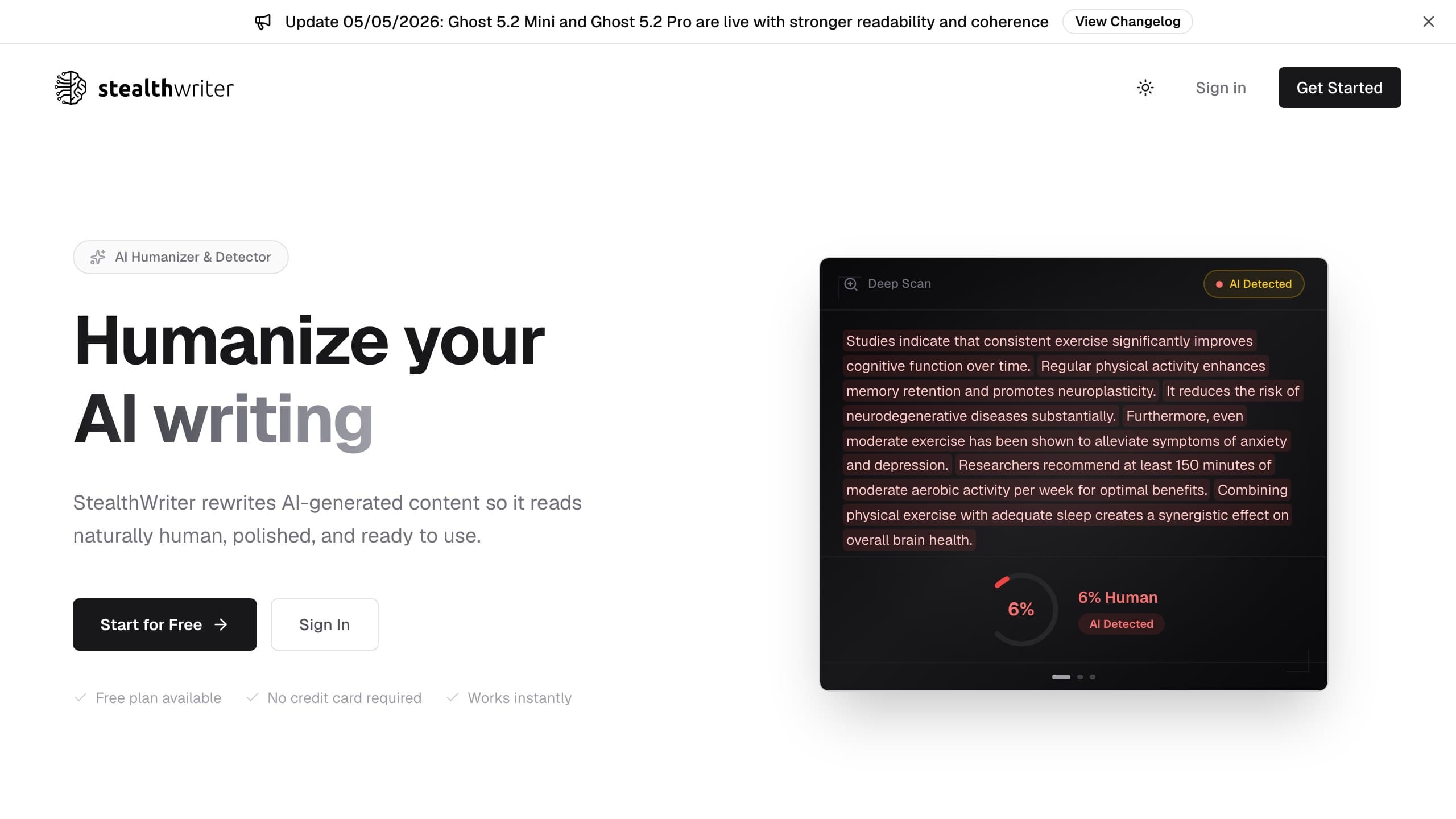
The sample below illustrates the style of the Ghost variant on an academic passage. It's a register illustration, not a detection claim, it says nothing about whether this text would clear any specific checker:
Pricing (verified June 2026)
I checked StealthWriter against its live checkout in June 2026. The monthly/annual toggle changes the headline numbers, and, given the refund terms, the annual decision deserves extra scrutiny, so confirm everything at checkout before subscribing.

| Plan | StealthWriter | WriteHybrid |
|---|---|---|
| Free | 250 words, one-time (lifetime) | 500 words/month, recurring, no card |
| Entry paid | $19/mo, 30,000 words (Pro) | $9/mo, 10,000 words (Starter) |
| Higher tier | $39/mo, 100,000 words (Premium) | $19/mo, 50,000 words (Pro, + API) |
| Input cap | ~5,000 characters per pass | Long drafts in one pass |
| API | No | Yes, on $19/mo Pro |
| Refund | 3 days, no prorated refunds on annual; tightens once used | 14 days |
On the math: StealthWriter Pro is about $0.0006 per word ($19 ÷ 30,000) and Premium about $0.0004 ($39 ÷ 100,000), so the per-word rate is competitive on paper, the higher tier in particular. But per-word value means little if you can't safely cancel: the three-day refund window is the shortest I audited, annual plans aren't prorated, and reviewers report eligibility evaporating once you've used a meaningful share of your allowance. WriteHybrid Starter is about $0.0009 per word ($9 ÷ 10,000) on a no-lock-in monthly plan with a 14-day refund and a recurring 500-word monthly free tier (roughly 6,000 words a year for testing). StealthWriter can win the spreadsheet on rate and lose badly on risk, weight the refund terms accordingly.
How to use StealthWriter for the best results
If you do use it, the variant model rewards a disciplined routine, and the billing reputation demands a few defensive habits:
- Protect your billing first. Prefer monthly billing and consider a virtual or single-use card, given the documented charge-after-cancellation reports. Note your renewal date.
- Split long drafts at natural breaks. With a ~5,000-character cap, cut at section boundaries rather than mid-argument so the stitched result reads coherently.
- Generate all three variants, then read, don't skim. Compare Ninja, Ghost, and Stealth on each chunk and pick the cleanest, usually a gentler tab on academic work.
- Repair the over-edits. Watch for forced synonyms and reordered clauses, especially from Ghost, and restore your original phrasing where it read better.
- Verify on the checker that grades you. Run your chosen variant through the specific detector your audience uses; the variant model explicitly puts that testing on you, so don't skip it.
What real users say about StealthWriter
I read across StealthWriter's Trustpilot, ProductHunt, and Reddit footprint to check my impressions against a wider sample, and the picture is sobering. At the time of writing, StealthWriter sits at roughly 2.1–2.8 stars on Trustpilot across a small review count (a few dozen), with the large majority of those reviews being one-star. ProductHunt is notably kinder at around 4.1, which suggests the more technical, careful crowd has a smoother experience than the general user base, a gap worth keeping in mind.
The limited praise is genuine but thin:
- The variant interface is fast and convenient for quick rewrites.
- Some users are simply satisfied with the output on casual content.
The complaints, though, are unusually serious and repeat across different reviewers:
- Charges after cancellation: multiple people report being billed again after cancelling, and being unable to get stored card details deleted.
- Duplicate and surprise charges: reports of cards charged more than once in a month, with no resolution.
- Absent support: the in-app chat and email are widely described as going unanswered for weeks, with refunds refused.
- Reliability and over-editing: scattered reports of downtime, paid accounts treated as free, and the aggressive variant producing forced, "trying-too-hard" phrasing.
I want to be fair: StealthWriter is a functioning product, not a phantom, and some users are content. But the volume and consistency of billing-and-support complaints is high enough that I'd treat it as a real risk, not background noise. If you proceed, do so monthly, with a card you can lock, and watch your statement closely.
Why the detector landscape makes this harder to pin down
This category stopped standing still in 2025. Turnitin's late-August 2025 detector update specifically targeted humanizer-style output, and results across the board became less predictable afterwards. GPTZero, Originality.ai, and Copyleaks keep revising their models independently, and independent testers have reported StealthWriter output still flagged as partially AI by Originality.ai and GPTZero in some runs.
That's the heart of why no honest review should hand you a pass-rate number. Any figure, including the high ones in StealthWriter's marketing, is a snapshot against one detector version at one moment, and the variant model multiplies the uncertainty because each tab produces different text. By the time you paste your own draft, the detector may have moved. The only reliable measurement is your own check, which is exactly why WriteHybrid stopped publishing headline bypass percentages.
Detection: what we can and can't tell you
Plainly: StealthWriter markets bypass across Turnitin, GPTZero, and Originality.ai, but outcomes vary enormously with the exact text, its length, the variant you pick, and which detector, and version, runs the scan. Neither I nor StealthWriter can promise a result for your draft, and I won't quote pass rates I can't defend.
The StealthWriter-specific point is that the product expects you to do the testing, generating variants and checking them yourself is the workflow, not an optional extra. So paste your real draft (split to fit the cap), humanize it across all three tabs, and run each candidate through the checker your audience actually uses before submitting anything graded. Then reread the winning variant for the clause reordering and forced synonyms the aggressive tabs introduce, especially in conclusions.
Who should use StealthWriter, and who should skip it
Consider StealthWriter only if you:
- Genuinely enjoy generating and comparing variants rather than accepting one output.
- Work in short passages that fit the ~5,000-character cap.
- Will guard your billing with monthly plans and a lockable card, and verify detection yourself.
Skip it if you:
- Write long essays and don't want the split-and-stitch tax or the inconsistent seams.
- Want a confident single output without the comparison workload.
- Value a forgiving refund and responsive support, both are weak points here, or are billing-sensitive.
How to get the most natural output
Whichever tool you use, these habits do more for naturalness than any feature:
- Edit after the rewrite. Trimming a forced synonym or restoring a clearer clause beats re-generating variants endlessly.
- Own your intro and conclusion. Write or heavily edit the sections a grader reads most closely yourself.
- Keep the tone varied. A perfectly uniform register is itself a tell; let sentence length and rhythm move.
- Check more than one detector. GPTZero, Turnitin, and Originality.ai disagree routinely, so one pass isn't a clean bill of health.
- Read every word before submitting. A broken citation or a synonym the variant mangled is the fastest way to get flagged.
Frequently asked questions
Related reading
Try WriteHybrid on your text
Paste AI-generated copy below. 500 humanized words free every month after signup.
Was this page helpful?
Your feedback helps us improve our testing write-ups.