Undetectable AI Review (2026): Pricing, the Built-In Dial, and Who It's For
Independent review
Undetectable.ai
A mass-market humanizer with a persuasive built-in detector dial, which scores against its own model, not a third party, and a Trustpilot reputation dominated by billing complaints.
Disclosure. I'm Huzefa Abbasi, founder of WriteHybrid, so I have a direct stake in how this lands. Undetectable AI is a competitor I've used hands-on, and everything below comes from that use, from its public pricing as I verified it in June 2026, and from publicly visible customer reviews, not a controlled lab benchmark. Whether any humanizer clears a detector depends on your exact text and the specific checker (and version of it) your institution runs, so treat every "undetectable" promise, mine included, as a claim you verify on your own draft.
What Undetectable AI is, and who it's for
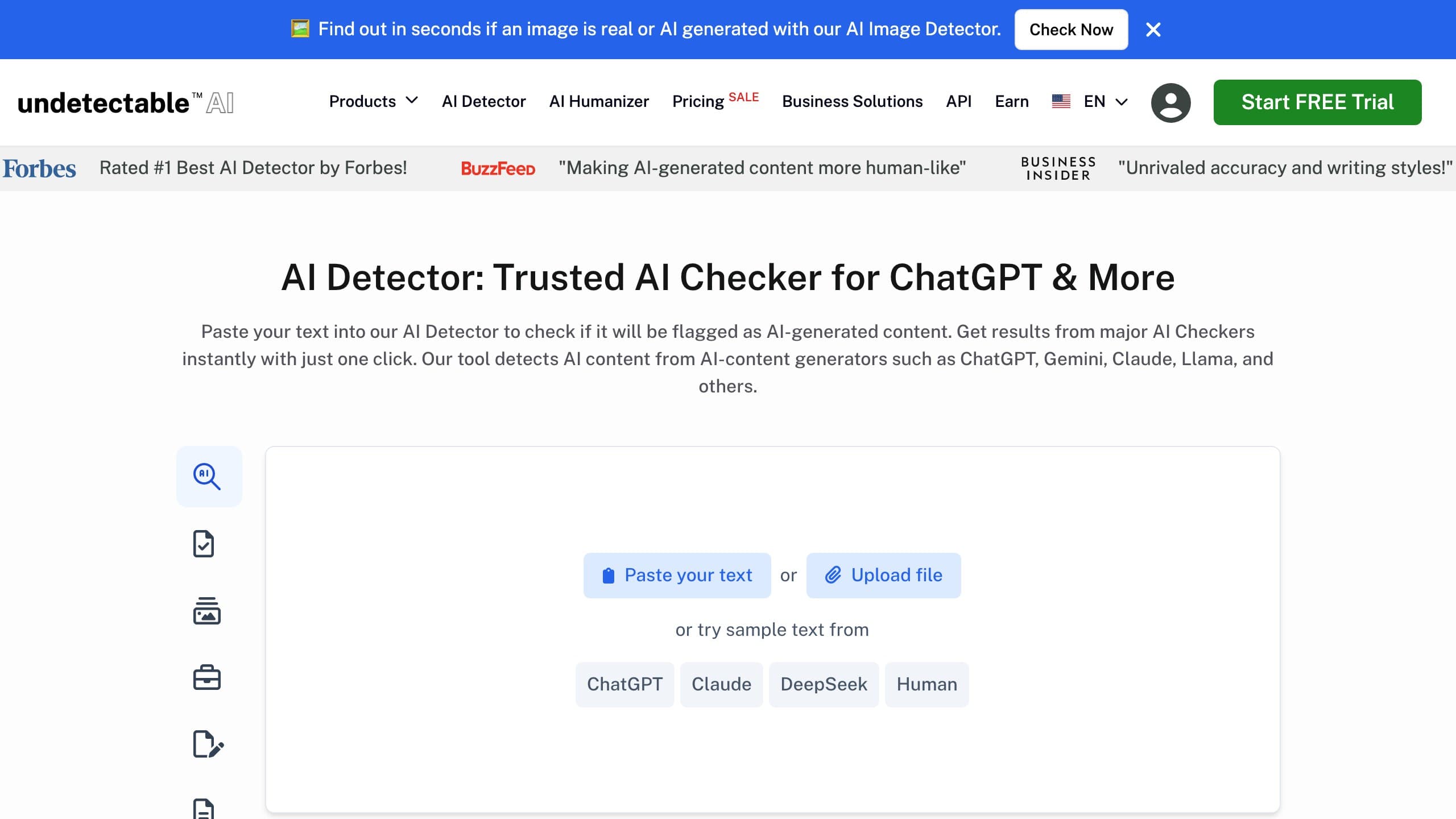
Undetectable AI is one of the most heavily marketed names in the category. It targets students, marketers, freelancers, and content teams with a single promise broadcast in its name: paste AI-generated text, run it, and walk away with something a detector won't flag. The product behind the slogan is genuinely capable, a clean editor, a large input window, readability and purpose presets, and a side-by-side view that lets you compare the original against the rewrite line by line.
The audience it actually fits is a content team or solo writer who runs AI-assisted drafts through a humanizing pass as one step in a larger workflow, and who treats the output as a draft to edit rather than a finished file to submit. If you want a mainstream tool with broad feature coverage and you're disciplined about verifying results elsewhere, it does the job. If you're a student with a single graded essay riding on the outcome, the billing reputation and the self-scoring dial are reasons to slow down before you subscribe.
The feature everyone remembers is the detector dial: a red-to-green meter that animates toward "human" after humanization. It's the centerpiece of the "humanize and check in one loop" pitch, and it's persuasive precisely because it looks like an independent verdict. It isn't. Understanding that distinction is the single most important thing about using this tool well, and it shapes most of the review below.
Key features that actually matter
Marketing copy rarely tells you how a humanizer feels once the novelty wears off. Here are the parts that decide whether you'll keep paying after the first month.
Readability presets and purpose modes
Instead of a handful of named "voices," Undetectable AI splits control across two dimensions. Readability presets set the target reading level, high school, university, journalist, or marketing, and purpose presets nudge the structure toward an essay, an article, or general copy. In practice this gives you more register control than the single-slider tools, and the university preset is the one most students gravitate toward. The catch is that none of these presets is a true "academic" mode in the sense of preserving formal connectives and discipline-specific terminology; they shift readability, not scholarly register, so a dense methods section can come back smoother but looser than a marker expects.
Input and word limits
The editor accepts pasted input up to roughly 15,000 characters, about 2,300 words, which is generous and means most essays and articles fit in a single pass rather than being chopped into chunks you then have to stitch back together. That single-pass capacity is a real advantage for keeping voice consistent across a long document, and it's one of the things the tool does better than the 8,000-character-class competitors. Monthly word allowances are a separate ceiling, covered in pricing below.
Free tier and trial
This is where the evaluation experience falls down. The free trial is 250 words, one-time, and, more limiting than the word count, it previews only a truncated output behind an email capture and a paywall prompt. You paste, click humanize, wait, and then hit a wall before the full rewrite renders. For a product whose entire value proposition is "see the humanized text," being shown a teaser is like test-driving a car around a single parking space. You cannot properly judge the output on your own writing before you've paid, which matters more here than for tools with a usable free allowance.
API, extensions, and integrations
Undetectable AI does offer an API, but it sits at the very top of the ladder on the $209/month Business tier. That's the steepest API gate in this roundup by a wide margin, and it effectively rules the API out for individual writers and small teams. There's no free-tier or mid-tier API access to experiment with, so if programmatic humanizing is part of your plan, budget for the Business plan or look elsewhere. Browser-extension and document-add-in coverage are similarly thin compared with the website experience, which is where the product is clearly designed to be used.
Editor UX and the dial
The editor itself is one of the tool's strengths: paste, choose presets, run, and read the result beside the original. The side-by-side view is genuinely useful for spotting where the rewrite changed meaning rather than just phrasing. The dial dominates the interface, though, and that's a double-edged design choice. It encourages a fast iterate-until-green loop that feels productive, but it quietly trains you to trust a number that isn't measuring what you think it is. I'd use the side-by-side view constantly and the dial sparingly.
Support and billing experience
Support and billing are where the reputation gets complicated, covered in detail in the user-sentiment section below. The structural issue is the combination of auto-renewal, annual-default pricing, and a refund policy that excludes plans where more than about 20% of the words have been used. Each piece is defensible on its own; together they produce the renewal and refund complaints that dominate the tool's public reviews. Read the cancellation terms before you subscribe, and set a calendar reminder ahead of any renewal date.
The editor in practice, and an illustrative rewrite
On marketing and blog copy, the output reads naturally and the readability presets do real work, the marketing preset loosens stiff SaaS phrasing into something closer to how a person actually pitches a product. The friction I hit repeatedly was length: on longer marketing inputs the output ran noticeably over the original, which is a problem when you're writing to a character budget for a meta description, an ad, or a product blurb. On academic input, the smoothing can soften the formal scaffolding a grader looks for, so plan on a manual pass to restore connectives and terminology.
The side-by-side view is the feature I leaned on most, and it's where the tool earns back some of the trust the dial costs it. Reading the rewrite against the original makes it obvious when a paraphrase has quietly altered a claim, a hedged "may contribute to" turned into a flat "causes," a specific figure rounded away, or a citation's surrounding sentence reshaped so the reference no longer reads cleanly. Those are the edits that get a draft flagged for the wrong reason: not AI detection, but a factual or attribution slip introduced by the rewrite itself. If you use Undetectable AI at all, use that view on every paragraph rather than skimming the green dial and copying out.
One more practical note on the presets: switching readability levels mid-document is something I'd avoid. Running the introduction at "university" and the body at "journalist," for instance, produces a register seam that a careful human reader notices even when no detector does. Pick one level for the whole piece, then do your tone variation by hand. It's a small discipline, but it's the kind of thing that separates output that merely passes a checker from output that actually reads like one person wrote it start to finish.
The sample below shows the kind of transformation the marketing preset tends to produce. It illustrates register and style, it is not a pass/fail claim, and it should not be read as one:
Pricing (verified June 2026)
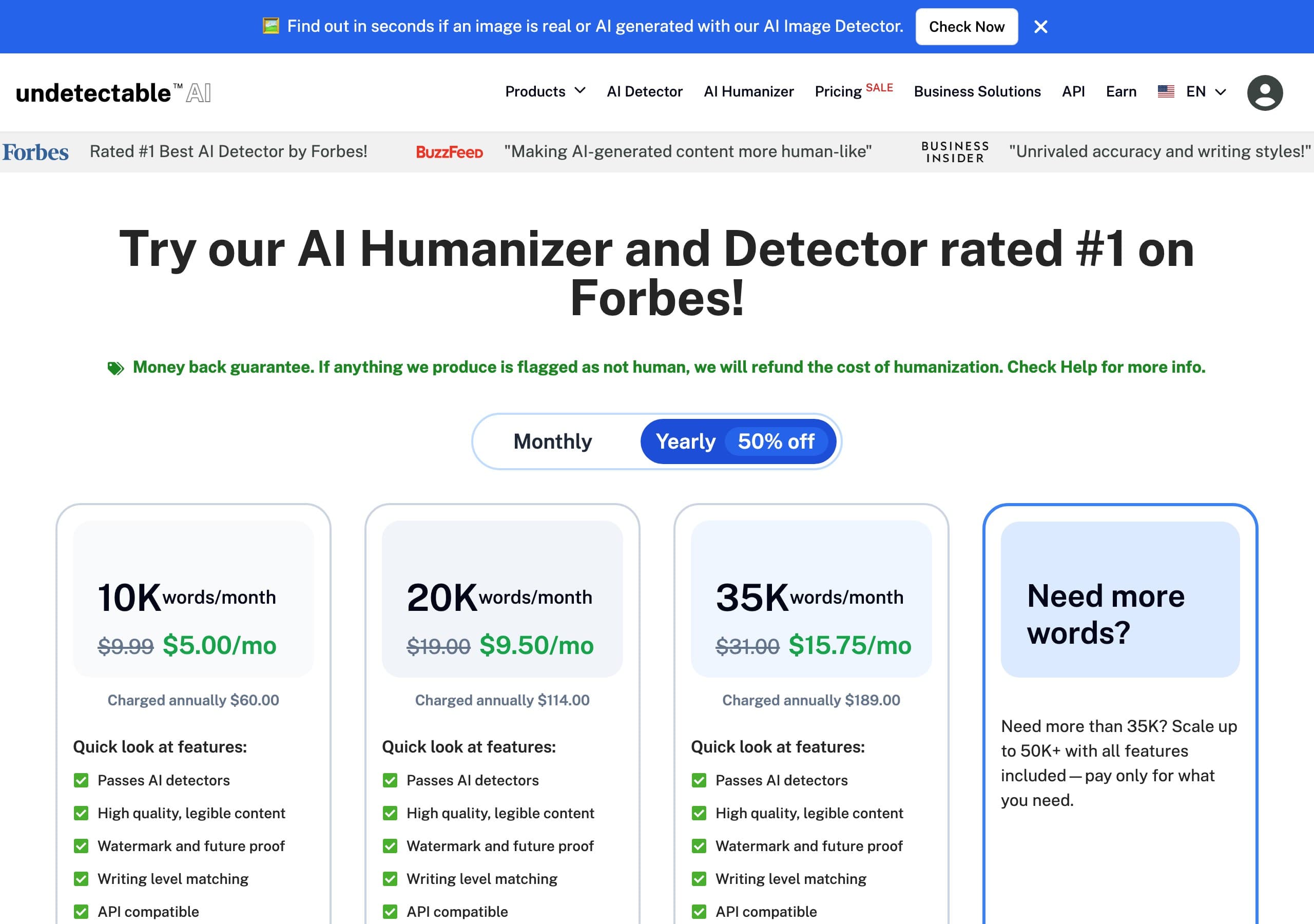
I checked Undetectable AI against its live checkout in June 2026. One quirk to flag up front: the default checkout view shows annual-equivalent monthly pricing, and flipping to the monthly toggle reveals a higher number. Many shoppers anchor on the lower figure without realising it assumes a year up front. Confirm exactly which billing cycle you're agreeing to before you pay.
| Plan | Monthly price | Words | Notable terms |
|---|---|---|---|
| Free trial | $0 | 250 words, one-time (truncated preview) | Email capture; full output paywalled |
| Starter | $14.99 (≈$9.99 annual) | 10,000 words/mo | No API |
| Pro | $29.99 (≈$18.66 annual) | 50,000 words/mo | No API |
| Business | $209 (≈$125 annual) | 380,000 words/mo | API access unlocked here |
| Refund window | 7 days; auto-renews; refund excluded once ~20% of words are used | ||
On the per-word math: Starter works out to about $0.0015 per word ($14.99 ÷ 10,000) at monthly billing, dropping toward $0.001 on the annual rate. Pro is far more efficient at roughly $0.0006 per word ($29.99 ÷ 50,000), and Business lands near $0.00055 per word ($209 ÷ 380,000), cheap per word, but only if you genuinely consume hundreds of thousands of words a month. For comparison, WriteHybrid's Starter is $9 for 10,000 words (about $0.0009 per word), and its Pro is $19 for 50,000 words with API included (about $0.00038 per word), so WriteHybrid is both cheaper to start and includes API four tiers earlier.
Two things to weigh beyond the headline rates. First, the API gate at $209 is genuinely high, so don't subscribe to a cheaper plan expecting to add programmatic access later. Second, the auto-renew-plus-restrictive-refund structure is the mechanical source of most billing complaints, the refund door effectively closes the moment you've used a fifth of your words, which is easy to do while you're still evaluating.
How to use Undetectable AI for the best results
The tool rewards a deliberate workflow far more than a fast iterate-until-green one. Here's the sequence I'd follow:
- Clean the draft before you humanize. Fix structure, facts, and citations first, the humanizer changes phrasing, not the quality of your argument, and feeding it a messy draft just produces messier output.
- Pick the readability preset on purpose. University for coursework, marketing for web copy. Don't leave it on a default that doesn't match where the text is going.
- Use the side-by-side view to police meaning. Read the rewrite against the original and catch any place the tool changed a claim, mangled a quote, or dropped a qualifier.
- Treat the dial as a hint, not a verdict. A green reading tells you the tool's own model is satisfied; it tells you nothing reliable about GPTZero, Turnitin, Originality.ai, or Copyleaks.
- Verify on the detector that actually grades you. Run the final text through the specific checker your institution or client uses, because that is the only result that counts.
- Edit the length back down. If the marketing preset inflated your copy, trim it by hand to fit your character budget before publishing.
What real users say about Undetectable AI
I read through Undetectable AI's public Trustpilot profile and the recurring threads on Reddit (r/ChatGPT, r/SEO, r/artificial) to check my own impressions against a larger sample. The headline number is genuinely hard to pin down: depending on when and which regional Trustpilot profile you open, the score sits anywhere from around 2 stars to roughly 3.5 stars across more than 800 reviews. Several independent reviews through early 2026 cited it near the bottom of the category, while the live profile has more recently shown a higher, "Average"-band score. The wide swing is itself worth knowing about.
What satisfied users tend to praise:
- The tool is capable and fast, with the broadest set of readability and purpose presets in its class.
- Several recent reviewers describe the support team as responsive and helpful once they reach a human.
- For content teams running AI drafts through a quality gate, it does lower detection signals on casual and marketing copy.
The recurring complaints are remarkably consistent, which is why they're worth taking seriously:
- Billing after cancellation. The single most repeated theme is being charged after the user believed they had cancelled, or being auto-renewed without a clear heads-up.
- Accidental upgrades. Multiple reviewers describe a pricing interface that made it easy to trigger a more expensive plan than intended, sometimes more than one subscription at once.
- Refund friction. The refund policy excludes plans where more than about 20% of words have been used, and reviewers describe that threshold as easy to cross before they realised the output wasn't what they needed.
- Inconsistent results between runs. The same passage can read clean one run and flag the next, which is a known trait of paraphraser-class rewriting and a frequent Reddit grievance.
None of this makes Undetectable AI a scam, plenty of people use it productively and the product clearly works. But the complaint pattern is specific and repeated enough that I wouldn't dismiss it as the usual selection bias of online reviews, especially if you're committing to annual billing.
Why the late-2025 detector shift still matters here
This category does not sit still. Turnitin shipped a detector update in late August 2025 that specifically targeted humanizer output patterns, and tools across the board, Undetectable AI among them, per its own users, saw less consistent results afterward. GPTZero, Originality.ai, and Copyleaks all iterate on their own schedules too, sometimes quietly.
The practical consequence is that any "bypass rate" you read in a review, including the impressive ones, is a snapshot of one moment against one detector version. By the time you paste your own essay, the detector may already have moved. That's precisely why a self-scoring dial is risky as a source of truth: it can stay reassuringly green while the third-party checker your school actually runs has tightened underneath it. It's also why WriteHybrid doesn't publish headline bypass percentages and instead points you to test your own draft, which is the only measurement that reflects today's detector on today's text.
Detection: what we can and can't tell you
Here's the honest part. Undetectable AI is built and marketed around beating named detectors, but detection outcomes vary enormously with the exact text, its length, and which detector, and which version of it, runs the check. Neither I nor Undetectable AI can promise a result for your specific draft, and I won't publish pass-rate percentages I can't stand behind.
The one caution I'd underline above all others is the dial. Do not treat the built-in green light as proof of anything. It reflects Undetectable's own scoring model, and that model can and does disagree with the third-party detector your institution actually uses. The dial is fine as a quick A/B signal while you iterate on your own; it is not a substitute for a real check. What I can say from hands-on use is unsurprising: casual and marketing rewrites read naturally, while dense academic passages with preserved citations and terminology are where any humanizer is most likely to leave a detectable fingerprint. Humanize your real draft, then run it through the checker your audience uses before anything is submitted.
Who should use Undetectable AI, and who should skip it
Consider it if you:
- want a mainstream, full-featured editor with genuine readability and purpose control;
- regularly paste long documents and value a single-pass input window and a side-by-side view;
- will ignore the dial and verify on a real third-party detector as a matter of habit;
- consume enough words monthly that the Pro or Business per-word rate works in your favour.
Skip it if you:
- write tight, length-constrained copy that the wordier presets would inflate;
- need API access without climbing to the $209 Business tier;
- want to evaluate properly before paying, the truncated free preview makes that impossible;
- are wary of auto-renew billing and a refund policy that closes early.
How to get the most natural output from any humanizer
Whichever tool you settle on, a few evergreen habits do more for naturalness than re-running the rewrite five times:
- Treat the rewrite as a first pass. A short manual edit, varying sentence length, cutting a repeated transition, beats hammering the humanize button.
- Don't let the tone go perfectly uniform. A flawlessly even register is itself a tell; let some sentences run long and others stay short.
- Keep your own voice in the intro and conclusion. Those are the sections a human reader scrutinises most closely.
- Run the output through more than one detector. GPTZero, Turnitin, Originality.ai, and Copyleaks disagree constantly; clearing one is not clearing all.
- Protect citations and technical terms by hand. Humanizers quietly break quoted material and discipline-specific vocabulary, lock those down after the rewrite, never before.
Frequently asked questions
Related reading
- WriteHybrid vs Undetectable AI
- Undetectable AI alternatives
- Undetectable AI explained
- Our 2026 humanizer ranking
- How to humanize AI text
Tools worth comparing
Try WriteHybrid on your text
Paste AI-generated copy below. 500 humanized words free every month after signup.
Was this page helpful?
Your feedback helps us improve our testing write-ups.