Phrasly Review (2026): Citation Handling, Pricing, and Who It's For

Independent review
Phrasly
An academic-positioned humanizer with the healthiest reputation in the category, credible for clean APA references, shakier on footnote styles, and built around an annual-billing default worth understanding before you pay.
Disclosure. I'm Huzefa Abbasi, founder of WriteHybrid, so I have a clear commercial interest in how this review lands. Phrasly is a competitor I've used hands-on, and everything below is based on that, on its public pricing as verified in June 2026, and on publicly visible customer reviews, not a controlled lab benchmark. Whether any humanizer clears detection depends on your exact text and the specific checker your school or client runs, so treat every vendor's "bypass" marketing (mine included) as a claim you verify on your own draft.
What Phrasly is, and who it's for
Phrasly is the most credibly academic-positioned tool in this review set. Log in and the workspace opens with rewriting front and centre, an AI-detector readout beside it, and a Google-Docs-style "Pages" editor for longer drafts. The marketing speaks fluently about Turnitin, GPTZero, and the realities of coursework, which is a refreshing change from the category's usual "100% undetectable" noise.
The intended user is obvious from the first screen: an undergraduate or graduate student turning a rough AI draft into something that reads in their own register before it goes through an institutional checker. If that's you, Phrasly is built around your workflow more deliberately than most rivals. If you're a marketer, an agency, or anyone who needs to wire humanizing into an automated pipeline, the lack of an API and the per-session word cap will frustrate you quickly, that's not the audience Phrasly is courting.
A genuinely academic-leaning humanizer with the strongest reputation in the category, undercut by a one-time free sample and an annual-billing default that makes the headline price look cheaper than month-to-month reality.
Best for: Students writing in clean APA parenthetical style who want an academic-default editor, will check citations by hand, and are comfortable committing to annual billing.
Pros
- +Best public sentiment here: ~4.4–4.7 Trustpilot stars across 2,300+ reviews
- +Clean, fast editor with rewrite-intensity control and a built-in detector readout
- +Reliable on clean APA parenthetical references
- +A large, established user base and an active blog that discusses detectors honestly
Cons
- −Free tier is a one-time ~500-word sample, not a recurring allowance
- −Headline price is annual, billed upfront; month-to-month costs noticeably more
- −No public API; ~5,000-word per-session cap forces chunking on long work
- −Aggressive rewrites repeat phrase-openers and can inflate word count
Key features that actually matter
Marketing pages rarely tell you how a humanizer feels after the novelty fades. Here's what decides whether Phrasly earns a place in your workflow.
Rewrite modes and tone control
Phrasly's rewriting is built around intensity rather than a single button. A lighter pass stays close to your original phrasing and mostly smooths obviously mechanical sentences; a more aggressive pass moves clauses around, swaps vocabulary harder, and produces a chattier rhythm. The lighter setting is the safer default for academic work, it preserves your argument structure. The aggressive setting reads more conversationally, which flatters a blog but can strip the formal register a graded essay needs and, in my use, leaned on repeated sentence-openers ("In addition," "On the other hand") that are themselves a tell. Pick the gentlest setting that gets the job done, then edit by hand.
Citation handling
This is the feature most worth scrutinising, because Phrasly's audience leans on it. I stress-tested rewriting across several reference styles, APA parenthetical, APA narrative, MLA inline, Chicago footnote, and Vancouver numbered. Clean, end-of-sentence APA parentheticals came through reliably. Footnote and mid-clause inline styles fared worse: Chicago footnotes and inline MLA, where an author's name sits mid-sentence, were the ones most likely to get mangled or shuffled. That matters because those are exactly the formats humanities students use, and the academic marketing implies broader coverage than the rewrite delivers. If your department mandates Chicago Notes-Bibliography, test your own references before trusting it, manual repair afterwards erases the time you saved.
Input limits and the Pages editor
Phrasly accepts comfortably long inputs in the editor, but reviewers and my own use point to a per-session ceiling around 5,000 words, so a long dissertation chapter still gets chunked and stitched. The Pages editor is a nice touch for drafting in place rather than copy-pasting between tabs, and the inline AI-detector readout gives you a quick gut-check, though I'd treat that internal score as a hint, never as the verdict your institution's checker will return.
Free tier and trial
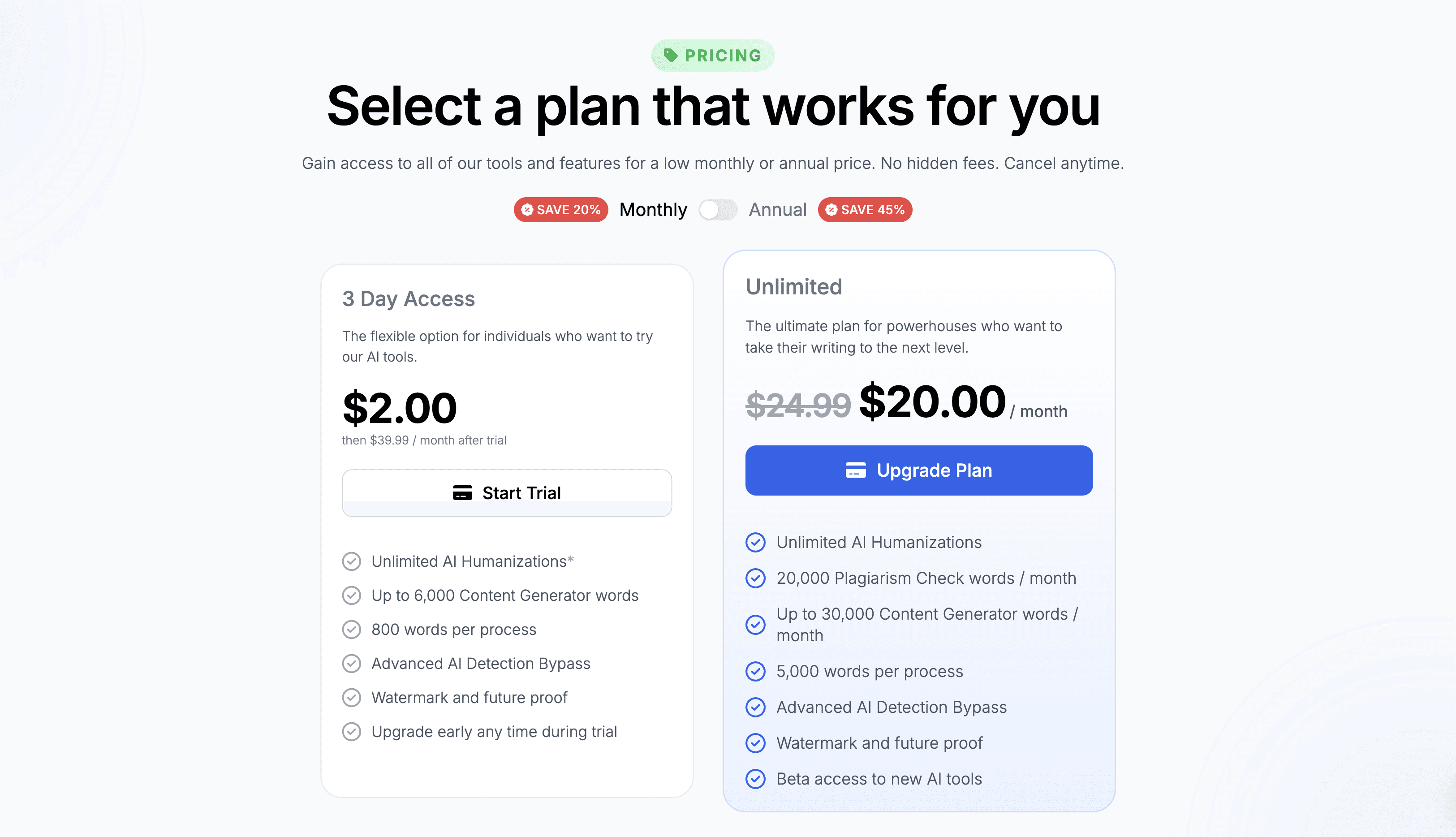
This is the sharpest limitation. Phrasly's free access is a one-time sample of roughly 500 words total, not per day, not per month. It's enough to watch the editor transform a paragraph, but nowhere near enough to evaluate output across the kinds of assignments you'd actually submit. There's also a low-cost short-term access pass (around $2 for a few days) that some users buy to trial properly before committing to a subscription, which is worth knowing if you want a real test without the annual lock-in.
API, extensions, and integrations
There is no public API. For a student that's a non-issue; for anyone trying to humanize content programmatically or in bulk, it's a hard stop. Phrasly is a website you log into, paste into, and copy out of, capable within that box, but not a building block for a workflow.
Support and billing experience
Billing is where Phrasly's otherwise strong reputation gets its asterisks, and it's covered in detail in the user-reviews section below. The short version: the advertised monthly price is an annual plan billed upfront, the refund is widely reported to void as soon as you use the tool, and a meaningful slice of negative reviews are about that surprise rather than output quality. Read the checkout carefully before you click pay.
Hands-on: what the output actually looks like
In daily use, Phrasly's lighter mode is its strongest setting for academic work, it tidies mechanical phrasing without redrawing your argument. The aggressive mode is more visibly "rewritten," and that's where I'd slow down: it occasionally reorders the sentences in a conclusion in a way that blunts a carefully built case, and it tends to pad. If you're working to a tight word brief, watch for inflation.
The sample below illustrates the style of an academic-mode rewrite on a cited passage. It is a register illustration, not a detection claim, it says nothing about whether this text would pass any particular checker:
Pricing (verified June 2026)
I checked Phrasly against its live checkout in June 2026. Phrasly has moved toward a flat "unlimited" subscription rather than tiered word buckets, and the monthly-versus-annual toggle changes the headline number substantially, so confirm the exact terms at checkout before subscribing.
| Plan | Phrasly | WriteHybrid |
|---|---|---|
| Free | One-time sample (~500 words) | 500 words/month, recurring, no card |
| Short-term access | ~$2 for a few days | Free tier never expires |
| Entry paid | ~$11/mo billed annually (~$132 upfront); ~$20/mo month-to-month | $9/mo, 10,000 words (Starter) |
| Words | "Unlimited," ~5,000 per session | 10,000/mo (Starter), 50,000/mo (Pro) |
| API | No | Yes, on $19/mo Pro |
| Refund | Reported to void once the tool is used | 14 days |
On the math: Phrasly's plan is flat-rate, so the more you write the cheaper each word effectively gets, good news for a heavy semester. The catch is the structure, not the rate. The attractive ~$11/month is the annual price, which means roughly $132 charged in one go; the genuine month-to-month option lands closer to $20, so anyone planning to use it for a single deadline pays a premium or commits to a year. WriteHybrid Starter, by contrast, works out to about $0.0009 per word ($9 ÷ 10,000) with no annual lock-in, and its 500 free words every month add up to roughly 6,000 words a year you can spend testing your real drafts. Different shapes for different users: Phrasly rewards heavy, year-round writers who'll commit; WriteHybrid is friendlier to anyone who wants to start small and prove the value first.
How to use Phrasly for the best results
The tool matters less than the habits around it. This sequence consistently produced cleaner output:
- Fix the substance first. Phrasly rewrites phrasing, not arguments, sort out structure, evidence, and logic before you humanize, or you'll just get a smoother version of a weak draft.
- Start on the lighter mode. Run the gentlest setting first and only escalate if the output still reads mechanically. The aggressive mode is a last resort, not a default.
- Protect citations and key terms manually. Lock down quoted material and technical vocabulary after the rewrite, and pay special attention if you use footnotes or inline MLA, where I saw the most breakage.
- Reread conclusions out loud. This is where the aggressive setting reorders sentences and where padding creeps in. Trim repeated openers and any inflated word count.
- Verify on the detector that grades you. Phrasly's built-in score is a hint; the only result that counts is your final text through your institution's actual checker, Turnitin, GPTZero, Originality.ai, whatever it is.
What real users say about Phrasly
I read through Phrasly's public Trustpilot profile and Reddit threads to weigh my impressions against a far larger sample. At the time of writing, Phrasly holds roughly a 4.4–4.7-star Trustpilot rating across 2,300+ reviews (the figure varies a little by regional Trustpilot domain), comfortably the healthiest public sentiment of any tool in this category.
What satisfied users consistently praise:
- A clean, fast interface that gets first-time users to a result in seconds.
- Genuinely useful tidying of clunky AI phrasing into something clearer and more natural.
- Helpful for routine academic drafting where a light human pass finishes the job.
The recurring complaints cluster around money rather than output, and they show up from enough different people to take seriously:
- Annual-billing surprise: multiple reviewers describe signing up at the headline price and being charged a full year upfront, having read it as month-to-month.
- Refunds tied to usage: the money-back option is widely described as effectively void the moment you run the tool even once, which makes "try and refund" unreliable.
- Detector inconsistency: several users note that output that cleared a lighter checker still got flagged by stricter models, so a pass on one detector should not be read as a pass everywhere.
None of this makes Phrasly a bad product, its ratings are genuinely strong and most users are happy. But if you're a student on a budget, treat the free sample as a demo, consider the cheap short-term pass for a real trial, and go in clear-eyed about the annual charge.
Why the detector landscape makes this harder to pin down
This category stopped being static in 2025. Turnitin shipped a detector update in late August 2025 that specifically targeted humanizer-style output, and tools across the board, Phrasly among them, per its own users, saw less consistent results overnight. GPTZero, Originality.ai, and Copyleaks each iterate on their own schedules too, and Originality's hardened "Turbo" model in particular is where reviewers report the most misses.
The practical upshot is simple: any pass rate you read in a review (including the ones quoting "99%") is a snapshot of one moment against one detector version. By the time you paste your own essay, the detector may have moved. That's precisely why WriteHybrid no longer publishes headline bypass percentages and instead points you at the only measurement that reflects today's detector on your actual text, your own check.
Detection: what we can and can't tell you
Here's the honest part. Phrasly markets "bypass Turnitin" alongside its academic features, but detection outcomes swing enormously with the exact text, its length, and which detector, and which version of it, runs the scan. Neither I nor Phrasly can promise a result for your specific draft, and I won't publish pass-rate numbers I can't stand behind.
What I can say from hands-on use is tool-specific and about citations as much as detection: if your instructor mandates Chicago footnotes or inline MLA, test the citation handling on your own references before trusting the academic badge. For detection itself, the routine is unchanged, humanize your real draft, run the output through the checker your audience actually uses, and reread conclusions to confirm the argument still lands after any sentence reordering.
Who should use Phrasly, and who should skip it
Consider Phrasly if you:
- Write in clean APA parenthetical style and want an editor that defaults to an academic register.
- Value the strongest public reputation in the category and a polished, fast interface.
- Write year-round and are comfortable committing to an annual plan to get the lower effective rate.
Skip it if you:
- Need Chicago footnotes or inline MLA preserved, where citation handling was least reliable.
- Want to evaluate properly for free before paying, the one-time ~500-word sample won't get you there.
- Need an API or bulk pipeline, or you only have a single deadline and don't want an annual charge.
How to get the most natural output
Whichever humanizer you land on, a few evergreen habits do more for naturalness than re-running the tool ever will:
- Treat the rewrite as a first pass. A short manual edit, varying sentence length, cutting a repeated transition, deflating padded phrasing, beats five automated re-runs.
- Keep your own voice in the intro and conclusion. Those are the sections a grader scrutinises most, so write or heavily edit them yourself.
- Don't let the tone go uniform. A perfectly even register is itself a pattern; let some sentences run long and others stay short.
- Run the output through more than one detector. GPTZero, Turnitin, and Originality.ai disagree constantly, clearing one is not clearing all.
- Never submit unread. The fastest route to a flag is pasting output with a broken citation or a phrase the rewrite quietly mangled.
Frequently asked questions
Related reading
Try WriteHybrid on your text
Paste AI-generated copy below. 500 humanized words free every month after signup.
Was this page helpful?
Your feedback helps us improve our testing write-ups.