Smodin AI Humanizer Review (2026): Free Tier, Multi-Language, and the Billing Catch

Independent review
Smodin Humanizer
The humanizer module inside Smodin's veteran multi-tool suite, real multi-language support and a recurring free allowance, dragged down by a confusing trial flow and a long trail of billing complaints.
Disclosure. I'm Huzefa Abbasi, and I founded WriteHybrid, which competes directly with Smodin's humanizer, so read this knowing my bias. What follows comes from hands-on use of the product, its public pricing as verified in June 2026, and a wide read of public customer reviews; it is not a controlled benchmark. Detection is decided by your specific text and the exact checker your school or client runs, so any "passes every detector" claim, from Smodin or from me, is something to confirm on your own draft, not to take on faith.
What Smodin's humanizer is, and who it's for
Smodin is the elder statesman of this review set. It launched well before the current wave of humanizers and grew into a broad writing platform, an AI writer, a paraphraser, a plagiarism checker, a translator, and a study assistant, with the humanizer bolted on as one tool among many. That heritage cuts both ways. You get a mature, feature-dense product used by a very large base; you also get a humanizer that has to share a dashboard with half a dozen other tools.
Two things genuinely set it apart. First, the multi-language support is real: you can humanize text in dozens of languages, not just English, which almost nothing else in this category does well. Second, the free allowance recurs instead of evaporating after one use, so you can keep testing over weeks. The trade-off is that English humanization sits squarely mid-pack, and, as the reviews section makes painfully clear, the billing experience is the thing most likely to burn you. Smodin suits multilingual writers and existing suite users; English-only writers who want the cleanest output with the least billing risk have safer options.
A mature, multilingual writing suite with a genuinely recurring free allowance, undercut by mid-pack English output and a billing reputation that demands caution.
Best for: Multilingual writers and existing Smodin suite users who want humanizing alongside their other tools, will stick to monthly billing, and will verify detection themselves.
Pros
- +Genuine multi-language humanization across dozens of languages
- +Recurring free allowance makes evaluation over time realistic
- +Long-established product with a deep feature set beyond humanizing
- +A stronger rewrite setting available on the higher tier
Cons
- −English output is mid-pack despite the multilingual marketing
- −Confusing trial flow and a long trail of billing complaints
- −Credits reset monthly with no rollover; cluttered multi-tool interface
- −Roughly 6,000-character cap forces splitting longer drafts
Key features that actually matter
A long feature list is easy to market and hard to live with. Here's what shapes the day-to-day.
Rewrite modes and tone control
Smodin's humanizer offers escalating rewrite settings rather than register presets, a baseline pass that lightly smooths text, a middle setting, and a stronger setting that rewrites more aggressively. The stronger setting produces the most natural English and is the one you'd want for anything detection-sensitive, but it lives behind the paywall on the higher tier. Don't judge the tool on the free or entry setting: the gap between the baseline and the strongest rewrite is real, and reviewers who tried only the cheap option tend to come away unimpressed for exactly that reason.
Multi-language support
This is Smodin's standout. Where most humanizers are English-first and treat other languages as an afterthought, Smodin handles a wide spread of languages credibly. If you write academic or professional text outside English, that alone can justify it. One honest caveat: quality is not uniform across every language, and an impression you form testing English won't transfer to, say, German or Spanish, so test each language you actually write in rather than assuming parity.
Input limits and credits
The editor accepts pasted input up to roughly 6,000 characters, about 920 words, so longer essays must be chunked, humanized in pieces, and stitched back together, with the seams reread for consistency. Usage is metered as credits that reset on a cycle and, per many reviewers, do not roll over: unused allowance simply disappears at the reset. Budget for that if your output is uneven month to month, because you can end up paying for capacity you never touched.
Free tier and trial
The recurring free allowance is the commercial highlight and a real one, it lets you evaluate the humanizer over time instead of burning a one-shot trial in a single paragraph. But the paid trial flow is where trouble starts: a large share of complaints describe signing up expecting a long trial and being charged within 24 hours, often because the terms were buried or poorly translated. If you move to paid, read the trial window precisely and assume the shortest interpretation.
API, extensions, and integrations
A Chrome extension is available on the higher tier for browser-wide rewriting, which is a genuine convenience if you work across web apps. Programmatic API access, though, is gated behind enterprise/contact-sales arrangements rather than offered openly on a standard plan, so individual users wanting to script or bulk-process humanizing won't find a self-serve path.
Editor UX, support, and billing
Because the humanizer is one tile in a crowded suite, the interface carries clutter the single-purpose tools don't: sidebars and cross-promotions for the paraphraser, detector, and writer surround the control you actually want. Support and billing are the weakest link by a distance, covered in detail below, and the pattern of private refund refusals followed by public-review escalations is the single thing I'd weigh most heavily before paying.
Hands-on: what the output actually looks like
In English, Smodin's strongest setting reads naturally enough for low-stakes work, but it's solid rather than special, competent rewriting that you'll still want to read over. Switch languages and the picture changes: the multilingual capability is the reason to choose Smodin, not the English rewrite quality. If you hop between languages in one session, reread longer passages for the faint translation-style stiffness that can creep in.
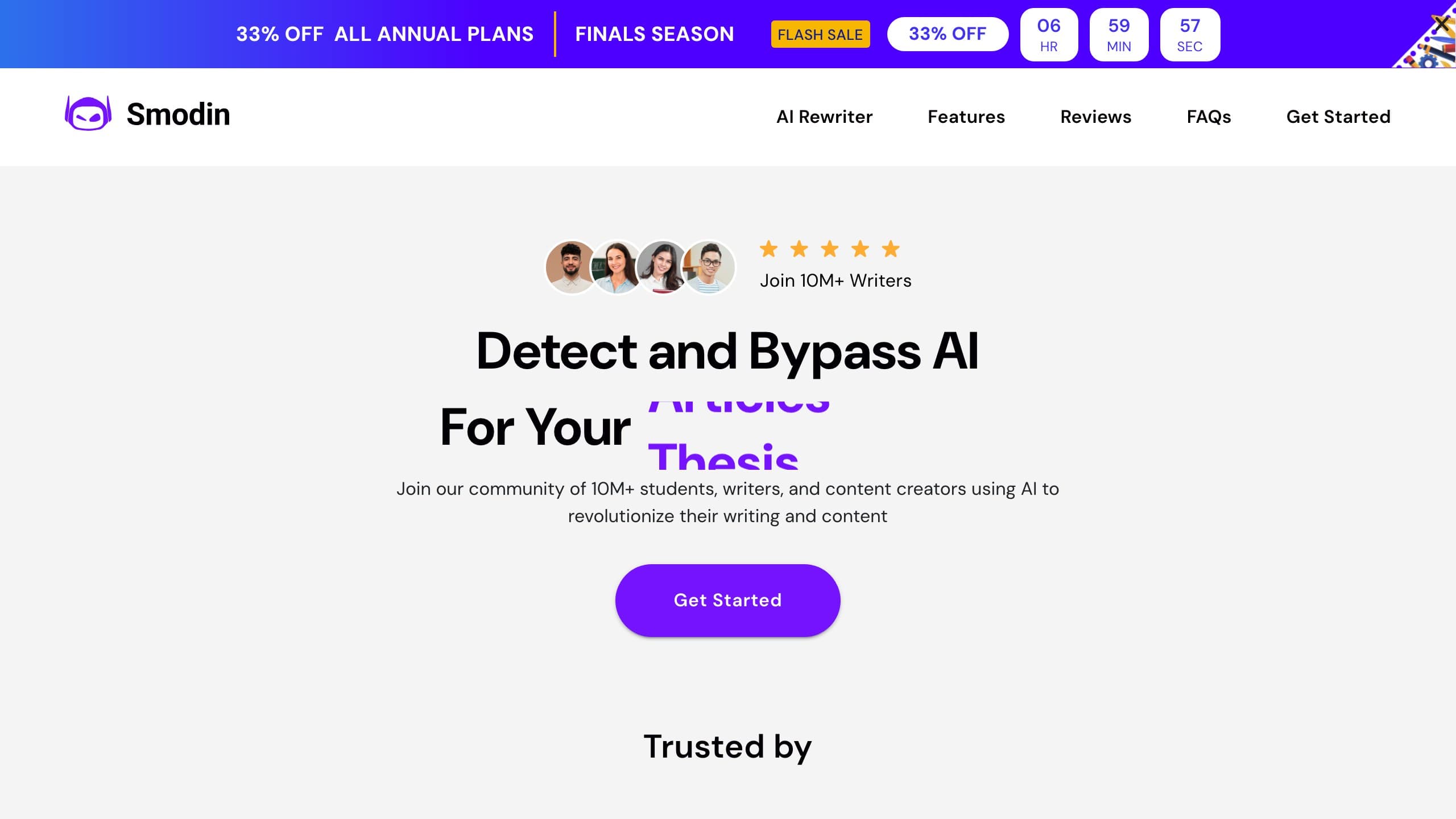
The sample below illustrates the style of Smodin's stronger setting on an English academic passage. It's a register illustration, not a detection claim, it tells you nothing about whether this would clear any specific checker:
Pricing (verified June 2026)
I checked Smodin against its live checkout in June 2026. The suite is sold as tiered subscriptions, and the monthly/annual toggle changes the headline number, so confirm the current terms, and especially the trial window, at checkout before you commit.
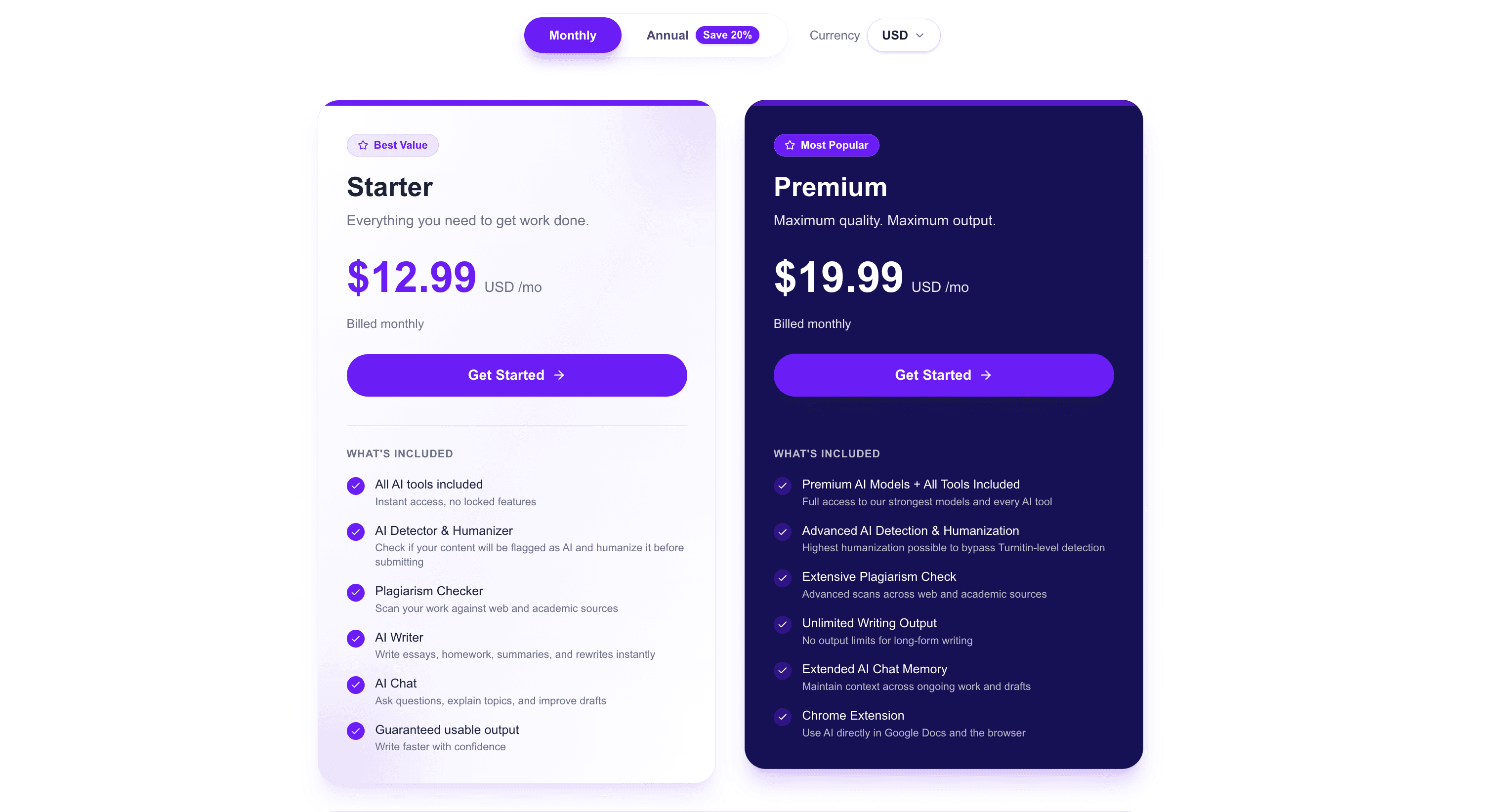
| Plan | Smodin | WriteHybrid |
|---|---|---|
| Free | Recurring allowance (~1,000 words), credits reset, no rollover | 500 words/month, recurring, no card |
| Entry paid | ~$12.99/mo (~$10.39 annual) | $9/mo, 10,000 words (Starter) |
| Higher tier | ~$19.99/mo (~$15.99 annual), strongest model + Chrome extension | $19/mo, 50,000 words (Pro, + API) |
| Strongest rewrite | Gated to the higher tier | All four modes on every paid plan |
| API | Enterprise / contact sales only | Included on $19/mo Pro |
| Refund | Policy exists but widely disputed by reviewers, confirm first | 14 days |
On the math: Smodin's tiers are priced for volume, so per word they're cheap once you're writing steadily, but "cheap per word" only helps if you actually use the credits before they reset, and the no-rollover policy means light months are effectively dead money. Annual billing shaves roughly 20% off, at the cost of locking in a year with a vendor whose refund handling is contested. WriteHybrid Starter is about $0.0009 per word ($9 ÷ 10,000) on a no-lock-in monthly plan, and its recurring 500 free words a month accumulate to roughly 6,000 words a year for risk-free testing. The honest framing: Smodin can be the better raw value at high, steady multilingual volume; WriteHybrid is the lower-risk way to start, especially if your usage is lumpy or English-only.
How to use Smodin's humanizer for the best results
The suite rewards a deliberate routine more than casual use:
- Pick the language first, then the setting. Confirm the humanizer is working in your target language before you run anything, and reach for the strongest rewrite setting if detection matters.
- Chunk long drafts intentionally. With a ~6,000-character cap, split at natural section breaks rather than mid-argument, and reread the seams so the tone matches across pieces.
- Mind the credit clock. Because credits don't roll over, batch your humanizing within a cycle rather than spreading it thin and losing the remainder.
- Test each language separately. Don't assume the quality you saw in English carries to another language, run a real sample in each one you write in.
- Verify on the checker that grades you. The suite's own detector is convenient but not the authority; run your final text through the specific detector your audience uses before submitting anything that matters.
What real users say about Smodin
I read across Smodin's Trustpilot and Sitejabber profiles and Reddit threads to weigh my own impressions. The reputation picture is genuinely mixed and worth reading as a spread rather than a single figure. At the time of writing, Smodin's main Trustpilot profile had its score suspended for a guideline breach, Trustpilot's notice states it removed a batch of fake reviews, while regional Trustpilot profiles sit near 4.6 across several hundred reviews, and Sitejabber lands closer to 3.5. That divergence is itself the signal.
What satisfied users tend to praise:
- A real time-saver for drafting, summarising, and especially translating across languages.
- The plagiarism checker and study tools are handy companions to the humanizer.
- The recurring free allowance lets cautious users evaluate before paying.
The recurring complaints are unusually consistent and centre on money, not output:
- Trial-to-charge surprises: numerous reviewers describe expecting a long trial and being charged within 24 hours, often blaming buried or poorly translated terms.
- Unexpected annual billing and denied refunds: users report being charged annually when they intended monthly, then having refund requests refused in private support until they escalated with a public review.
- Credits that vanish: the no-rollover policy and occasional reports of paid features being inaccessible after a charge come up repeatedly.
None of this means the humanizer doesn't work, for many multilingual users it clearly does. But the weight of billing complaints is real, and the sensible defence is the same one experienced reviewers recommend: use a monthly plan, consider a virtual card, and keep an eye on your statement.
Why the detector landscape makes this harder to pin down
The category shifted under everyone's feet in 2025. Turnitin's late-August 2025 detector update was built to catch humanizer-style patterns, and tools across the board produced less consistent results afterwards. GPTZero, Originality.ai, and Copyleaks keep iterating on their own timelines, and a humanizer that read as clean last term can read differently this one.
For a multi-language tool the moving target is doubly true, because detector coverage and behaviour differ by language as well as by version. So treat any pass figure you read, Smodin's marketing quotes very high numbers, as a snapshot against one detector at one moment. The only measurement that reflects today's checker on your actual text is the one you run yourself, which is exactly why WriteHybrid dropped headline bypass percentages in favour of pointing you at your own check.
Detection: what we can and can't tell you
Honestly: Smodin promises detector bypass prominently, but outcomes swing hard with the exact text, its length, the language, and which detector, and version, runs the scan. Neither I nor Smodin can promise a result for your draft, and I won't quote pass rates I can't defend.
The Smodin-specific cautions are two. First, the entry and free settings are weaker than the strongest paid one, so don't judge detection on the cheapest option. Second, English results won't predict results in another language, test each language on its own. Then do the universal thing: humanize your real draft, run it through the checker your audience actually uses, and reread for meaning, because Smodin's rewriting occasionally shifts emphasis in longer passages.
Who should use Smodin, and who should skip it
Consider Smodin if you:
- Write in multiple languages and need humanizing beyond English.
- Want to evaluate over weeks for free before paying, and will stick to monthly billing.
- Already live in the Smodin suite and want humanizing next to your other tools.
Skip it if you:
- Write only in English and want top-tier output without paying up to the higher tier.
- Are billing-sensitive or have been burned by confusing trials before, the complaint pattern here is hard to ignore.
- Need a larger input cap, open API access, or a clutter-free single-purpose editor.
How to get the most natural output
Whatever tool you use, these habits matter more than any single feature:
- Edit after the machine, not instead of it. A short human pass, trimming a repeated phrase, varying rhythm, does more for naturalness than re-running the rewrite.
- Keep the opening and closing in your own words. Those carry the most scrutiny from a reader or grader, so don't outsource them entirely.
- Avoid a perfectly even tone. Uniformity reads as machine-made; let sentence length and structure breathe.
- Cross-check on more than one detector. GPTZero, Turnitin, and Originality.ai routinely disagree, so a single pass is not a guarantee.
- Read every word before it ships. Rewrites can drift in meaning or break a citation, and that's what gets caught.
Frequently asked questions
Related reading
Try WriteHybrid on your text
Paste AI-generated copy below. 500 humanized words free every month after signup.
Was this page helpful?
Your feedback helps us improve our testing write-ups.