Netus AI Review (2026): Paraphrase-First Output, the Transparency Gap, and Who It's For

Independent review
Netus AI
A paraphrase-first tool aimed at bloggers, synonym swaps and sentence reshuffling rather than deep humanization, with a friendly Trustpilot score but shaky independent detection results.
Disclosure. I'm Huzefa Abbasi, and I build WriteHybrid, so Netus AI is a competitor and my perspective isn't neutral, weigh it accordingly. What follows is an editorial review based on hands-on use, on Netus AI's public pricing verified in June 2026, and on publicly visible reviews and independent tests; it is not a controlled benchmark, and I publish no bypass percentages of my own. Detection depends on your exact text and the precise detector version it meets, so the only result you can trust is the one you generate on your own draft.
What Netus AI is, and who it's for
Netus AI does something most of its rivals won't: it tells you roughly what it is. Rather than promising a magical, guaranteed bypass, it positions itself as a paraphrase-and-humanize tool for bloggers, and that framing is broadly accurate to how it behaves. The output is paraphrasing-led, it substitutes synonyms and reshuffles sentence structure rather than attempting the deeper burstiness-and-rhythm reshaping that purpose-built humanizers go for. If you've spent time in QuillBot's paraphraser, the underlying instinct will feel immediately familiar.
That honesty is genuinely a point in its favour, and it sets expectations correctly: this is a rewriter for readable, low-stakes content, not a detector-evasion guarantee. The audience it fits is a blogger or content marketer who wants quick, plausible variation on AI drafts and will accept some looseness in exchange for speed and a low price. The audience it doesn't fit is anyone whose work has to survive a strict institutional checker or preserve precise meaning, because, as both the hands-on section and the independent tests below show, synonym substitution is a blunt instrument.
Key features that actually matter
The marketing talks about bypassing detectors and saving time. Here's how Netus AI actually behaves on the things that decide whether it earns its $19 a month.
Writing mode and rewrite control
There's one Standard mode and no tone controls, no academic-versus-casual selector, no intensity slider. You paste, you paraphrase, you get one flavour of output. For the blogger it targets, that simplicity is fine; you're not choosing a register because there's only one. But it also means you can't ask the tool to rewrite harder on a stubborn passage or more gently on one where meaning is fragile. Whatever the engine does, it does to everything equally.
Input and word limits
This is the friction you'll feel first. The editor caps pasted input at roughly 5,000 characters, about 770 words, which is among the smallest caps in the category. A standard 1,200–1,500-word blog post therefore needs splitting into two passes, and because paraphrasing changes word choice as it goes, the seam where the two halves meet can read inconsistently. You'll want to reconcile the joins by hand. The monthly allowance is generous (50,000 words), so it's the per-paste ceiling, not the monthly budget, that constrains real work.
Free tier and trial
Netus AI gives a one-time 200-word trial and nothing recurring. That's enough to watch the paraphraser swap a few words, but not enough to judge how it handles a full post across an intro, a body, and a close. As with several tools in this space, you're essentially asked to subscribe before you can evaluate it properly on your own writing.
API, integrations, and extras
Netus bundles a few adjacent features around the paraphraser, a built-in AI detector and a summarization tool among them, which is a reasonable convenience. The important caveat on the built-in detector is that it checks output against Netus's own scoring, not against the third-party checkers that actually decide your fate, so a green light there isn't a green light on Turnitin or Originality.ai. There's no Chrome extension or CMS plugin, so it stays a separate browser step in your workflow.
Editor experience and transparency
The editor itself is simple and quick. The bigger experience issue sits around the product rather than inside it: Netus AI is notably opaque about who operates it, where it's registered, and how it handles the content you paste in. Independent reviewers repeatedly flag this lack of transparency, and a handful of users report hitting persistent error pop-ups that blocked them from using the service after paying. Neither is disqualifying on its own, but together they're worth knowing before you hand over a card.
Support and billing
Billing is monthly-only, there's no annual plan, so no price lock-in and no annual saving, but also no long commitment to claw back. The stated refund window is 7 days. Combined with the small trial, that short window means your realistic evaluation period is tight, so plan to test hard in the first few days if you do subscribe.
Hands-on: what the output actually reads like
In use, the paraphrase-heavy approach produces perfectly readable blog copy. "Audit" becomes "examine," "trust" becomes "confidence," sentences get reshuffled into a slightly different order. For casual content that reads fine. But that's also exactly where the risk lives: swapping words one-for-one can quietly shift what a sentence asserts, so your post ends up saying roughly-the-same-thing while specific claims, emphasis, and nuance move underfoot. On a longer draft split across the small cap, the most common artifact is a tonal mismatch at the seam, where the second pass reaches for slightly different synonyms than the first.
The sample below shows the kind of synonym-substitution rewrite Netus AI produces on blog copy. It illustrates the style, not a detection result:
An honestly positioned paraphraser for bloggers, fine for readable, low-stakes rewrites, riskier wherever meaning precision or strict detection matters.
Best for: Bloggers who want quick, readable paraphrasing for low-stakes content, will reconcile the seams on split drafts, and will verify detection on their own checker.
Pros
- +Honest positioning as a paraphraser rather than a guaranteed-bypass tool
- +Produces readable, blog-ready rewrites quickly
- +Competitive per-word cost on the Solo plan
- +Bundles a built-in detector and summarizer alongside the paraphraser
Cons
- −Synonym substitution can drift meaning, claims, dates, and emphasis shift
- −Small ~5,000-character cap forces splitting most blog posts
- −Single mode, monthly-only billing, and only a 200-word trial
- −Opaque company ownership and independent tests showing output still flagged
Pricing (verified June 2026)
I checked Netus AI against its live checkout in June 2026 and archived the page. Billing is monthly-only with no annual toggle, so the math is simple, but confirm the current figure at checkout before subscribing, as pricing in this category shifts quietly.
| Plan | Price | Words / month | Modes | Free tier | Refund |
|---|---|---|---|---|---|
| Trial | Free | 200 words (one-time, lifetime) | Single Standard mode | n/a | n/a |
| Solo | $19/month | 50,000 | Single Standard mode | 200-word trial | 7 days |
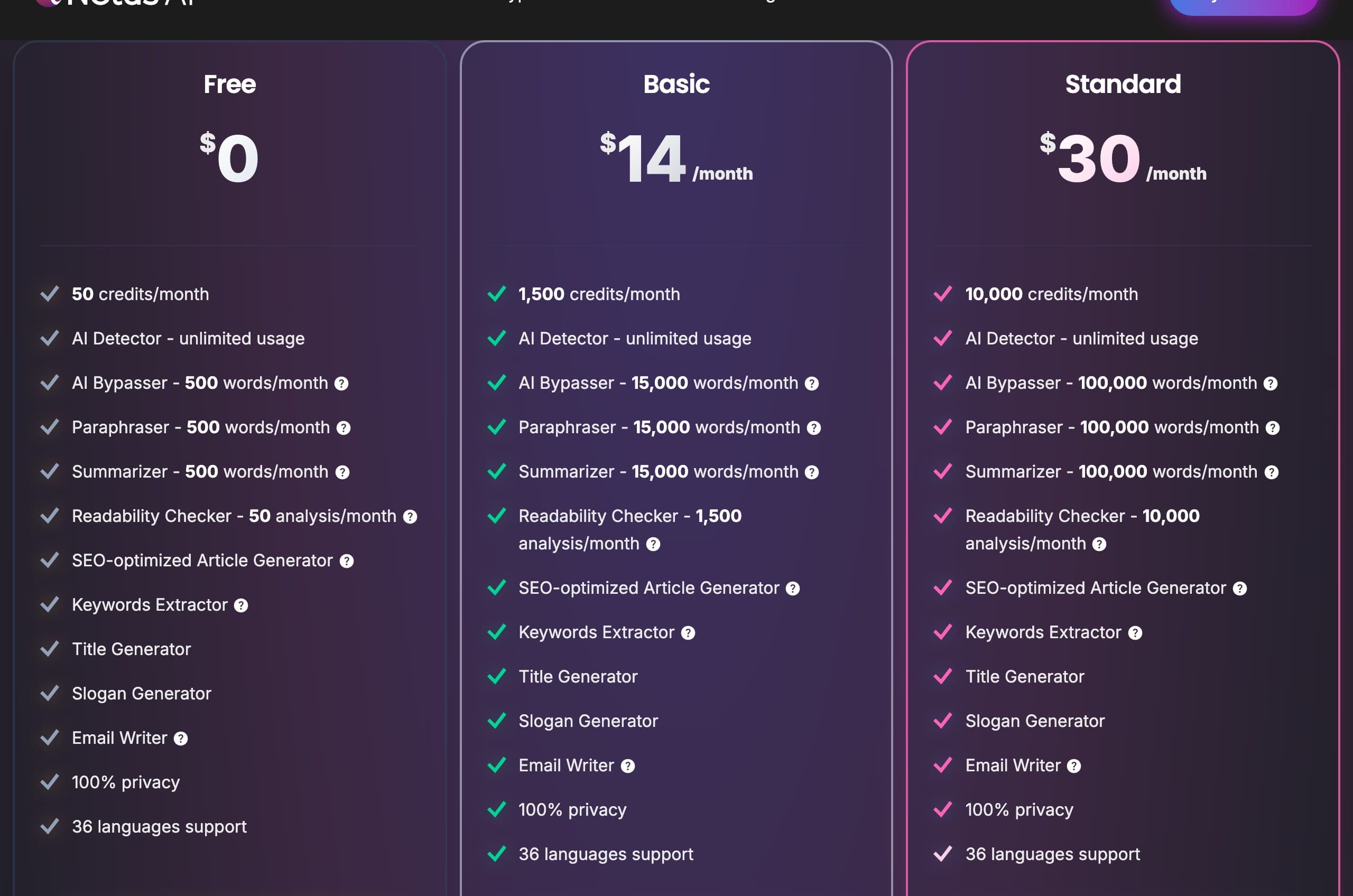
On the math: $19 ÷ 50,000 words is about $0.0004 per word, which is genuinely competitive, especially at volume. The trade-offs are structural rather than about the rate. Monthly-only billing means there's no annual discount to chase, and the single plan means there's no cheaper entry point for a light user who only needs a few thousand words a month, you're paying for 50,000 words whether or not you use them. Set against a recurring free allowance you can keep using indefinitely (covered in the WriteHybrid section), the 200-word one-time trial is closer to a demo than a free tier.
How to use Netus AI for the best results
Because the technique is paraphrasing rather than deep rewriting, the process is mostly about damage control:
- Keep meaning-critical text out of it, or check it closely. Synonym swapping is fine for atmosphere and flow, riskier for precise claims, so reread any sentence carrying a statistic, a date, or a specific argument.
- Split long posts deliberately. Stay under the ~770-word cap per paste, run sections in order, and then smooth the seam where two passes meet so the synonym choices don't clash.
- Don't trust the built-in detector as your final word. It scores against Netus's own model, not the third-party checkers that actually matter, so treat its green light as a hint, not a verdict.
- Restore your own voice afterwards. Paraphrased copy tends toward a flat, even register; vary sentence length and put a few of your own phrasings back in, especially in the opening and closing.
- Verify on the detector your audience uses. Humanize your real draft, then run the output through the specific checker, Turnitin, GPTZero, Originality.ai, Copyleaks, your client or institution relies on, because that's the only result that counts.
What real users say about Netus AI
I read through Netus AI's public Trustpilot profile and independent reviews to weigh its reputation against my own use. At the time of writing it holds a relatively friendly rating around 4.4 stars across roughly 40+ Trustpilot reviews, higher than most tools in this category. That number deserves context, though, because the picture from independent testing is much more mixed, and the sample behind the rating is small.
What satisfied users genuinely report:
- Students and researchers say it saves real time on rewriting and paraphrasing tasks.
- Some SEO users credit it with helping their content perform better after search-algorithm changes.
- The bundled AI detector and summarizer get praised as handy conveniences in one place.
The cautions that recur, from reviews and independent tests alike:
- Detection misses: multiple users note the output still gets flagged by certain detectors, and independent testing, including Originality.ai's own published review, found Netus output scored as heavily AI-generated by Originality.ai, Copyleaks, and GPTZero. In other words, it often won't clear a strict checker like Turnitin.
- Access and reliability: a handful of reviewers describe paying and then hitting persistent error pop-ups that blocked them from using the service.
- Transparency: reviewers repeatedly flag how little is public about who operates Netus AI or how it handles your content, which makes the high star rating harder to take fully at face value given the modest review count.
The honest read is that Netus AI is a real, usable paraphraser that many casual users like, but the gap between its friendly Trustpilot score and its independent detection results is the thing to internalise: a good rating is not a promise that your draft will pass.
The detector landscape shifted in late 2025, and it matters here
This category moves fast. Turnitin shipped a detector update in late August 2025 aimed specifically at humanizer-style output, and tools across the board produced less consistent results afterward, a paraphraser like Netus, whose whole approach is synonym substitution, is especially exposed to that kind of update because substitution is a pattern detectors can be tuned to recognise. GPTZero, Originality.ai, and Copyleaks all iterate independently too. So any "Netus passed detector X" claim you read is a snapshot of one moment against one detector version, which is exactly why I point you at your own draft and your own checker rather than a frozen result.
Detection: what we can and can't tell you
Here's the unvarnished version. Netus AI lists detector bypass among its promises, but detection outcomes vary enormously with the exact text, its length, the topic, and which detector, and which version, runs the check. I won't publish a pass-rate percentage I didn't measure under controlled conditions, and I wouldn't trust one I read elsewhere either.
What I can say with confidence is about technique. Heavy synonym substitution is precisely the signal some detectors are built to catch, so a paraphraser can clear one checker and get flagged by the next, and independent tests of Netus reflect exactly that inconsistency. Because the company also doesn't publish a transparent methodology, you're trusting marketing copy unless you test it. If your work is going through an institutional checker, paste your real draft, humanize it, and run the output through the detector your audience actually uses before submitting anything graded.
Who should use Netus AI
- Bloggers producing low-stakes content who want readable paraphrasing fast and can absorb a little meaning drift.
- Writers who value its comparatively honest "paraphraser, not magic" positioning over inflated bypass promises.
- Users comfortable with a single mode, the small input cap, and a monthly-only plan.
Who should skip it
- Anyone who needs precise meaning preservation for academic or technical work.
- Writers facing a strict or paraphrase-sensitive detector like Turnitin, where independent tests suggest the output often won't clear it.
- Buyers who want annual savings, a larger input cap, multiple register modes, or a company whose ownership and data handling are transparent.
How to get the most natural output
Whichever humanizer you choose, these evergreen habits do more for naturalness than any tool setting:
- Treat the rewrite as a starting point. A short manual edit, varying sentence length, restoring a precise word the paraphraser softened, beats re-running the tool again and again.
- Don't let the register go flat. Paraphrased copy tends to even out into one tone; deliberately mix long and short sentences and keep some of your own phrasing.
- Protect facts and citations by hand. Synonym-swapping rewriters are the kind most likely to quietly alter a date or loosen a technical term.
- Cross-check across detectors. GPTZero, Turnitin, and Originality.ai disagree constantly; clearing one is not clearing all.
- Read it aloud before you submit. It's the quickest way to catch the nuance drift that one-for-one synonym swaps introduce.
Frequently asked questions
Related reading
Tools worth comparing
Try WriteHybrid on your text
Paste AI-generated copy below. 500 humanized words free every month after signup.
Was this page helpful?
Your feedback helps us improve our testing write-ups.