5 Humbot Alternatives (2026): Honest Picks for Volume & Graded Work
Alternatives to Humbot





Disclosure. I'm Huzefa Abbasi, and I build WriteHybrid, which leads the list below, so treat that entry as a builder's pick, not a neutral verdict. Everything here is editorial: hands-on impressions, public pricing as of June 2026, and publicly visible Trustpilot and Reddit reviews, not a lab study with published scores. No tool can promise it will clear the detector your client or professor runs, because that depends on your own text, so test it yourself.
Why Humbot users start looking
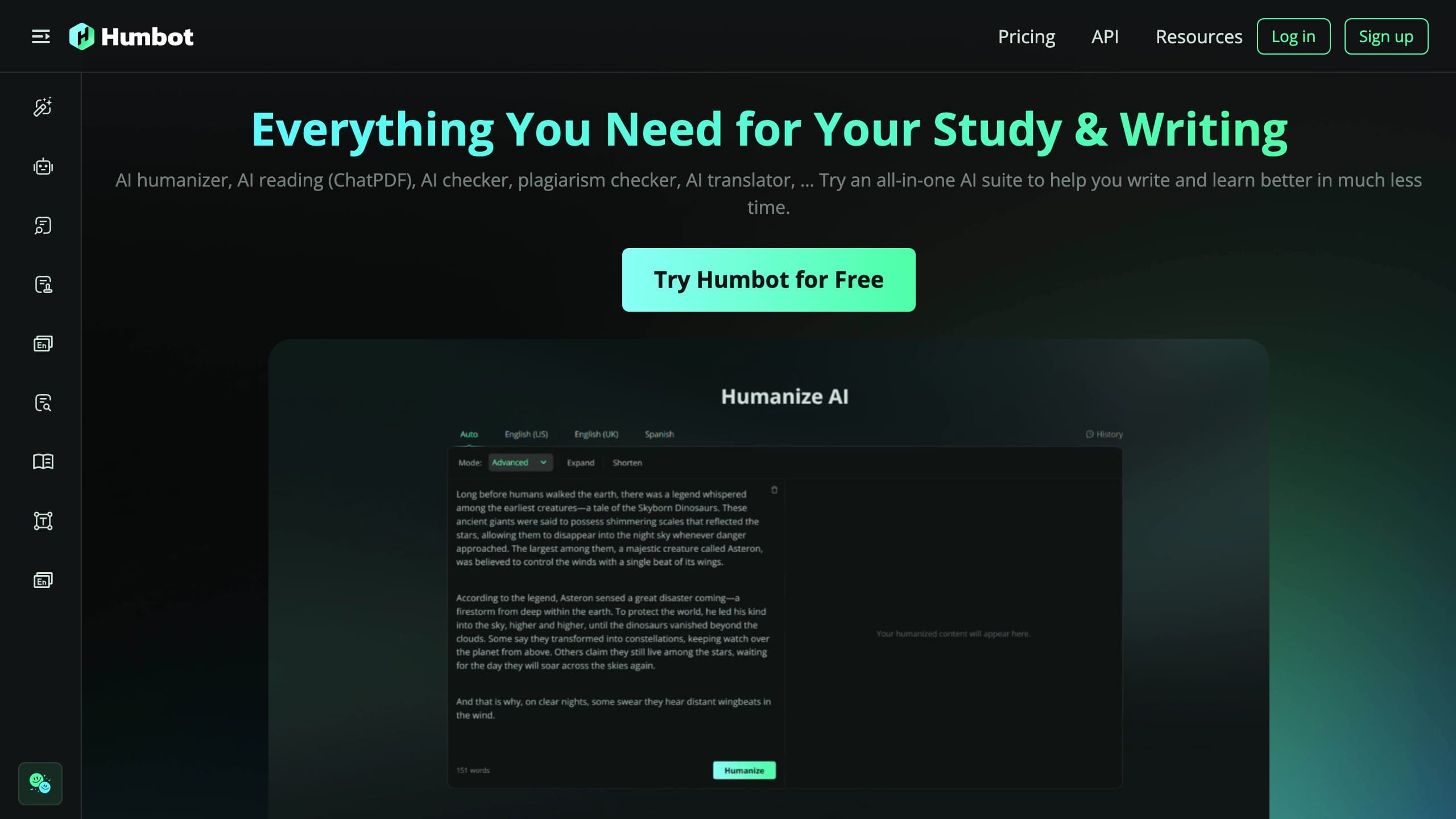
Humbot is built for one thing: volume. Basic gives 50,000 words a month for $9.99, bulk upload and API arrive on the roughly $50 Ultra tier, and the whole funnel is aimed at SEO agencies pushing a lot of copy. For GPT-style blog batches where nobody is grading the output, that's a defensible deal on cost alone.
The trouble starts when the same pipeline meets work that's actually being checked, and Humbot's reviews suggest it starts sooner than the price implies. At the time of writing its Trustpilot rating sits around 2.4–2.7 stars, one of the lowest in the category. The complaints repeat with unusual consistency: output that reads as "gibberish" or swaps in wrong synonyms that lose the meaning, text that still trips detectors after a pass, a money-back guarantee refused once you've run more than about 1,000 words, and, most damaging, cancellation that only works by email, with several users reporting no reply and unexpected renewal charges. Reddit threads are kinder for casual use, where people humanize forum posts and shrug off the rough edges.
So the question isn't "is Humbot bad", it earns its keep on throughput for low-stakes content. It's "what else belongs on the shortlist when your work mixes cheap volume with anything that gets reviewed." Below are five, ranked on things you can verify rather than detection figures no vendor should be quoting you.
The five alternatives, ranked
I've ordered these by how well they cover a mixed queue, with the same breakdown for each, what it is, key features, pricing, who it's for, and a frank verdict, so you can match a tool to the riskiest work in your pipeline.
1. WriteHybrid, API at the entry tier, modes for mixed work
What it is: a dedicated humanizer that puts pipeline tools and register control on the cheap plan, instead of paywalling automation to the top.
Key features: API access is included on the $9/month Starter plan (10,000 words), so you can script per-section humanization without jumping to a $50 plan. Four named modes, Academic, Marketing, Casual, Technical, mean a client blog paragraph and a thesis excerpt aren't handled the same way, which is precisely the split Humbot's single aggressive setting struggles with.
Pricing: the free tier is 500 words a month, recurring, no card, useful for spot-checking before you point paying work at any tool. Starter is $9/month (10,000 words, API included); Pro is $19/month for 50,000 words. Refunds are a flat 14 days.
Who it's for: teams whose queue mixes marketing copy with work that gets reviewed and who want one tool that handles both without surprise paywalls.
Honest verdict: this is my product; the editor is less surgical than WriteHuman's diff view, and there's no bulk-zip upload like Humbot Ultra, so true high-volume bulk shops may still want a dedicated volume tier alongside it.
Try WriteHybrid free · WriteHybrid vs Humbot
2. Undetectable AI, a re-scan built into the workflow
What it is: Undetectable AI pairs the rewrite with an in-app detector, so you humanize and re-score without leaving the tab.
Key features: a Maximum mode and readability presets, plus that bundled checker, genuinely useful for a former Humbot user who kept the volume habit but lost faith in eyeballing output. It accepts pasted input up to roughly 15,000 characters and offers a side-by-side output view; just remember the in-app score is a convenience, not your client's checker.
Pricing: a 250-word one-time free credit; Starter at $14.99/month for 10,000 words (far fewer than Humbot Basic's 50,000 at nearly the same price); Pro at $29.99/month for 50,000. Maximum mode isn't on by default, and the refund policy excludes plans where more than 20% of words are used.
Who it's for: agencies that QA a stack of documents before client handoff.
Honest verdict: you trade Humbot's word economics for dashboard convenience and a sturdier reputation, reasonable if QA speed matters more than raw volume.
3. WriteHuman, the pick when an essay slips into the batch
What it is: WriteHuman is the opposite of a volume tool, paste, review changes in a diff view that surfaces exactly what moved, and read every reordered sentence.
Key features: that visible diff is what you want for the essay paragraphs that have no business going through a 50-post batch, with input running to about 10,000 characters per paste. There's no API, so pair it with a scripted tool for the bulk side. Enhanced mode lives on Pro, so confirm which mode you're buying.
Pricing: the free trial is 200 words, used once; $12/month buys Basic with 80,000 words, and $22/month buys Pro with 200,000 words plus Enhanced mode. WriteHuman runs a 14-day refund, a sharp contrast with Humbot's usage-capped one.
Who it's for: the graded sections a bulk queue shouldn't touch.
Honest verdict: the careful-editor's tool; the small trial and missing API are the limits, but its refund and review behaviour are far steadier than Humbot's.
4. StealthWriter, tone variety for repurposed batches
What it is: StealthWriter returns three outputs per paste, Ghost, Ninja, and Phantom, so one piece of source copy can become several posts across client verticals.
Key features: the variants help when you're adapting tone rather than chasing raw throughput. There's no native bulk upload on the lower tiers and a tight ~5,000-character input cap, so it suits variety more than volume. No academic-register label, so formal work needs a manual pass.
Pricing: 250 free words once; Pro is $19/month for 30,000 words and Premium $39/month for 100,000. Its refund window runs just a few days, so decide quickly.
Who it's for: repurposers who want several voices from one draft.
Honest verdict: a good fit for multi-channel content teams, a poor one for high-volume single documents.
5. Phrasly, for the student-facing pages in a commercial pipeline
What it is: Phrasly is built around student writing, essay cadence, citation helpers, an interface that assumes references and footnotes.
Key features: if your Humbot queue ever carries academic work, Phrasly is a better home for those paragraphs than a volume tool. It accepts input around 12,000 characters and supports document upload, but there's no bulk upload at scale or API, and aggressive rewrites can shuffle footnote anchors, so re-check every reference after a pass.
Pricing: a small one-time free allowance (around 200 words); Student at $12.99/month for 25,000 words; Pro at $24.99/month for 75,000. Note the recurring billing complaints, multiple reviewers report trials auto-renewing into annual charges, so set a cancellation reminder.
Who it's for: citation-heavy sections mixed into otherwise commercial work.
Honest verdict: strong essay UX with a healthy overall Trustpilot rating, but the auto-renewal pattern and lack of API are real caveats.
How the shortlist compares
Pricing verified against public checkout in June 2026; confirm at checkout, since annual toggles change the headline rate.
| Tool | Free tier | Entry price | Words (entry) | Modes | Refund |
|---|---|---|---|---|---|
| WriteHybrid | 500 words/mo, recurring (no card) | $9/mo Starter | 10,000 | Academic / Marketing / Casual / Technical (+ API) | 14 days |
| Humbot | 300 words, one-time | $9.99/mo Basic | 50,000 | Light / Balanced / Aggressive (bulk + API on Ultra) | Short; void past ~1,000 words |
| Undetectable AI | 250 words, one-time | $14.99/mo Starter | 10,000 | Normal / Maximum + in-app detector | Excludes plans >20% used |
| WriteHuman | 200 words, one-time | $12/mo Basic | 80,000 | Standard / Enhanced (Enhanced on Pro) | 14 days |
| StealthWriter | 250 words, one-time | $19/mo Pro | 30,000 | Ghost / Ninja / Phantom variants | ~3 days |
| Phrasly | ~200 words, one-time | $12.99/mo Student | 25,000 | Essay UX; citation helpers; no API | Strict; auto-renew complaints |
On the math: Humbot Basic is roughly $0.0002 per word ($9.99 ÷ 50,000), genuinely the cheapest here, while WriteHybrid Starter is about $0.0009 per word but includes API and a recurring free tier. The right comparison isn't sticker price; it's cost per word at your volume against the reliability your work demands.
How to choose
Sort your queue by stakes first, then pick per bucket:
- Pure low-stakes bulk: Humbot's words-per-dollar is hard to beat, accept the rough edges and never submit unread.
- Mixed marketing + reviewed work: WriteHybrid's named modes and entry-tier API handle both without a $50 plan.
- Agency QA at scale: Undetectable AI's bundled re-scan speeds up handoff checks.
- Graded essay sections: WriteHuman's diff view (and 14-day refund) is the safe home for anything submitted.
- Citation-heavy academic pages: Phrasly understands the shape of references, just watch its billing.
- You genuinely need bulk upload: Humbot's Ultra tier and Undetectable AI's higher plans accept batch/zip input; WriteHybrid scripts the same job via API on its Starter plan, while the paste-only tools won't scale to hundreds of files.
The cheap option and the safe option are rarely the same tool. Splitting your stack by risk usually beats forcing everything through one queue, and the few minutes it takes to route work into the right bucket is cheaper than re-doing a flagged client deliverable.
What reviewers actually report about Humbot
I cross-checked my hands-on impressions against Humbot's public Trustpilot profile and Reddit threads, because a 2.4–2.7-star average is unusual enough to warrant a close read. The split is sharp: casual users are forgiving, while paying subscribers are not.
Where Humbot earns goodwill:
- It's fast and easy, and works well enough for minor text tweaks and casual forum-style rewrites.
- Reddit users repurposing posts often report decent, "good enough" results for low-stakes content.
- The free tier lets people test before paying, and many do exactly that.
The complaints that recur across many reviewers:
- Unreadable output, the single most common theme: "gibberish," wrong-synonym substitutions, and sentences that lose their original meaning, especially on aggressive mode.
- Still detected, multiple users report content that still scores as AI after a pass, defeating the point for graded work.
- Refunds refused and cancellation blocked, a money-back guarantee void once you exceed roughly 1,000 words, email-only cancellation that some say goes unanswered, and reports of unexpected or duplicate charges.
I'd weigh those patterns heavily for anything reviewed. For throwaway bulk where you'll edit afterward, the cost still tempts, but go in with eyes open.
The detector landscape shifted in late 2025
Bulk humanizers were hit hardest by the late-August 2025 Turnitin update, which retargeted humanizer output patterns; high-throughput tools saw their results get less consistent overnight, and Humbot's reviews from that period reflect it. GPTZero, Originality.ai, and Copyleaks update on their own cadences too.
The lesson for a volume workflow is specific: a pass rate that held last quarter against last quarter's detector tells you nothing about today's scan on today's draft. That's why I won't publish bypass percentages, and why anything reviewed should be re-checked on a real paragraph from that exact workflow before you trust it at scale.
Detection: what I can and can't tell you
Here's the honest version. I didn't run a controlled study for this roundup, and I won't publish pass-rate numbers I can't reproduce for your specific text. Detection depends on the passage, its length, and which checker, and which release of that checker, reads it. Two tools that look identical on a marketing paragraph can diverge sharply on a dense academic one.
The pattern I'll stand behind from hands-on use: bulk-oriented rewrites are fine for casual blog copy and most likely to slip on formal, terminology-heavy passages, exactly the work that tends to be graded. So split your stack by risk. Run volume copy through whatever's cheapest that clears the detector your client names, and route anything reviewed through a tool you've personally verified on a real paragraph, checked against Turnitin, GPTZero, Originality.ai, or Copyleaks as appropriate.
How to get the most natural output at volume
When you're pushing a lot of words, a light, repeatable process protects quality better than any single setting:
- Right-size your batches. Humanize in smaller chunks rather than dumping a whole queue through aggressive mode at once, meaning drift compounds across long inputs.
- Skip aggressive mode on anything reviewed. It's where the wrong-synonym and "gibberish" complaints cluster; reserve it for content nobody grades.
- Spot-read every batch. Pull a sample from each run and read it for sense before publishing, volume tools fail quietly, not loudly.
- Keep numbers and named entities locked. Aggressive rewrites drift on dates and figures ("in 2024" becoming "in recent years"), so restore those by hand.
- Verify the riskiest piece, not the average one. Run your toughest passage through Turnitin, GPTZero, Originality.ai, or Copyleaks, the batch is only as safe as its hardest paragraph.
Tools worth comparing
Frequently asked questions
Related reading
Try WriteHybrid on your text
Paste AI-generated copy below. 500 humanized words free every month after signup.
Was this page helpful?
Your feedback helps us improve our testing write-ups.