WriteHybrid vs HIX Bypass (2026): Suite Module vs Focused Humanizer
Side-by-side comparison


Disclosure. I'm Huzefa Abbasi, founder of WriteHybrid, so read this as a competitor's informed opinion, not a neutral lab report. I've used HIX Bypass hands-on, checked its public pricing in June 2026, and read its public Trustpilot and Reddit history. There's no benchmark here, detection depends entirely on your own draft and the detector you face, so verify any "bypass" claim, mine included, on your own text.
What you're actually choosing between
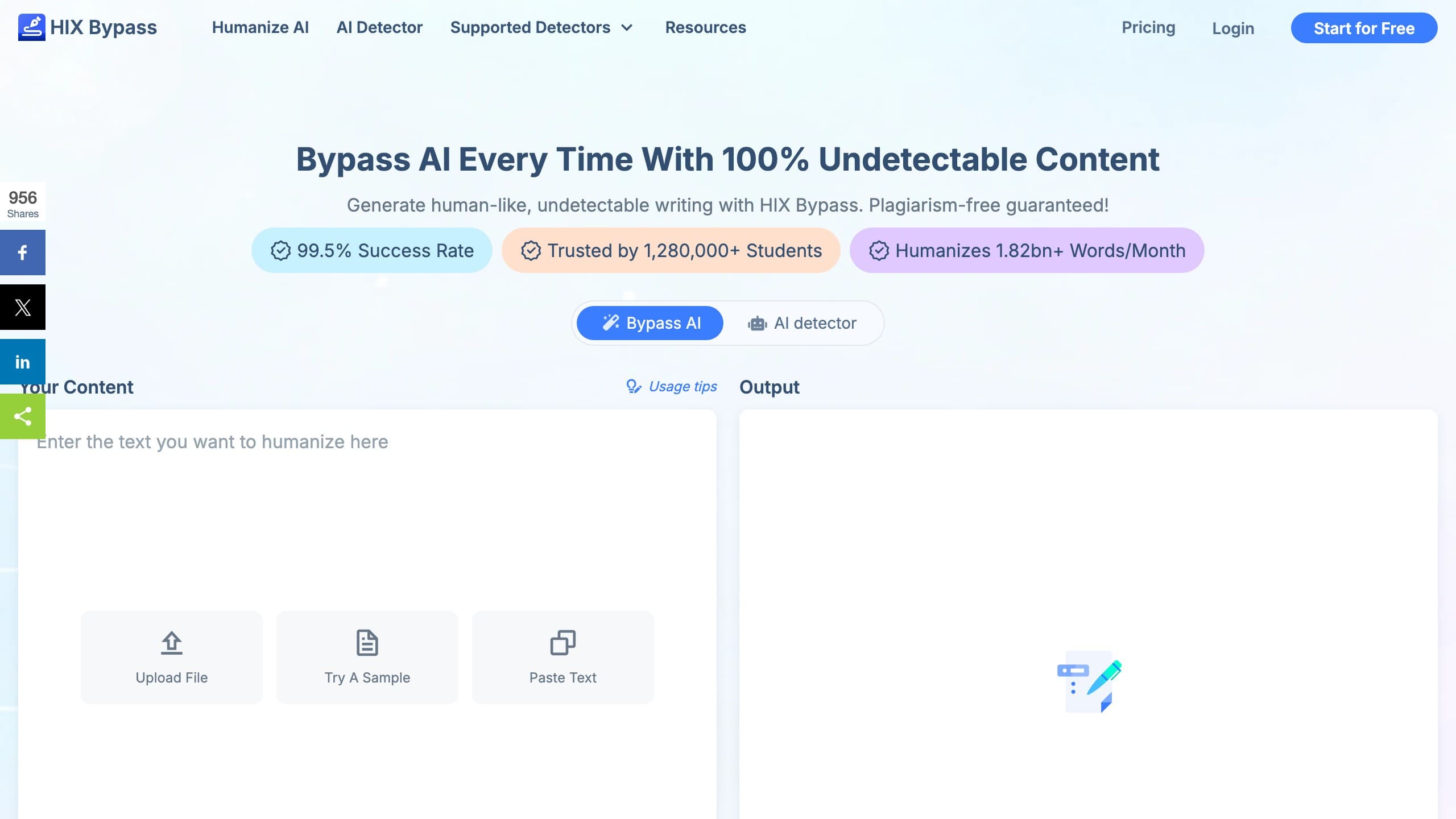
HIX Bypass isn't really a standalone product, it's a feature inside HIX.AI, a broad suite that bundles a writer, a chat assistant, translation, and the bypass module under one subscription. WriteHybrid is the opposite: a single humanizer surface with nothing else to navigate around.
That architecture is the whole story. If you already pay for HIX, or you genuinely want the writer and chat tools, the bypass module costs nothing extra to use and the Chrome extension is a real convenience. If humanizing is all you need, that suite subscription means paying for tools you may never open, and inheriting a company whose billing reputation is, to put it gently, contested.
Who HIX Bypass is for: people already inside the HIX ecosystem, multilingual writers who value the 50+ language support, and anyone who wants in-browser humanizing through the extension and is comfortable watching their renewals closely. Who WriteHybrid is for: writers who want humanizing and nothing else, students and freelancers who want to test before paying, and anyone who prefers a clean, single-purpose tool with explicit registers.
HIX Bypass is reasonable if you want (or already pay for) the wider HIX suite; WriteHybrid is the better value if you only need humanization and want a cleaner billing relationship.
Best for: Writers deciding whether a bundled suite module (HIX Bypass) or a cheaper standalone humanizer (WriteHybrid) fits how they actually work, and who will verify detection on their own checker.
Pros
- +HIX Bypass: Chrome extension for humanizing in-browser on supported sites
- +HIX Bypass: marginal cost is near zero if you already pay for HIX Pro
- +WriteHybrid: $9 entry plan and a recurring 500-word free tier you can actually test with
- +WriteHybrid: four dedicated modes with no suite chrome to wade through
Cons
- −HIX Bypass: advanced mode is gated behind the $39.99/mo Pro bundle
- −HIX Bypass: you subsidize Writer, Chat, and Translate you may not use
- −HIX Bypass: recurring reports of hard cancellations and output artifacts
- −WriteHybrid: no in-browser extension at parity with HIX today
Key features that actually matter
Headline marketing rarely tells you how a humanizer behaves day to day. These are the features that change your actual experience, broken down so you can match each to how you work.
Writing modes and tone control
WriteHybrid splits the job into four explicit modes, Academic, Marketing, Casual, and Technical, chosen before you run the rewrite. The benefit is intent: an academic paragraph is rewritten to preserve formal register and terminology, while marketing copy is allowed to loosen up. HIX Bypass offers two modes, normal and advanced, and the more capable advanced mode sits behind the top Pro bundle. Advanced tends to rewrite more aggressively and expand the text, which suits conversational copy but can over-loosen a formal passage. If matching a specific register matters to you, four named modes give you more deterministic control than one general-purpose rewrite with an "intensity" lever.
Input and word limits
HIX Bypass accepts roughly 10,000 characters per paste, about 1,500 words, so a long essay or report still needs to be broken into chunks, and the seams between chunks are where tone can drift. WriteHybrid's plans are metered by monthly word allowance (10,000 on Starter, 50,000 on Pro) rather than a tight per-paste cap, which suits people working through longer documents. For either tool, chunking a 3,000-word essay means re-establishing voice consistency across passes by hand.
Free tier and trial
This is one of the sharpest differences. WriteHybrid gives 500 words every month, with no card required, roughly 6,000 words across a year you can spend re-testing on real drafts before you ever subscribe. HIX Bypass offers a 500-word trial that is one-time, for the life of the account: enough to see the editor once, not enough to evaluate the tool across several different kinds of writing. A recurring allowance changes the buying psychology entirely, because the paid decision comes after you already know how the tool handles your work.
API, extensions, and integrations
HIX Bypass's standout integration is its Chrome extension, which humanizes text in place on supported sites, genuinely convenient if you draft inside web apps, and something WriteHybrid does not match today. On the other side, WriteHybrid offers API access on its $19/month Pro plan, so you can wire humanizing into your own pipeline or tooling; HIX gates programmatic and advanced features behind its higher suite tiers. Which matters more depends entirely on whether you live in the browser or in a build.
Editor UX
WriteHybrid's interface is deliberately narrow: paste, pick a mode, run. There is no suite navigation to wade through, which makes the path from draft to rewrite short. HIX Bypass lives inside the broader HIX.AI app, so the humanizer shares space with the writer, chat, and translation tools. That breadth is a feature if you use the suite and friction if you don't, several reviewers describe the bypass module as feeling secondary to the rest of the product.
Support and billing experience
This is where the two diverge most, and it's worth weighing before you enter a card. WriteHybrid runs a 14-day refund window. HIX runs a 7-day window, and, far more importantly, its cancellation and billing experience is the single most common theme in its public reviews, with many customers describing charges that continued after they believed they had cancelled. If predictable billing matters to you, treat this as a first-order feature, not a footnote.
The editors, side by side
Beyond the spec sheet, here's how the two actually feel in hands-on use, broken into the dimensions that decide which one you'll be happier with.
Output quality
On casual and marketing copy, HIX Bypass's advanced mode produces readable, naturally loosened text. The recurring problem its users report, and that I've seen, is artifacts: stray words, occasionally characters from other languages, inserted mid-sentence in a way that wasn't in the source. On dense, citation-heavy academic writing, those artifacts are most damaging because they're hardest to catch on a quick read. WriteHybrid's Academic and Technical modes are built to preserve terminology and structure, which is exactly the register where general-purpose rewrites tend to introduce the most noticeable seams.
Customization
HIX's customization is essentially the normal/advanced toggle plus the suite's broader settings. WriteHybrid's customization is the four-mode split, which front-loads the register decision rather than asking you to dial intensity after the fact. Neither offers deep per-sentence control; the practical difference is whether you'd rather pick a named register or nudge a single rewrite.
Ease of use
For a first-time user who only wants to humanize one paragraph, WriteHybrid's single-purpose screen is faster to reach a result. For someone who already keeps the HIX app open for writing and chat, HIX Bypass is "right there" and the extension makes in-browser edits quick. Ease of use is genuinely context-dependent here.
Support and billing
In practice this is the deciding factor for many buyers. WriteHybrid's shorter, simpler relationship, one product, a 14-day window, a recurring free tier, means lower stakes if it doesn't work out. HIX's reputation for difficult cancellations means the smart move, if you do subscribe, is to use a virtual or prepaid card and set a renewal reminder.
An illustrative rewrite
This is the kind of register shift HIX Bypass's advanced mode produces on marketing copy. It's a style illustration, not a detection claim:
Pricing (verified June 2026)
Both subscriptions were checked at their live checkouts in June 2026. Suite bundles and annual toggles move these numbers, so confirm at checkout before subscribing.
| Plan | WriteHybrid | HIX Bypass |
|---|---|---|
| Free | 500 words/month, recurring, no card | 500 words, one-time (lifetime) |
| Entry paid | $9/mo, 10,000 words (Starter) | $19.99/mo, 10,000 words (Basic) |
| Higher tier | $19/mo, 50,000 words (Pro, + API) | $39.99/mo, 50,000 words (Pro suite) |
| Modes | Academic, Marketing, Casual, Technical | Normal, Advanced (advanced gated to Pro) |
| Refund window | 14 days | 7 days |
On a humanizer-only budget the arithmetic favors WriteHybrid: Starter is about $0.0009 per word ($9 ÷ 10,000), while HIX Bypass Basic is roughly $0.0020 per word ($19.99 ÷ 10,000), more than double for the same word allowance. The honest caveat is the bundle: HIX's $39.99 Pro tier includes a writer, chat, and translation, and works out to about $0.0008 per word on the 50,000-word allowance. If you'd genuinely buy those tools anyway, the bypass module is effectively free and the per-word comparison stops being apples to apples.
The refund window is the other practical gap, 14 days at WriteHybrid versus 7 at HIX, and it matters more than usual here, because HIX's cancellation experience is one of the most common things its own customers complain about. WriteHybrid's recurring free tier sidesteps that risk entirely: 500 words every month is roughly 6,000 words across a year you can use to evaluate before you ever enter a card, while HIX's 500-word trial is gone the first afternoon.
How to get the best results from HIX Bypass
If you do use HIX Bypass, a little discipline gets you a cleaner result and fewer surprises:
- Start in normal mode, then escalate to advanced only if the output still reads stiff, advanced expands text and is where artifacts tend to creep in.
- Paste in chunks under the ~1,500-word limit, and keep related paragraphs together so the tool isn't re-establishing voice mid-argument.
- Proofread for stray characters, scan specifically for out-of-place words or non-English characters that weren't in your source, the most reported HIX artifact.
- Re-run your humanized text through a detector you trust, GPTZero, Turnitin, Originality.ai, or Copyleaks, rather than relying on HIX's built-in checker, which several users say has flagged the tool's own output.
- Manage the subscription deliberately: note your renewal date, consider a prepaid card, and keep a record of any cancellation confirmation.
The same workflow applies to WriteHybrid, minus the artifact-hunting step: pick the mode that matches your register, run, verify on your own detector, and make a few manual edits to restore anything the rewrite flattened.
What real users say about HIX Bypass
I read through HIX's public Trustpilot profile and Reddit threads to sanity-check my own impressions against a larger sample. At the time of writing, the parent HIX.AI profile that HIX Bypass lives under sits at roughly 2.5–2.9 stars across 150+ Trustpilot reviews (the exact figure varies by regional Trustpilot domain), which Trustpilot labels "Poor." The HIX Bypass module has its own listing with far fewer reviews, under thirty, so treat that smaller number as noisy rather than representative.
What satisfied users tend to praise:
- The breadth of the suite, having a writer, chat, translation, and the bypass module behind one login is genuinely convenient.
- The Chrome extension and broad language support make in-browser editing fast for casual work.
- Some reviewers find it good enough for low-stakes rewriting and routine content.
The recurring complaints are harder to dismiss, because the same patterns show up from many different reviewers:
- Billing and cancellation: by far the most common theme. Multiple reviewers describe difficulty cancelling, and being charged again after they believed a subscription was cancelled. Reddit threads on r/artificial and r/ChatGPT echo this, with several users using the word "scam" specifically about billing.
- Output artifacts: several reviewers report stray random words, sometimes characters from other languages, appearing mid-sentence in humanized text that wasn't in the original.
- Inconsistent results: a number of users say the output still gets flagged, occasionally even by HIX's own built-in detector, and that results got less reliable after detectors tightened in late 2025.
None of this makes HIX unusable, plenty of people run the suite happily for low-stakes content. But if you're a student with a graded submission or a freelancer billing a client, the cancellation reports alone are worth taking seriously before you commit to a year of suite pricing. If you do subscribe, a virtual or prepaid card is a sensible precaution.
The detector landscape shifted in late 2025, and it matters here
This category is not static. Turnitin shipped a detector update in late August 2025 that specifically targeted humanizer output patterns, and tools across the board, HIX Bypass included, per its own user reviews, saw less consistent results overnight. GPTZero, Originality.ai, and Copyleaks all iterate on their own schedules too.
The practical takeaway is the same regardless of which tool you pick: any "bypass" figure you read in a review is a snapshot of one moment against one detector version. By the time you paste your own essay, the detector may have moved. That's the core reason WriteHybrid no longer publishes headline bypass numbers and instead points you to test your real draft, the only check that reflects today's detector on your actual text.
Detection: what we can and can't tell you
This is the honest part. HIX markets the bypass module on its ability to clear named detectors, but no vendor can guarantee a result for your specific text. Detection swings with the passage, its length, and which detector, and which version of it, runs the check. I'm not going to publish pass rates I can't reproduce for your draft, and HIX can't honestly promise one either.
From hands-on use, the advanced mode handles conversational and marketing copy comfortably; dense, citation-heavy academic writing is where any humanizer is most exposed, and it's also where HIX's stray-character artifacts do the most damage. The reliable test is yours: humanize your real draft and run the output through the detector your audience uses, Turnitin, GPTZero, Originality.ai, Copyleaks, whichever applies, before anything goes in graded or client-facing.
When HIX Bypass is the better pick
- You already pay for HIX Pro, so the bypass module is incremental and effectively free.
- You want the rest of the suite, writer, chat, translate, under one subscription.
- You value the Chrome extension for humanizing in-browser, or you work across many languages.
When WriteHybrid is the better pick
- You only need humanization and don't want to subsidize unused suite modules.
- You want a lower entry price ($9 vs $19.99), a longer refund window, and a recurring free tier instead of a one-time trial.
- You want distinct registers or API access on a single, transparent plan, and a cleaner cancellation story.
If you're buying the whole HIX suite mainly for the bypass feature, you're paying suite prices for one module, and a standalone humanizer at less than half the entry cost is the more rational spend. If you're already living inside the HIX ecosystem, the calculus flips, but check your renewal date carefully either way. Switching is just copy-paste; there's no document history to migrate, so a single afternoon of re-running your recent drafts in both tools tells you everything.
If you're moving away from HIX
Because HIX's most common complaint is billing rather than output, leaving cleanly takes a little care that an ordinary cancellation doesn't. A practical checklist:
- Cancel well ahead of the renewal date, not on it, leave a few days' buffer in case the cancellation doesn't take the first time, which several users report.
- Screenshot the cancellation confirmation and the account screen showing no active plan, so you have a record if a charge appears anyway.
- Check your next one or two statements. The recurring pattern in reviews is charges continuing after a believed cancellation, so verify it actually stopped.
- If a charge slips through, dispute it promptly with your bank; a virtual or prepaid card set up at signup makes this far easier to contain.
- Re-run your active drafts in your new tool first, so you're not mid-deadline when you pull the plug. There's no export step, copy your source text across and you're done.
None of this is unique to HIX as software; it's simply prudent given what its own customers describe. A tool with a longer refund window and a recurring free tier, like WriteHybrid, removes most of the reason this checklist exists.
How to get the most natural output
Whichever tool you land on, the difference between "obviously rewritten" and "reads like you" comes down to how you use it. These habits help with any humanizer:
- Match the mode to the register. Run academic work in an academic-leaning mode and marketing copy in a looser one; forcing one general setting across everything is what produces tonal mismatch.
- Edit by hand afterward. The most human signal is your own judgment, break up a too-even rhythm, restore a specific example, cut a phrase the rewrite over-smoothed. A few manual touches do more than another automated pass.
- Run the result through more than one detector. GPTZero, Turnitin, Originality.ai, and Copyleaks disagree constantly; checking two or three gives you a far more honest read than trusting any single score.
- Keep citations and quotations intact. Let the humanizer rephrase your prose, not your sources, altered quotes and mangled references create accuracy problems that are worse than a detection flag.
- Read it aloud. If a sentence trips you when spoken, it will read as off on the page too, regardless of what a detector says.
Frequently asked questions
Frequently asked questions
Related reading
Try WriteHybrid on your text
Paste AI-generated copy below. 500 humanized words free every month after signup.
Was this page helpful?
Your feedback helps us improve our testing write-ups.