5 BypassGPT Alternatives (2026): Honest Picks, Pricing & Trade-offs
Alternatives to BypassGPT





Disclosure. I'm Huzefa Abbasi, founder of WriteHybrid, which sits first on this list, so read that pick as an interested party's, not a neutral ruling. Everything below is editorial: hands-on use, each tool's public pricing as of June 2026, and publicly visible Trustpilot and Reddit reviews, not a lab benchmark with published pass rates. Whether any tool clears the detector your school or client actually runs depends on your exact text, so verify on your own draft before you rely on it.
Why people look past BypassGPT
BypassGPT built its brand on detector-name SEO, separate "bypass GPTZero," "bypass Turnitin," and "bypass Originality" landing pages wrapped in "100% human" hero copy. The product underneath is simpler than that marketing wall suggests: paste, choose Normal or Aggressive, click, copy. On short casual or blog content it works and it's fairly priced.
The reasons writers go shopping are concrete. The free trial is 150 words used once, barely a paragraph, not enough to judge the tool on your own writing before paying. Input is capped near 8,000 characters (roughly 1,200 words), so a long export gets chopped into chunks you stitch back together. Aggressive mode, the setting most people actually want, sits behind the paid Pro tier. And there's no API, Chrome extension, or Word add-in for anyone trying to automate.
The bigger story is in the reviews. At the time of writing BypassGPT holds roughly a 3.2–3.5-star Trustpilot rating across 200+ reviews (the figure drifts by regional Trustpilot domain), which Trustpilot labels "Average", the lowest of the well-known humanizers. The recurring complaints aren't vague: multiple reviewers describe stray random characters and capital letters dropped mid-sentence, output that still gets flagged after several rewrites, and, most consistently, a money-back guarantee they call almost impossible to use, limited to a tiny time window and voided once you've run more than about 1,000 words. Several also report auto-renewal charges with no obvious way to cancel from the dashboard.
None of that makes BypassGPT a scam, plenty of people use it happily for low-stakes content. It makes it a tool worth comparing before you commit a year of billing. Below are five I'd put on the shortlist, differentiated on things you can verify, pricing, free tiers, word caps, modes, and refund terms, rather than detection numbers no vendor (mine included) can promise for your specific text.
The five alternatives, ranked
Each pick gets the same treatment, what it is, the features that matter, pricing, who it suits, and an honest one-line verdict, ordered from the best all-round fit for ex-BypassGPT users down to the most situational.
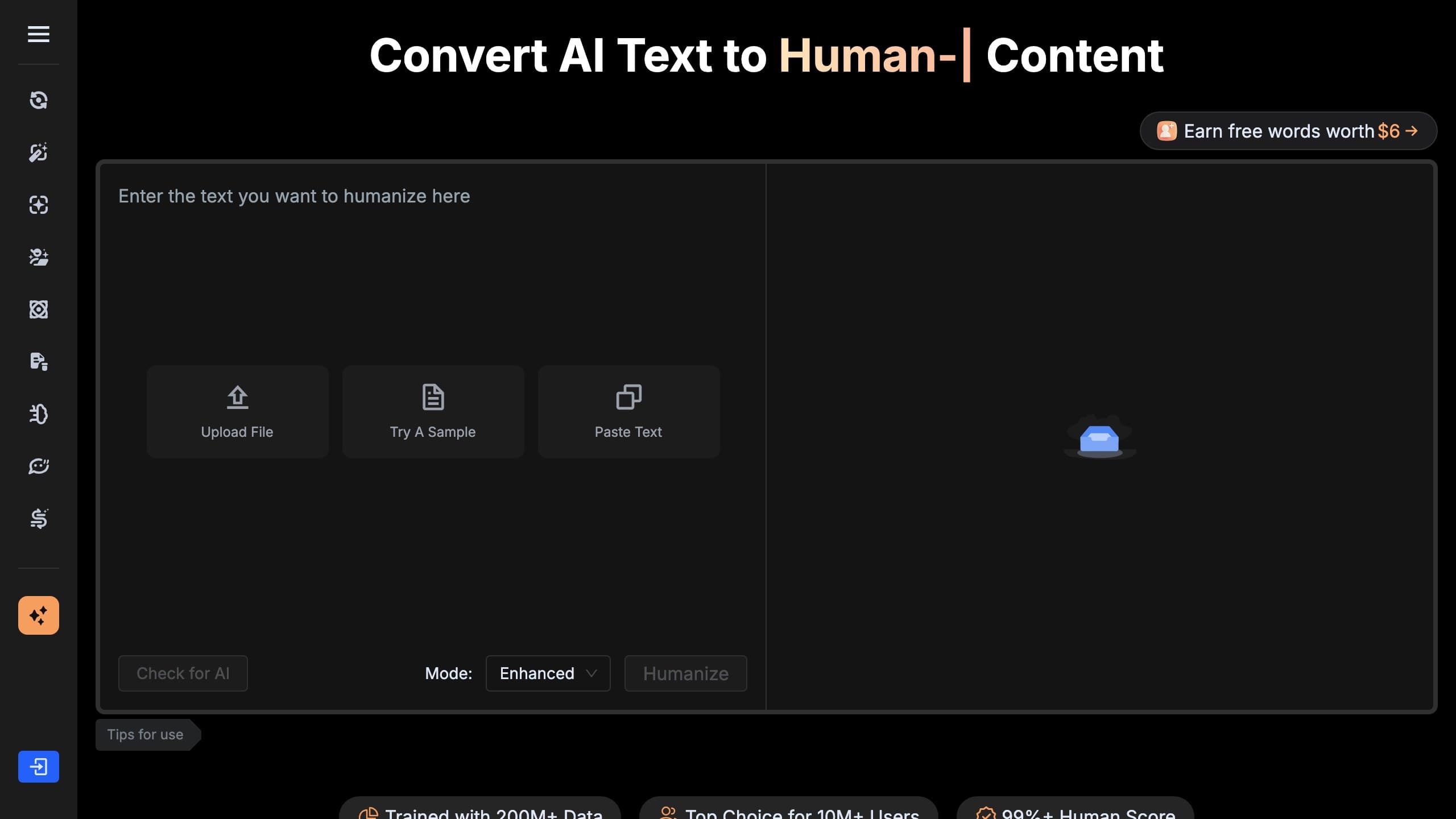
1. WriteHybrid, recurring free tier and named modes
What it is: a dedicated humanizer built around testing-before-paying and explicit register control, rather than a single aggression lever.
Key features: four named writing modes, Academic, Marketing, Casual, and Technical, so a thesis paragraph and a landing page get different treatment instead of one slider applied to everything. It accepts longer pastes in a single pass, which keeps tone consistent across a full document, and API access ships on the entry paid plan for anyone scripting per-section rewrites.
Pricing: the free tier is 500 words every month, recurring, no card on file, over a year that's roughly 6,000 words you can spend re-testing your own drafts. Starter is $9/month for 10,000 words (API included); Pro is $19/month for 50,000 words. Refunds run a flat 14 days regardless of how many words you've used.
Who it's for: writers who want to evaluate properly before paying and who switch register between academic and marketing work, exactly the two things BypassGPT users complain are hardest there.
Honest verdict: it's my product, so weigh that; the diff/editor view is less surgical than WriteHuman's and there's no triple-variant output like StealthWriter's, but the recurring free tier and real refund make it the lowest-risk place to start.
Try WriteHybrid free · WriteHybrid vs BypassGPT
2. Undetectable AI, a humanizer with a built-in checker
What it is: Undetectable AI pairs the rewrite with an in-app detector that scores your text right after it runs, so you humanize and re-scan without leaving the tab.
Key features: a Maximum mode marketed much the way BypassGPT markets Aggressive, plus readability presets (high-school, university, journalist, marketing). The genuine differentiator is that bundled re-scan, which is handy for agency QA, just remember a vendor's own green check is a sanity test, not your instructor's checker.
Pricing: a 250-word one-time free credit; Starter at $14.99/month for 10,000 words (fewer words than BypassGPT Basic's 15,000 at the same sticker price); Pro at $29.99/month for 50,000. Note Maximum mode isn't the default, and the refund policy excludes plans where more than 20% of words have been used.
Who it's for: teams that want a rewrite and a re-score in one place and will treat the bundled detector as a first pass.
Honest verdict: the convenience is real, but you pay in words-per-dollar and the upsell modal before full output is a known annoyance.
3. StealthWriter, three tone variants per paste
What it is: StealthWriter returns several outputs per input, labelled Ghost, Ninja, and Phantom, so you shop the cleanest one instead of re-running a single setting.
Key features: the variant approach is genuinely useful when you're adapting one draft into several voices. The trade is a decision step (you read three versions and pick) and a tight ~5,000-character input cap that forces splitting long essays. There's no dedicated academic-register label, so formal work still needs a manual tone pass.
Pricing: a 250-word one-time trial; Pro at $19/month for 30,000 words; Premium at $39/month for 100,000. That's a higher entry than BypassGPT Basic, but the variants can replace the A/B paste sessions you'd otherwise run by hand. The refund window is short (around 3 days).
Who it's for: content repurposers who value options over the simplest possible workflow.
Honest verdict: strong for tone variety, weak for long single documents, and the variant names are marketing for aggression levels, not distinct models.
4. WriteHuman, in-place editing for essay writers
What it is: WriteHuman leans privacy-first and minimal, paste, humanize, review changes, leave, with an editor that surfaces what moved.
Key features: a clean diff-style review that suits line-by-line essay editing, which is exactly where BypassGPT's stray-character output is most dangerous. There's no API, so it fits flagship drafts more than automated pipelines. Its Enhanced mode, the one most reviews quote, is gated to the Pro plan, so confirm which mode you're buying.
Pricing: a 200-word one-time trial; Basic at $12/month for 80,000 words; Pro at $22/month for 200,000 words with Enhanced mode. Notably, WriteHuman runs a 14-day refund window, matching WriteHybrid and far more generous than BypassGPT's.
Who it's for: writers who edit carefully and want to see every change before submission.
Honest verdict: the best pick here for graded essays you'll proofread closely; the small trial and missing API are the real limits.
5. Humbot, volume pricing for low-stakes batches
What it is: Humbot is the words-per-dollar option, aimed squarely at SEO teams pushing high volume.
Key features: Basic gives 50,000 words for $9.99/month, far more words than BypassGPT Basic, with bulk upload and API arriving on the roughly $50 Ultra tier. Light/balanced/aggressive controls exist, but aggressive mode is where reviewers most often report meaning drift and unreadable output.
Pricing: a 300-word one-time trial; Basic at $9.99/month for 50,000 words; Ultra around $50/month for bulk plus API.
Who it's for: purely low-stakes blog batches where nobody is grading the output.
Honest verdict: the economics are genuinely strong, but Humbot's own Trustpilot is rougher than BypassGPT's, with heavy complaints about gibberish output and refused refunds, so I would not route anything reviewed through it. Test carefully before standardizing.
How the shortlist compares
Pricing verified against public checkout in June 2026. Annual and monthly toggles can show different headline numbers, so confirm at checkout before subscribing.
| Tool | Free tier | Entry price | Words (entry) | Modes | Refund |
|---|---|---|---|---|---|
| WriteHybrid | 500 words/mo, recurring (no card) | $9/mo Starter | 10,000 | Academic / Marketing / Casual / Technical (+ API) | 14 days |
| BypassGPT | 150 words, one-time | $14.99/mo Basic | 15,000 | Normal / Aggressive (Aggressive gated to Pro) | Minutes; void past ~1,000 words |
| Undetectable AI | 250 words, one-time | $14.99/mo Starter | 10,000 | Normal / Maximum + in-app detector | Excludes plans >20% used |
| StealthWriter | 250 words, one-time | $19/mo Pro | 30,000 | Ghost / Ninja / Phantom variants | ~3 days |
| WriteHuman | 200 words, one-time | $12/mo Basic | 80,000 | Standard / Enhanced (Enhanced on Pro) | 14 days |
| Humbot | 300 words, one-time | $9.99/mo Basic | 50,000 | Light / Balanced / Aggressive (bulk + API on Ultra) | Short; usage-capped |
On the math: WriteHybrid Starter is about $0.0009 per word ($9 ÷ 10,000); BypassGPT Basic is about $0.0010 per word ($14.99 ÷ 15,000). At light volumes WriteHybrid is cheaper to start and Humbot is cheapest per word at scale, but the starkest gap is the free tier and the refund. WriteHybrid's 500 monthly words let you keep testing; BypassGPT's 150-word lifetime trial is gone in a paragraph, and its refund is the single most-cited complaint in its reviews.
How to choose
Match the tool to the riskiest thing in your queue, not the cheapest line item:
- You want to evaluate before paying: WriteHybrid's recurring free tier is the only one here that lets you keep testing your real drafts month after month without a card.
- You want a re-scan in the same tab: Undetectable AI's bundled checker saves tab-switching for agency QA.
- You repurpose one draft into many voices: StealthWriter's variants do in one paste what you'd otherwise A/B by hand.
- You edit essays line by line: WriteHuman's diff view plus its 14-day refund is the careful-writer pick.
- You push high-volume, low-stakes blog content: Humbot wins on words-per-dollar, just keep graded work away from it.
Whatever you shortlist, run the same paragraph through two tools' free tiers and check both on the detector you actually answer to. The decision gets easy fast.
What reviewers actually report about BypassGPT
To sanity-check my own impressions against a larger sample, I read through BypassGPT's public Trustpilot profile and Reddit threads. The picture is genuinely mixed rather than uniformly bad, which is why it's worth laying out both sides.
What satisfied users tend to praise:
- It's genuinely useful for everyday coursework, research summaries, and quick casual rewrites.
- The editor is fast and frictionless, paste, run, copy, with no learning curve.
- A subset of reviewers credit support with eventually sorting out subscription changes.
The complaints that repeat across different reviewers:
- Output artifacts, stray random characters, capital letters dropped mid-sentence, and out-of-context words that need manual cleanup before the text is usable.
- Still flagged, several users report output that trips detectors even after ten-plus rewrites, with a clear spike in complaints dated to the August 2025 Turnitin update.
- Refund and billing friction, a money-back window reviewers describe as measured in minutes and void past roughly 1,000 words, auto-renewal that's hard to cancel from the dashboard, and slow, templated support replies.
None of this means BypassGPT can't work for low-stakes content, it clearly does for many people. But if you're a student with a graded submission, the artifact reports and refund terms are worth taking seriously before you commit a year of billing.
The detector landscape shifted in late 2025
This category isn't static. Turnitin shipped a detector update in late August 2025 that specifically targeted humanizer output patterns, and tools across the board saw less consistent results overnight, BypassGPT reviewers literally date their complaints to "after the 27 August Turnitin update." GPTZero, Originality.ai, and Copyleaks all iterate on their own schedules too.
The practical takeaway holds regardless of which tool you pick: a "bypass rate" you read in any review is a snapshot of one moment against one detector version. By the time you paste your own essay, the detector may have moved. That's exactly why I won't publish headline pass percentages, and why the only test worth trusting is your real draft against the checker your audience runs today.
Detection: what I can and can't tell you
Here's the honest part most "X alternatives" posts fudge. Detection outcomes swing with the exact passage, its length, and which checker, and which version of it, runs the scan. I didn't run a controlled study for this roundup, so I won't hand you pass-rate percentages I can't stand behind for your work.
What I can say from hands-on use: aggressive rewrites read most naturally on casual and blog content, and dense academic passages with preserved terminology and citations are where every humanizer here is most likely to leave a recognizable pattern. Neither I nor BypassGPT can promise a result for your specific draft. Run your humanized output through the detector your institution or client actually uses, Turnitin, GPTZero, Originality.ai, or Copyleaks, because that's the only number that counts.
How to get the most natural output
Whichever tool you land on, a few habits do more for naturalness than the choice of humanizer itself:
- Treat the rewrite as a first pass, not a finished answer. A two-minute manual edit, varying sentence length, cutting a repeated transition, beats re-running the humanizer five times.
- Proofread specifically for artifacts. Because BypassGPT and similar tools occasionally drop stray characters or mid-sentence capitals, never paste output blind; read it once for glitches before anything else.
- Protect citations and technical terms. Humanizers mangle quoted material and domain vocabulary; lock those down by hand after the rewrite, not before.
- Keep your real voice in the intro and conclusion. Those are the paragraphs readers and graders scrutinize most, so let them sound like you.
- Check the result on more than one detector. GPTZero, Turnitin, Originality.ai, and Copyleaks disagree constantly, clearing one is not clearing all of them.
Tools worth comparing
Frequently asked questions
Related reading
Try WriteHybrid on your text
Paste AI-generated copy below. 500 humanized words free every month after signup.
Was this page helpful?
Your feedback helps us improve our testing write-ups.